

Province Expands Mental Health and Addictions Network with New HART Hub
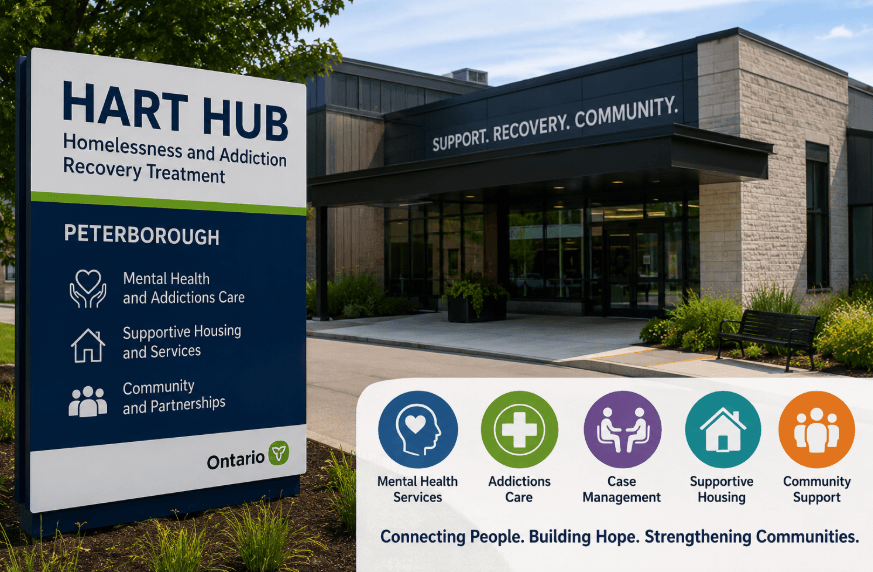
PETERBOROUGH, Ont. — The Ontario government has officially opened a new Homelessness and Addiction Recovery Treatment (HART) Hub in Peterborough, marking another step in the province’s effort to expand mental health, addiction recovery and housing support services across Ontario.
The new facility is part of Ontario’s investment of more than $560 million to establish 29 HART Hubs province-wide. The initiative is designed to improve access to treatment and recovery services for people facing homelessness, mental health concerns, substance use challenges and housing instability while enhancing community safety.
Announcing the launch, Associate Minister of Mental Health and Addictions Vijay Thanigasalam said the province is focused on building a more integrated and recovery-oriented system of care.
“We are building a stronger, more connected system of mental health and addictions care that better reflects the needs of communities and focuses on lasting recovery,” said Vijay Thanigasalam, Associate Minister of Mental Health and Addictions. “The opening of this new HART Hub will ensure that people struggling with mental health and addictions challenges in the Peterborough region can access support services that prioritizes their path to recovery and strengthen community safety.”
Comprehensive Services Under One Network
HART Hubs are designed to connect individuals with a broad range of treatment and recovery supports, including primary health care, mental health services, addictions treatment, social services, employment assistance and housing-related supports.
The Peterborough HART Hub operates under the leadership of the Four Counties Addictions Services Team (Fourcast) and brings together several local organizations, including the City of Peterborough Social Services, Canadian Mental Health Association – Haliburton, Kawartha and Pine Ridge, Elizabeth Fry Society of Peterborough, Peterborough Community Health Centre (PCHC), Peterborough County-City Paramedics and Peterborough Regional Health Centre (PRHC).
Located at 210 Wolfe Street, the hub will offer a coordinated approach to care through a network of clinical and community service providers. Services available through the hub include mental health and addictions treatment, primary care, case management for income and employment supports, supportive housing services and Indigenous-focused programs.
The provincial government says the model is intended to ensure individuals can access multiple services through a single coordinated system, reducing barriers to care and improving recovery outcomes.
Part of Broader Provincial Strategy
The Peterborough location is one of 29 HART Hubs being established across Ontario. The government first announced plans in March 2025 to create 28 hubs. In April 2026, a new location in Kingston was added, bringing the total number to 29.
The province also announced that the HART Hub program will support the creation of nearly 900 supportive housing units across Ontario, more than 300 above the original target. The additional housing is intended to help individuals transition into stable, long-term living arrangements as they progress through recovery.
Ontario officials emphasized that HART Hubs focus on treatment and recovery services and will not provide safer supply programs, supervised drug consumption services or needle exchange programs.
The initiative forms part of the province’s broader health-care strategy under Your Health: A Plan for Connected and Convenient Care and builds on Ontario’s Roadmap to Wellness framework. Since 2019-20, Ontario has invested more than $1 billion in mental health and addictions services to expand access, address service gaps and respond to growing demand.
Local Leaders Welcome the New Hub
Local elected officials and community partners praised the launch of the Peterborough HART Hub, describing it as a significant advancement in addressing the interconnected challenges of homelessness, addiction and mental health.
“For the first time in Ontario’s history, we are taking a look at the entire continuum for homelessness, addictions, and recovery. The Hart Hub is a fantastic approach; it means that we are crossing different sectors to ensure that we are providing the services where they need it, when they need it, and at the appropriate level. People can enter at any stage into the Hub, wherever they are, and then progress through. It is the first time that any province has looked at the entire continuum for homelessness, addiction, and rehab.”
— Dave Smith, MPP for Peterborough-Kawartha
“The opening of the Peterborough HART Hub marks an important step forward in ensuring that our most vulnerable residents have access to the supports they need. The HART Hub brings together health care, mental health and addiction services, housing supports, and other community resources in one place, helping people access compassionate care closer to home.”
— Laurie Scott, MPP for Haliburton–Kawartha Lakes–Brock
Community organizations involved in delivering services say the new funding will strengthen local efforts to provide long-term housing stability and integrated support.
“The provincial government’s investment in HART Hub Peterborough provides local partners with the opportunity to expand resources and services for those experiencing homelessness in our community. Building on the core foundations of homelessness services in Peterborough, we will diversify our housing solutions to target specialized services for specialized needs. Our unique model puts a laser focus on long term housing stability for those with few housing options. We believe that housing is the solution for those in our community facing the intersecting crisis of addiction, mental health and homelessness.”
— Donna Rogers, Executive Director, Four Counties Addiction Services Team (Fourcast)
Focus on Recovery and Long-Term Stability
With the opening of the Peterborough HART Hub, Ontario continues to expand a province-wide network aimed at providing integrated treatment, housing and social supports. Provincial officials say the model is intended to help individuals access care more quickly, improve recovery outcomes and create safer, healthier communities through a coordinated approach to mental health, addictions and homelessness services.
Discover more from Wire Service Canada
Subscribe to get the latest posts sent to your email.