

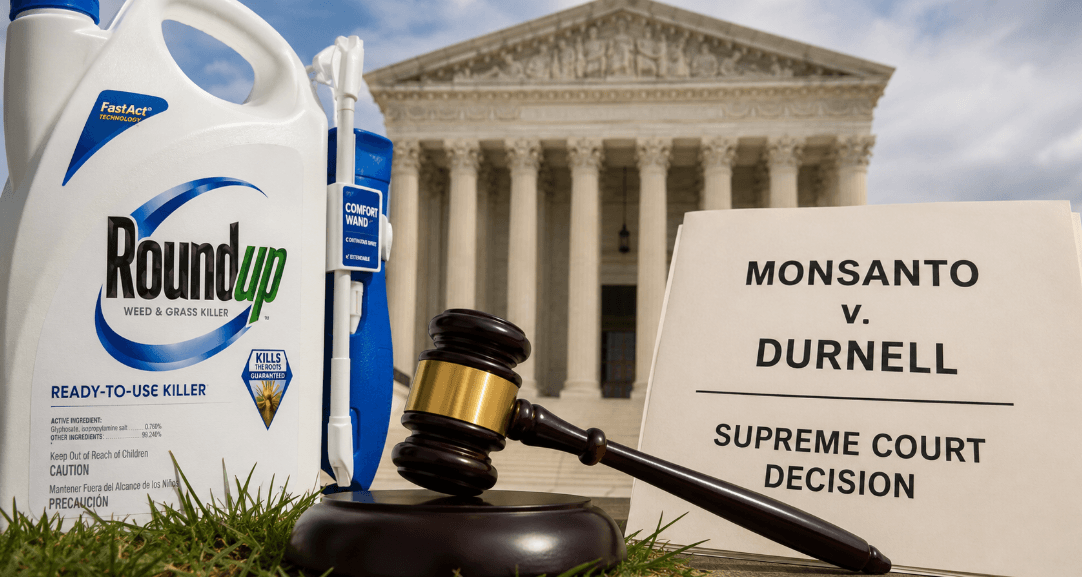
Decision narrows legal avenues for cancer-related lawsuits while prompting renewed calls for stronger federal pesticide oversight
WASHINGTON, D.C. — The U.S. Supreme Court has ruled in favour of Monsanto in a closely watched pesticide liability case, significantly limiting the ability of individuals to sue pesticide manufacturers for failing to warn consumers about potential cancer risks when federal regulators have not required such warnings on product labels.
In a 7-2 decision in Monsanto v. Durnell, the Court concluded that claims alleging pesticide manufacturers failed to warn users of cancer risks are preempted by federal law if the U.S. Environmental Protection Agency (EPA) approved the product without requiring a cancer warning. The decision represents a major legal victory for Monsanto, now owned by Bayer, while narrowing one of the principal legal arguments used in thousands of ongoing lawsuits involving the company’s Roundup herbicide.
The ruling is expected to affect tens of thousands of pending claims brought by individuals diagnosed with non-Hodgkin lymphoma (NHL), who allege their illness was caused by prolonged exposure to Roundup. Although plaintiffs have pursued multiple legal theories in these cases, “failure to warn” claims have been a central component of the litigation.
Food safety advocates criticize the decision
The Center for Food Safety (CFS), a U.S.-based nonprofit organization focused on food and agricultural policy, sharply criticized the Supreme Court’s decision, arguing it weakens consumer protections and increases the importance of federal oversight.
The organization had submitted an amicus brief on behalf of a coalition representing farmers, farmworkers, medical professionals, consumer advocates and conservation groups.
“Overturning decades of well-settled law, today the Supreme Court eliminated one way the public held pesticide corporations accountable for their products’ harms,” said George Kimbrell, Legal Director at the Center for Food Safety. “But the fight is far from over. EPA’s regulation of pesticides just became all the more vital to protecting the public health and public interest. We will continue to hold EPA accountable when it does not. And States and other governing bodies have other robust roles. The Roundup cancer cases are a telling sign that people are fed up with corporations poisoning their health and environment and want to choose a different future for their food. This decision, while tragic, is a clarion, galvanizing call to continued action: Americans need to continue speaking truth to power and demand their representatives are protecting their health, not corporations’ profit margins.”
EPA’s glyphosate assessment remains at the centre of debate
A key element of the Court’s reasoning relied on the EPA’s determination that glyphosate—the active ingredient in Roundup—is not likely to cause cancer in humans. That assessment has itself been the subject of legal challenges.
In 2022, a federal court ruled in favour of the Center for Food Safety, finding that the EPA’s human health assessment for glyphosate violated the agency’s own cancer evaluation guidelines. According to the nonprofit, the court concluded the EPA’s acknowledgement that glyphosate might contribute to non-Hodgkin lymphoma conflicted with its broader finding that the chemical was not carcinogenic.
The organization argues the issue extends well beyond glyphosate. According to its analysis, the EPA has classified approximately 200 pesticide active ingredients as either “likely” or “possible” carcinogens over the past four decades, while continuing to approve many of those products without requiring cancer warnings on their labels.
“It’s bad enough that EPA approves pesticides that likely cause cancer,” said Bill Freese, Science Director at the Center for Food Safety. “But then not to require a cancer warning on the label so that potential users can decide whether or not to buy the product, and be incentivized to wear rubber gloves and other protective equipment if they do? That’s simply outrageous. An absolute betrayal of the public trust,” he added.
Roundup litigation remains extensive
Glyphosate is the most widely used pesticide in the United States, with roughly 280 million pounds applied annually across nearly 298 million acres of farmland. Additional quantities are used by homeowners, forestry operations and along transportation corridors, resulting in widespread environmental presence.
The legal dispute stems from years of litigation alleging Monsanto failed to warn consumers that Roundup could increase the risk of developing non-Hodgkin lymphoma. In 2015, the International Agency for Research on Cancer (IARC) classified glyphosate as “probably carcinogenic to humans,” citing evidence from epidemiological studies, laboratory animal research and cellular testing.
Since then, multiple juries have found Monsanto liable for failing to warn users about potential cancer risks associated with Roundup. Bayer, which acquired Monsanto in 2018, has already settled approximately 100,000 claims for roughly US$10 billion, while tens of thousands of additional lawsuits remain unresolved.
Earlier this year, Bayer proposed a US$7.25 billion class action settlement intended to resolve many of the remaining cases collectively. A federal judge recently returned the matter to state court, strengthening the company’s efforts to secure approval of the proposed settlement. At the time the Supreme Court issued its decision, approximately 61,000 cases against Bayer were still pending.
While the Court’s ruling significantly limits one avenue of legal action, ongoing disputes over glyphosate’s safety, federal regulatory standards and remaining legal claims are expected to keep the issue at the forefront of U.S. agricultural and public health policy discussions.
Discover more from Wire Service Canada
Subscribe to get the latest posts sent to your email.