

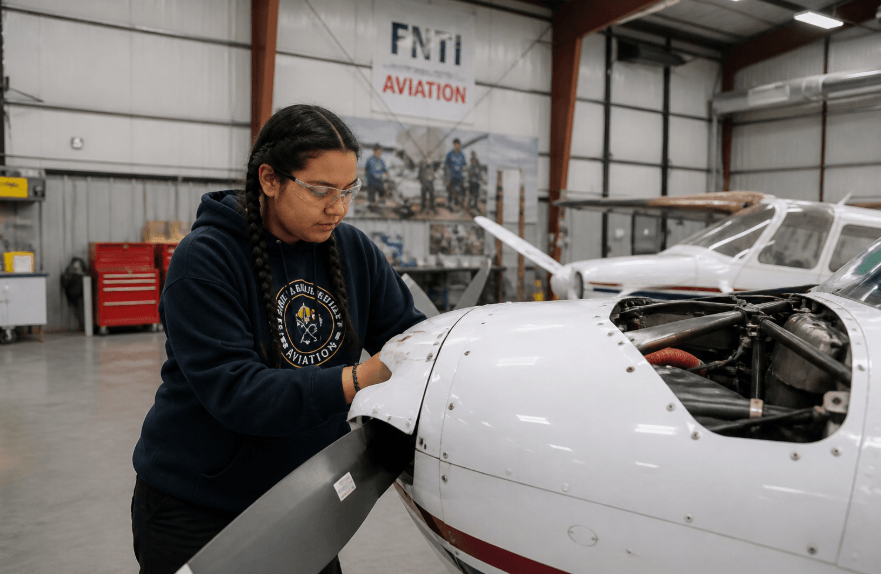
Funding Targets Workforce Gaps and Indigenous Access to High-Demand Careers
TYENDINAGA MOHAWK TERRITORY — The Ontario government is committing an additional $4.4 million to rebuild and expand aviation training capacity at First Nations Technical Institute (FNTI), aiming to increase Indigenous participation in one of Canada’s most in-demand skilled sectors.
The funding, announced May 1 by the Ministry of Colleges, Universities, Research Excellence and Security, will support reconstruction of FNTI’s Aviation Training Centre, which was destroyed by fire four years ago. The project is part of a broader $6.4-billion provincial investment designed to stabilize Ontario’s postsecondary system and align training with labour market needs.
“Ontario’s plan to protect Ontario includes taking decisive action to ensure students develop the skills they need to launch successful careers in industries that keep our economy moving,” said Nolan Quinn, Minister of Colleges, Universities, Research Excellence and Security. “This investment will protect access to world-class flight training for Indigenous students and help produce one of the most competitive workforces in the G7 for generations to come.”
Rebuilding Critical Training Infrastructure
The new aviation facility, currently under construction, will feature a modernized training environment, including updated classrooms and a state-of-the-art flight simulator. The rebuild is expected to expand program capacity and reduce barriers to entry for Indigenous students seeking careers in aviation.
The aviation sector plays a key role in connecting remote and northern communities, particularly in regions where air transport supports essential services such as mining, emergency response and supply chains.
“Delivering the only Indigenous aviation program of its kind in Canada, First Nations Technical Institute continues to be a leader in Indigenous post-secondary education and skilled workforce development,” said Greg Rickford, Minister of Indigenous Affairs and First Nations Economic Reconciliation and Minister Responsible for Ring of Fire Economic and Community Partnerships. “Through our partnership with FNTI, we are supporting students who are uniquely equipped to meet community priorities, enhance remote access and drive economic growth across Indigenous communities.”
Part of Broader Postsecondary Funding Strategy
The $4.4-million investment builds on $1.4 million previously allocated in 2024 for initial rebuilding work. It also forms part of a larger provincial funding model that includes $57 million earmarked specifically for Indigenous Institutes.
The government says the funding will nearly double annual operating support for these institutes by 2028 and create up to 780 new training seats tied to labour market demand.
“This historic investment will allow FNTI to continue rebuilding our Aviation Training Centre and expanding capacity to train the next generation of Indigenous aviation professionals,” said Suzanne Brant, President of FNTI. “By completing Phase 2 of our hangar construction, we are strengthening hands-on flight training and modern learning environments that prepare students for in-demand careers supporting Ontario’s critical industries. As Canada’s only Indigenous postsecondary aviation program of its kind, this support reinforces the province’s commitment to Indigenous learners, community connectivity, and a skilled workforce for the future. We thank Minister Quinn and the Government of Ontario for their continued partnership and leadership.”
Economic and Community Impact
Provincial officials and sector stakeholders say the investment addresses both workforce shortages and regional connectivity challenges, particularly in underserved areas.
“Today’s investment not only provides for renewed infrastructure and interest in learning locally at First Nations Technical Institute, but it also trains skilled pilots who can help better connect Ontario communities, including those in northern and rural areas. This educational pathway will help foster new opportunities for economic growth and prosperity.”
- Tyler Allsopp
MPP for Bay of Quinte
“We are grateful for this investment from the Province of Ontario. It marks an exciting step forward in our mission to expand flight training opportunities for Indigenous learners, strengthening access and empowering the next generation of Indigenous pilots. Most significantly, this funding drives the next phase of construction of our new hangar—a major milestone that will soon become FNTI’s Indigenous Aviation Centre for Skills Training, Research, and Development. This centre represents a bold investment in Indigenous talent, innovation, and leadership in aviation.”
- Jo-Anne Tabobandung
Dean of Aviation, FNTI
Sector Leaders Highlight Long-Term Benefits
“As Chair of the FNTI Board of Directors, I would like to thank the Government of Ontario and The Honourable Nolan Quinn, Minister of Colleges, Universities, Research Excellence and Security, for ensuring that FNTI received this contribution toward the completion of Phase 2 of the hangar construction. Once completed, this facility will serve as an important hub for Indigenous students from across Ontario, students who will train here and go on to contribute to the economic growth of their communities and the Province of Ontario. I would like to acknowledge Suzanne Brant and her team for the exceptional work they have done to bring FNTI to this point. I have been with the organization for approximately 12 years, and after a career that included work in both government and the private sector, I can honestly say that I have never seen an organization scale up as effectively as FNTI has under Suzanne’s leadership. On behalf of the Board of Directors, I wish to acknowledge the dedication and hard work of FNTI’s leadership team, and extend our sincere gratitude to Minister Quinn and the Province of Ontario for their continued support.”
- Ralph Brant
Board Chair, FNTI
“FNTI is not only a leader in post-secondary First Nations education; it is also synonymous with its ongoing innovation and creativity in providing learning opportunities that simply do not exist elsewhere. This funding to rebuild FNTI’s Aviation Training Center, and provide unique in-flight training opportunities for First Nations students, reflects this leadership and the vision of President Suzanne Brant to constantly be growing and addressing the learning potential of communities, and employment demands of industry. This funding is an exceptional investment in the future.”
- Sean Monteith
Executive Director, Indigenous Advanced Education and Skills Council
“First Nations Technical Institute has been an incredible post-secondary school over many years, under the fantastic leadership of Suzanne Brant. With this funding announcement, the Ontario government is recognizing that excellence and underscoring the importance of focused high-end education with an Indigenous cultural lens. I am so impressed with FNTI and appreciate their work.”
- Ric Breese
MPP for Hastings-Lennox and Addington
“For more than three decades, Canadore has been honoured to partner with First Nations Technical Institute in aviation education. The opening of this new hangar is a powerful symbol of Indigenous leadership, resilience, and self-determination, and reflects what is possible when institutions work together in ways that respect Indigenous authority and community priorities. It also strengthens the First Peoples’ Aviation Technology – Flight program, which has opened doors for generations of Indigenous learners to enter one of Canada’s most safety-critical and in-demand sectors, ensuring students can train close to home in a culturally grounded environment with access to world-class facilities.”
- Dr. Sandra Efu
President and CEO, Canadore College
Outlook
With construction underway and expanded funding secured, Ontario officials say the initiative will help ensure long-term sustainability in postsecondary education while strengthening workforce readiness in critical sectors.
The province positions the investment as part of a broader strategy to enhance economic resilience, improve regional connectivity and support Indigenous-led education pathways tied directly to industry demand.