

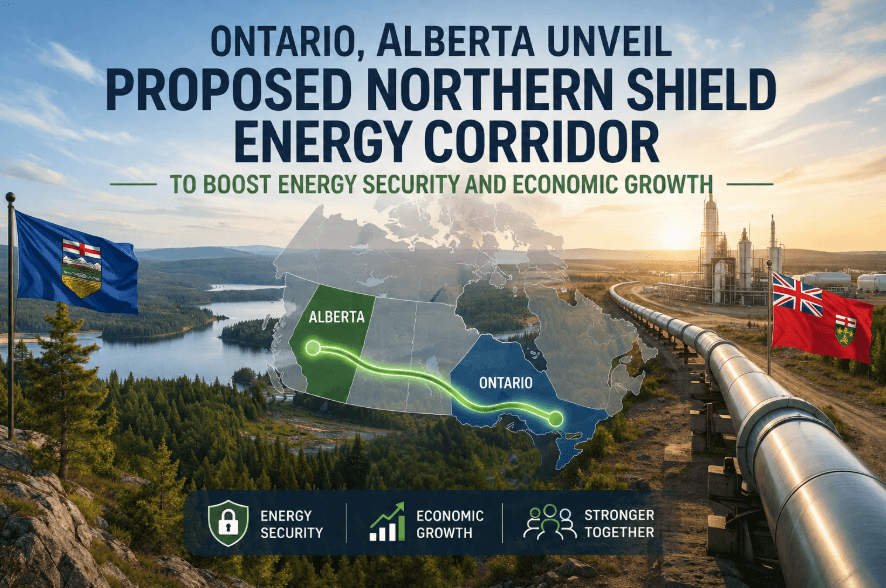
Proposed pipeline aims to connect Western crude to Eastern refineries while reducing reliance on foreign imports
CALGARY — Ontario and Alberta have unveiled plans for a major interprovincial energy project that could reshape Canada’s domestic oil transportation network and strengthen national energy security.
Ontario Premier Doug Ford and Alberta Premier Danielle Smith on July 6 introduced the proposed Northern Shield Energy Corridor, a 3,300-kilometre crude oil pipeline stretching from Hardisty, Alberta, to Sarnia, Ontario. The project, still under feasibility review, is positioned as a nation-building initiative designed to reduce reliance on foreign oil, improve supply chain resilience and support economic growth across multiple provinces.
“Our plan to build the Northern Shield Energy Corridor is a plan to protect workers in Ontario, Alberta and every part of the country,” said Premier Ford. “We’re going to keep working to build a more secure, united and resilient Canadian economy, so we can keep Canadian workers on the job, make life more affordable for Canadian families and help get Canadian energy to new markets across the country and around the world.”
Capacity expansion and market access central to proposal
The proposed corridor would initially transport an estimated 500,000 barrels of oil per day, with the capacity to expand to 800,000 barrels. The pipeline would deliver crude to Sarnia, a key refining hub in Ontario with established links to domestic distribution and export infrastructure.
Officials say the project could also open pathways to international markets. Ontario is evaluating potential pipeline extensions to new and existing ports, while Manitoba is being given the opportunity to explore a possible connection to the Port of Churchill through collaboration with the Manitoba-Crown Indigenous Corporation.
“By connecting Alberta’s energy with Canadian refineries and markets, we can create jobs, grow our economy and make better use of the world-class resources we already have,” said Premier Smith. “Alberta is committed to working with provincial and federal partners to turn this opportunity into reality. A new west-east pipeline will connect Canadian energy with Canadian consumers while laying the foundation for future growth.”
Economic and national security considerations drive momentum
The Northern Shield Energy Corridor is being framed as both an economic and strategic initiative. By reducing dependence on imported oil, the pipeline could help stabilize fuel prices and enhance national energy independence, particularly during periods of global supply disruption.
The project is also expected to generate employment across construction, manufacturing and related industries. The use of Canadian steel has been highlighted as a key component, supporting domestic supply chains and industrial activity.
“The Northern Shield Energy Corridor will strengthen Canadian energy security and create good-paying jobs in communities across Saskatchewan and beyond,” said Saskatchewan Premier Scott Moe. “Projects like these not only build our economy but also generate the national wealth we need to invest in areas such as health care, education and community safety.”
In parallel, Ontario is exploring the development of a strategic petroleum reserve as part of the broader corridor initiative, a move that could further enhance energy resilience.
Feasibility study underway with industry advisory support
The proposal stems from a Memorandum of Understanding between Ontario, Alberta and Saskatchewan aimed at advancing interprovincial cooperation on energy and trade infrastructure. The agreement also includes commitments to collaborate on nuclear energy development to meet rising demand.
A comprehensive feasibility study is currently underway and is expected to conclude by the end of 2026. The advisory team includes GHD Limited, Ernst & Young LLP (EY Canada), Mokwateh, AtkinsRéalis Group Inc., Wood PLC and Turner & Townsend Limited, with Infrastructure Ontario acting as commercial advisor overseeing the process.
Provincial officials say the study will assess cost estimates, commercial models and additional development opportunities, including grid upgrades tied to the corridor.
Indigenous consultation and equity participation emphasized
Ontario has begun consultations with Indigenous communities as part of its legal duty and broader commitment to inclusion. The province has also signalled support for Indigenous equity participation in the project, backed by funding aimed at enabling meaningful ownership stakes.
“When Sir John A. Macdonald founded this country, he envisioned a nation connected from sea to sea. Ontario fully supports Alberta’s vision of building energy corridors and sovereign pipelines that make Canada self-reliant from the United States. Nation building requires vision and a plan of action. This proposed pipeline will make Canada more energy independent by moving Alberta’s oil to Ontario refineries using steel and workers — keeping Canadian energy in Canadian hands.”
- Stephen Lecce
Minister of Energy and Mines
“We are seizing a once-in-a-generation opportunity to build the energy and trade infrastructure our nation needs that will protect our workers and power up our economy with Canadian-made energy. The proposed route would strengthen connections between provinces, create jobs in the construction and manufacturing industries and bolster our domestic supply chains for generations to come.”
- Todd McCarthy
Acting Minister of Infrastructure
Next steps hinge on feasibility outcomes
While still in the planning phase, the Northern Shield Energy Corridor represents one of the most ambitious interprovincial energy proposals in recent years. Its future will depend on regulatory approvals, commercial viability and stakeholder alignment, including Indigenous partnerships and federal cooperation.
If approved, the project could mark a significant shift toward a more integrated and self-reliant Canadian energy system.
Discover more from Wire Service Canada
Subscribe to get the latest posts sent to your email.