

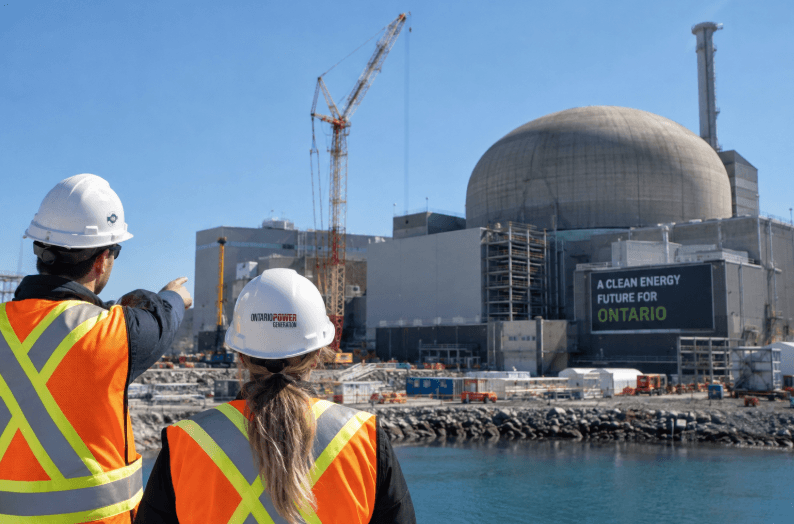
TORONTO — Ontario is investing nearly $1.9 million in a two-year initiative aimed at strengthening the province’s nuclear supply chain and preparing workers and businesses for a major expansion of nuclear power, as the government seeks to increase domestic industrial capacity and reduce exposure to global economic uncertainty.
The provincial funding, announced September 1, will support research led by the Organization of Canadian Nuclear Industries (OCNI) into workforce capacity, manufacturing capabilities and potential supply-chain constraints. Ontario says its planned nuclear build-out could ultimately support as many as 150,000 workers and generate more than $800 billion in additional gross domestic product.
Ontario Nuclear Expansion Drives Demand for Workers and Suppliers
Through the Ontario Labour Market Partnerships program, OCNI will assess the province’s nuclear supply chain and determine where additional workers, manufacturing capacity, engineering expertise and suppliers will be required.
“Ontario is securing our energy future,” said David Piccini, Minister of Labour, Immigration, Training and Skills Development. “We are going to be an energy superpower, and we’re building the skilled workforce, nuclear supply chain and industrial capacity to make it happen. By building more of what we need right here at home, we’re creating good-paying jobs, strengthening our economy and ensuring Ontario can power itself and help power North America for generations to come.”
The initiative comes as Ontario advances several major nuclear projects, including refurbishments at the Darlington and Bruce nuclear generating stations and construction of the G7’s first grid-scale Small Modular Reactor at Darlington. The province is also examining new generation opportunities at Wesleyville and Bruce C while expanding medical isotope production.
Three-Phase Study to Identify Supply-Chain Gaps
OCNI’s Strengthening Ontario’s Nuclear Supply Chain: A Strategic Study to Enable Clean Energy Growth will proceed in three phases.
The first will create an inventory and interactive map of Ontario’s nuclear supply chain, workforce capacity and related industries. The second will identify gaps in labour, manufacturing, engineering and supply-chain capabilities. The final phase will develop recommendations covering supplier capacity, Ontario content, workforce training, Indigenous economic participation, regional opportunities and international competitiveness.
“We will not sit idle as President Trump takes direct aim at Canada’s workers and economy, that is exactly why we are doubling down on Canadian nuclear energy, creating 150,000 jobs by leading the largest expansion in North America,” said Stephen Lecce, Minister of Energy and Mines. “Nuclear is tariff-proof, its recession-proof and is virtually entirely Made-in-Canada. To boost our economy and create generational employment for the next 100 years, Ontario is launching our very first workforce development strategy to meet demand for highly skilled workers and world-class expertise. With nation-building projects underway increasing competition for the same resources and skills, we are planning ahead and sequencing labour force planning and training pipelines to ensure energy projects across the economy can be delivered at scale and with speed.”
Nuclear Industry Faces Long-Term Labour Requirements
Ontario’s nuclear industry currently supports around 80,000 jobs and supplies roughly half of the province’s electricity. Demand for specialized workers is expected to increase as existing refurbishment programs continue and new reactors move into development.
A Canadian Nuclear Association workforce study cited by the province projects labour shortages could begin emerging around 2030, while more than 25 per cent of the existing nuclear workforce approaches retirement age between 2030 and 2035.
The four Small Modular Reactors planned at Darlington are expected to create approximately 18,000 construction jobs and sustain about 2,500 positions during operation. The proposed Wesleyville project is expected to support 10,500 jobs across Ontario and contribute an estimated $235 billion to provincial GDP over its lifespan.
Ontario Businesses Target Domestic and Global Nuclear Markets
OCNI, which represents more than 250 nuclear-sector companies, will work with industry leaders, Indigenous organizations, municipalities, educational institutions, training providers, economic development organizations and companies in adjacent industries.
“This funding represents a strategic investment in the workforce and manufacturing capabilities that power Ontario’s clean energy future,” said Ivette Vera-Perez, President and CEO of the Organization of Canadian Nuclear Industries. “Ontario has one of the most capable nuclear supply chains in the world, but the scale of the opportunity ahead requires a coordinated, data-driven approach. This initiative will help ensure Ontario workers and businesses are ready to support major projects at home while competing in growing nuclear markets around the world.”
The investment also forms part of Ontario’s broader effort to strengthen domestic supply chains and energy security. It complements the province’s Energy for Generations integrated energy plan, which is intended to coordinate electricity and other energy resources as demand grows from housing, industry and new investment.
By identifying workforce and industrial constraints before major projects reach peak construction, the province aims to keep a larger share of nuclear spending within Ontario while positioning local suppliers to pursue contracts in expanding nuclear markets internationally.
Discover more from Wire Service Canada
Subscribe to get the latest posts sent to your email.