

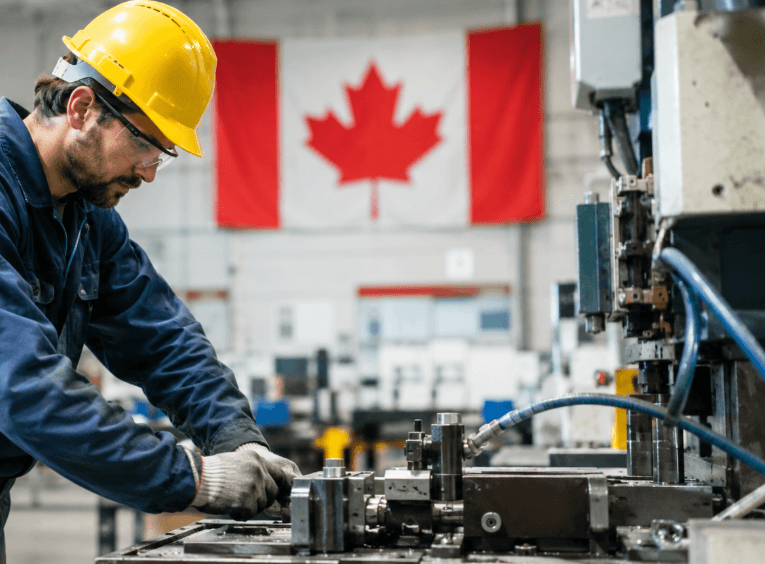
HAMILTON, Ontario —The Ontario government is investing more than $390,000 to help Hamilton businesses respond to U.S. tariffs, strengthen supply chains and protect local employment, particularly in the city’s steel and manufacturing industries.
The provincial funding, provided through the Trade-Impacted Communities Program (TICP), will support the creation of the Hamilton Tariff Response Team, a $588,000 initiative designed to help businesses navigate trade disruptions, identify new markets and improve long-term economic resilience.
Hamilton Tariff Response Team to Support Local Manufacturers
Administered by the City of Hamilton, the new Tariff Response Team will deliver targeted assistance to businesses affected by U.S. trade restrictions.
Hamilton is among Canada’s most tariff-exposed industrial regions, with steel production and manufacturing playing central roles in the local economy.
“Hamilton’s steel and manufacturing workers have stood at the heart of Ontario’s economy for generations, which is why in the face of ongoing tariff attacks, our government is taking targeted measures to ensure their long-term prosperity and resilience,” said Vic Fedeli, Minister of Economic Development, Job Creation and Trade. “Through the Trade-Impacted Communities Program, we are proud to support the City of Hamilton in this latest initiative, which will help local businesses diversify their supply chains and capitalize on opportunities in new markets.”
Two Programs to Strengthen Business Resilience
The initiative will operate through two streams.
The first will provide operational and administrative assistance to companies seeking to diversify export markets, reorganize supply chains and develop workforce retention strategies.
The second will expand Hamilton’s economic data resources, giving businesses access to updated statistics, industry analysis and information supporting investment decisions.
By combining regional consultations with statistical research, the city aims to identify emerging trade barriers and help manufacturers respond to changing market conditions.
Hamilton Mayor Highlights Threat to Local Employment
Hamilton Mayor Andrea Horwath said continued U.S. tariffs have created significant uncertainty for workers, businesses and families.
“Hamilton’s workers, businesses and families are on the front lines of ongoing Trump tariffs and trade uncertainty and protecting their livelihoods is a high-priority across our community,” said Andrea Horwath, Mayor of Hamilton. “Building on past commitments to leave no stone unturned and save good-paying local jobs, support businesses and strengthen Hamilton’s economy, this investment will support that work, providing additional resources to help tariff-impacted businesses navigate uncertainty, diversify their markets and supply chains and pursue new opportunities for growth. This funding responds to the uncertainty facing Hamiltonians. Hamilton workers will not be casualties in Trump’s attack on our country. I want to thank the Government of Ontario for recognizing the challenges facing our city and working with us to protect Hamilton’s workers, businesses, and families.”
Investment Forms Part of Ontario’s Broader Tariff Relief Strategy
The Hamilton investment falls under Ontario’s $40 million Trade-Impacted Communities Program, introduced as part of the province’s nearly $30 billion tariff relief and economic support plan.
The program supports municipalities, economic development organizations and industry associations working to reduce dependence on U.S. markets.
Additional provincial measures include the $1 billion Protect Ontario Financing Program, the $150 million Ontario Together Trade Fund and the Ontario Made Manufacturing Investment Tax Credit.
These initiatives are intended to support businesses facing trade-related financial pressures while encouraging domestic manufacturing and supply-chain investment.
U.S. Trade Restrictions Increase Pressure on Ontario Industries
Ontario businesses continue to face uncertainty surrounding American tariffs imposed under Section 232 of the U.S. Trade Expansion Act of 1962, affecting steel, aluminum, copper and automotive products.
According to the province, additional restrictions introduced under Section 338 of the Tariff Act of 1930 in August 2026 imposed 50 per cent tariffs on a broad range of Canadian goods.
Further restrictions affecting products including dairy, alcohol and motorcycles took effect September 29.
Local Leaders Emphasize Job Protection and Economic Growth
Monica Ciriello, MPP for Hamilton Mountain, said the investment would help manufacturers maintain employment and strengthen local supply chains.
Jeff Beattie, MPP for Hamilton East–Stoney Creek, described the initiative as a collaboration between municipal and provincial governments focused on long-term industrial competitiveness.
The Hamilton Tariff Response Team is expected to provide businesses with additional resources to manage trade uncertainty and explore alternative markets.
Its longer-term impact will depend on how effectively participating companies can diversify operations, maintain employment and reduce exposure to U.S. trade restrictions.
Discover more from Wire Service Canada
Subscribe to get the latest posts sent to your email.