

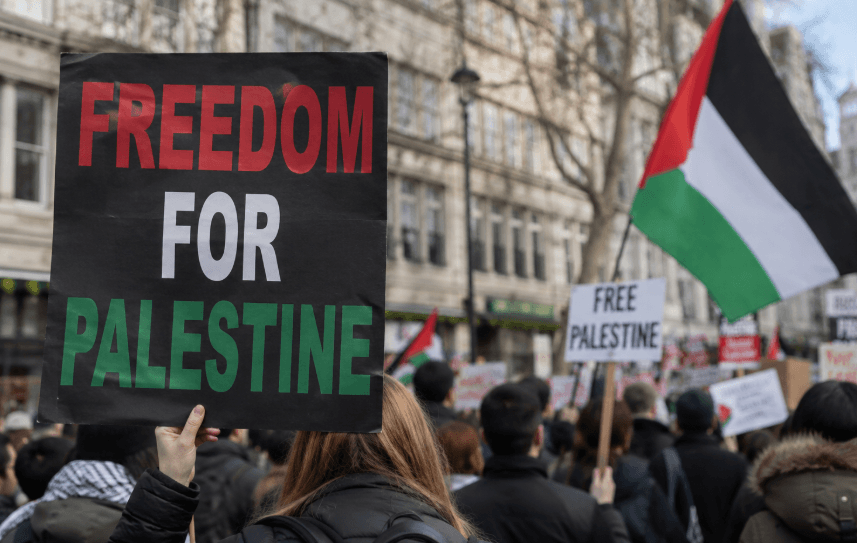
Legal case argues government action infringed freedom of expression and association rights
A landmark legal challenge has been launched against the UK government over its use of the International Holocaust Remembrance Alliance (IHRA) definition of antisemitism in relation to advocacy for Palestinian rights.
The case, brought by the European Legal Support Centre (ELSC) on behalf of community worker and charity trustee Bea Foster, seeks to test whether the government’s application of the non-legally binding definition is compatible with the Human Rights Act 1998. Support for the case has also come from the Palestine Solidarity Campaign (PSC).
At the centre of the dispute is Foster’s resignation from the board of Building Bridges Burnley (BBB), an interfaith charity she helped establish more than two decades ago.
Dispute Emerged Following Social Media Posts
Trustee says she was pressured to resign
Foster, a 76-year-old Methodist preacher from Burnley and a long-time Palestine solidarity activist, came under scrutiny following media allegations of antisemitism linked to social media posts she shared in a personal capacity.
The posts criticised what Foster described as Israel’s system of apartheid against Palestinians.
According to the legal claim, the Department for Culture, Media and Sport (DCMS) acknowledged that it applied the IHRA definition of antisemitism when assessing the allegations.
The controversy emerged shortly after Building Bridges Burnley received the King’s Award for Voluntary Service (KAVS) in November 2024. The award is considered the highest honour for local voluntary organisations in the United Kingdom and is often described as the equivalent of an MBE for volunteer groups.
Following the allegations, Foster says the government threatened to withdraw the award unless she resigned from the charity’s board and refrained from involvement with the organisation for three years.
Foster subsequently stepped down, stating that she did so to protect the charity from potential consequences while continuing to reject the allegations against her.
Human Rights Challenge Filed Against Government
Case targets application of IHRA definition
Lawyers acting on Foster’s behalf have filed proceedings against the Secretary of State for Culture, Media and Sport under the Human Rights Act.
The case argues that the government’s actions unlawfully interfered with Foster’s rights to freedom of expression, freedom of association and protection from discrimination.
The legal challenge seeks a court order overturning the government’s decision, a declaration that the actions were unlawful and an award of damages.
The case is also expected to examine the broader role of the IHRA definition in public decision-making.
The definition has been the subject of debate among legal scholars, academics and civil society organisations. Critics argue that its application can blur distinctions between criticism of the Israeli state and antisemitism, while supporters contend that it provides an important framework for identifying and addressing antisemitic conduct.
Foster Says Case Is About Defending Advocacy Rights
Commenting on the legal action, Foster said the case is intended to challenge what she views as restrictions on advocacy for Palestinian rights.
“I’m taking the government to court to fight for my right to be back in the charity that I helped create, and to keep demanding justice for the Palestinian people. If I win, it will show how the IHRA is not fit for purpose, it doesn’t fight antisemitism. Instead, it’s used to silence people like me who are speaking up for Palestine.”
Foster has been involved in humanitarian and community work for many years and has travelled to Palestine on multiple occasions, including recent visits with Christian groups supporting Palestinian farming communities.
Supporters Say Outcome Could Set Wider Precedent
Campaign groups highlight broader implications
The Palestine Solidarity Campaign said the case could have implications beyond Foster’s individual circumstances.
Ryvka Barnard, Deputy Director at the organisation, said:
“The government’s discriminatory action against Bea Foster is a clear example how of the IHRA definition of antisemitism is used to try to punish people who stand up for Palestinian rights. Opposing the use of the IHRA definition is essential to protecting our fundamental human rights and to ensuring that solidarity with the Palestinian people cannot be silenced. If Bea wins her case, it could set a positive precedent to show that the IHRA in and of itself is not fit for purpose and should not be used again.”
The European Legal Support Centre similarly argued that the case forms part of a broader debate about political expression and civil liberties.
Anna Ost, Senior Legal Officer at the ELSC, said:
“The ELSC is supporting Bea Foster to bring legal action against the UK government and the Secretary of State for Culture, Media and Sport, Lisa Nandy, challenging the use of the IHRA definition of antisemitism in a way that has infringed upon her fundamental human rights. The IHRA must be understood within the wider context of growing efforts to restrict and punish advocacy for Palestinian rights. Rather than simply addressing discrimination, its application has increasingly been used to conflate criticism of the State of Israel with antisemitism, resulting in lawful political expression being investigated, sanctioned and suppressed.
Bea is one of many Palestine advocates who have faced institutional repression in recent years. Our ‘Index of Repression’ has documented cases across universities, the NHS, charities, workplaces and public institutions, where people have experienced investigations, disciplinary action, dismissal and exclusion because of their solidarity with Palestine.
Those who continue to rely on the IHRA definition to restrict political expression should be aware that its use is now subject to legal challenge. ELSC will continue to defend the fundamental rights of the Palestine solidarity movement and challenge attempts to silence solidarity.”
Case May Influence Future Policy Debates
The legal proceedings are likely to attract attention from advocacy groups, legal experts and policymakers because of their potential implications for freedom of expression, anti-discrimination law and the use of the IHRA definition by public bodies.
As the case moves through the courts, its outcome could help clarify how governments and public institutions balance efforts to combat antisemitism with protections for political speech and advocacy related to the Israeli-Palestinian conflict.
Discover more from Wire Service Canada
Subscribe to get the latest posts sent to your email.