

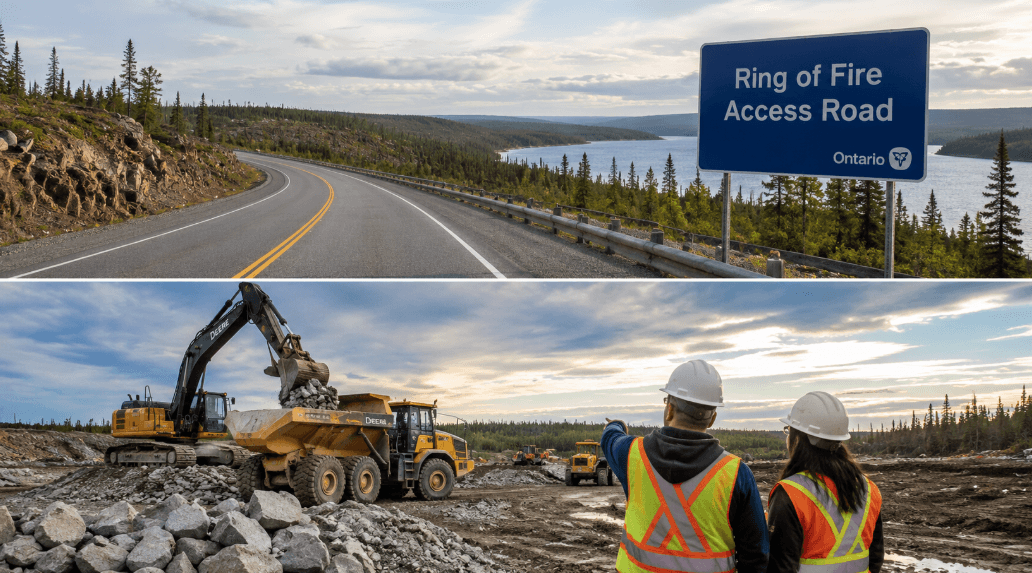
Geraldton Main Street Reconstruction Marks Major Step in Province’s Critical Minerals and Infrastructure Strategy
The Ontario government has officially broken ground on a major infrastructure project in Greenstone that it says will serve as a gateway to the Ring of Fire and support the province’s broader ambitions to become a global leader in critical minerals development.
Greg Rickford, Minister of Indigenous Affairs and First Nations Economic Reconciliation and Minister Responsible for Ring of Fire Economic and Community Partnerships, joined First Nation leaders, municipal officials and industry representatives on June 2 to mark the start of the Geraldton Main Street Rehabilitation Project.
The project forms part of Ontario’s larger strategy to accelerate all-season road access to the Ring of Fire region, an area in northern Ontario believed to contain significant deposits of critical minerals required for electric vehicles, batteries, defence technologies and advanced manufacturing.
“Geraldton’s Main Street has always been about more than rebuilding a road: It is about building the Corridor to Prosperity, with First Nations and northern communities as integral leaders and full partners, every step of the way,” said Greg Rickford, Minister of Indigenous Affairs and First Nations Economic Reconciliation. “Today, we provide the baseline access to responsibly develop the region, unlock the Ring of Fire and ensure that the infrastructure is in place for shared prosperity in northern and First Nation communities.”
Province Accelerates Ring of Fire Infrastructure Timeline
Ontario said the Geraldton rehabilitation project complements its broader plan to fast-track construction of four major roadways into the Ring of Fire region. Construction on the larger road network is expected to begin in June 2026, with portions scheduled to open by November 2030 — five years earlier than initially planned.
The province is investing $81.3 million into rebuilding Geraldton’s Main Street, which links Highway 11 to Highway 584 and provides access to the Trans-Canada Highway corridor.
Officials say the upgraded roadway will improve safety, accessibility and transportation capacity for residents, commercial traffic and heavy industrial vehicles. It is also expected to strengthen regional connectivity for northern communities and remote First Nations by improving access to education, health care and essential goods.
“Our government is making historic investments in highway infrastructure to unlock access to the Ring of Fire by 2030 and realize Ontario’s full economic potential,” said Prabmeet Sarkaria, Minister of Transportation. “The Ring of Fire possesses vast resources the world needs, including critical minerals, and we’re moving forward to build the roads that will transform Ontario’s mining sector into an economic powerhouse.”
Ring of Fire Seen as Strategic Economic Asset
Located roughly 500 kilometres northeast of Thunder Bay, the Ring of Fire spans approximately 8,000 square kilometres and has become central to Ontario’s long-term economic development strategy.
The province estimates that unlocking the region could generate more than 70,000 jobs and contribute approximately $22 billion to Ontario’s economy over the next three decades.
The government has increasingly framed the development of the Ring of Fire as both an economic and geopolitical priority, particularly as global demand rises for critical minerals used in clean energy technologies and advanced manufacturing supply chains.
Ontario officials argue the province is well positioned to attract long-term investment due to its mineral reserves, skilled workforce and stable regulatory environment.
The province also recently launched a $500 million Critical Minerals Processing Fund designed to support projects that accelerate processing capacity and strengthen domestic supply chains.
First Nations Partnerships Central to Development Plans
Ontario continues to emphasize that Indigenous partnerships are central to its Ring of Fire strategy.
Several agreements have been signed with First Nations communities over the past two years, including a Shared Prosperity Agreement with Aroland First Nation in January 2025, a Community Partnership Agreement with Webequie First Nation in October 2025 and another with Marten Falls First Nation in November 2025.
In March 2026, Ontario, Marten Falls First Nation and Webequie First Nation also signed Joint Statements of Economic Partnership related to infrastructure and critical minerals development.
The province says it is investing nearly $3.1 billion through loans, grants and scholarships to support Indigenous equity participation, ownership opportunities and long-term partnerships connected to infrastructure and mining projects.
A First Nation-owned partnership, Pioneer/Minodahmun Development LP, has been awarded the contract to rebuild Geraldton’s Main Street.
Greenstone Officials Call Project Transformational
Municipal leaders described the project as a historic investment for the region and a foundational step toward broader northern economic development.
“The rehabilitation of Main Street is a once in a generation project that provides much needed revitalization to a core piece of infrastructure that will serve as the starting point to the Corridor of Prosperity. This is the single largest municipal infrastructure project in Greenstone’s history and would not have been possible without the leadership of Premier Ford and Minister Rickford,” said James (Jamie) McPherson, Mayor of the Municipality of Greenstone.
The project also reflects Ontario’s wider effort to position northern infrastructure development as a catalyst for long-term economic growth, industrial investment and employment expansion across the province’s resource sector.
As construction begins, the Geraldton rehabilitation initiative is expected to become one of the earliest visible components of Ontario’s broader Ring of Fire transportation network strategy.
Discover more from Wire Service Canada
Subscribe to get the latest posts sent to your email.