

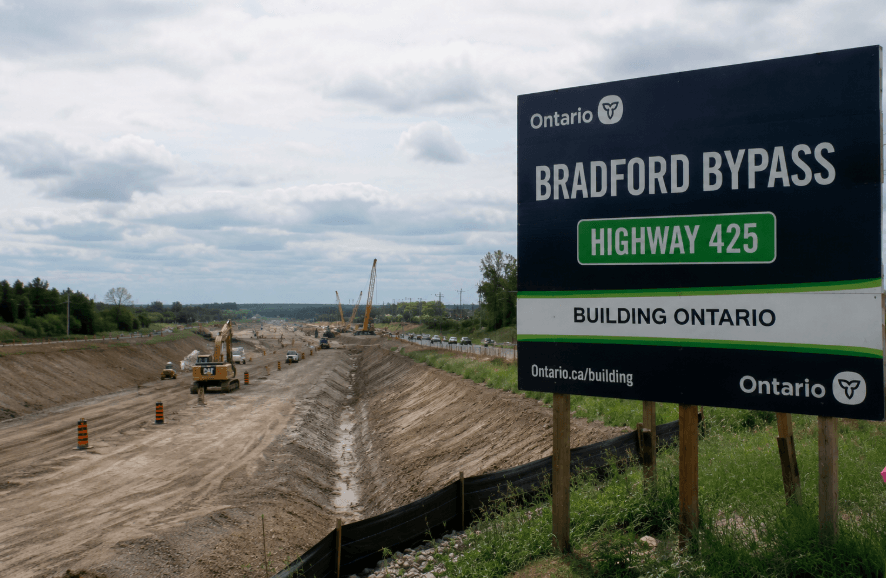
Province launches major phase of highway project aimed at reducing congestion in York Region and Simcoe County
BRADFORD, Ont. —
The Ontario government has officially begun major construction on the long-awaited Bradford Bypass, advancing a key infrastructure project intended to ease traffic congestion and improve transportation links between York Region and Simcoe County.
The province said construction of the new four-lane highway is expected to reduce travel times across the region by up to 35 minutes while supporting approximately 2,200 jobs annually and contributing as much as $286 million to Ontario’s gross domestic product.
Premier Doug Ford said the start of construction marks a significant milestone in the government’s broader transportation strategy.
“With major construction underway on the Bradford Bypass, we’ve reached a historic milestone in our plan to give relief to commuters from some of the most congested highways in North America,” said Ford. “We will continue to invest in our $236 billion plan to build, including the Bradford Bypass, Highway 413 and the 401 tunnel, saving drivers and businesses across Ontario time and money.”
Construction begins on west section
Crews have started work on the west section of the bypass at Sideroad 10. The project includes construction of a divided highway running from west of Artesian Industrial Parkway to Highway 400.
Key components of the work include new interchanges at Sideroad 10 and County Road 4, replacement of the bridge at Highway 400 and Line 9, and the addition of a new freeway-to-freeway interchange connecting the bypass with Highway 400.
Once completed, the 16.3-kilometre corridor will connect Highway 400 in the west with Highway 404 in the east. The province also announced the route will officially be designated as Highway 425.
Ontario Transportation Minister Prabmeet Sarkaria said the project is intended to address growing transportation demands in one of the province’s fastest-growing areas.
“Under the leadership of Premier Ford, our government continues to fight gridlock that costs Ontario up to $56 billion a year,” said Sarkaria. “The Bradford Bypass will provide much-needed relief to drivers in York Region and Simcoe County, support thousands of good-paying jobs and keep people and goods moving in one of Ontario’s fastest-growing regions.”
Population growth driving infrastructure demand
The province said the bypass is being built in response to rising population growth and traffic demand across the region. York Region’s population is projected to reach 1.8 million by 2041, while Simcoe County’s population is expected to grow to 416,000 by 2031.
The Ontario government is investing more than $31 billion in highway, road and bridge construction and rehabilitation projects across the province. Last year, contracts were awarded for detailed design work on the central and eastern sections of the bypass, alongside the appointment of a program management consultant for the overall project.
The Miller Group has been awarded the construction contract for the west section of the bypass. Provincial officials also confirmed that tree clearing along the west corridor has already been completed and a temporary detour at Sideroad 10 has been constructed to support bridge and interchange work.
Municipal leaders welcome progress
Local municipal officials welcomed the start of construction, describing the project as critical for regional growth and connectivity.
“Breaking ground on the west section of the Bradford Bypass is a significant milestone for our community and our region. As Bradford West Gwillimbury continues to grow, investments like these are essential to reducing congestion, improving travel times and supporting economic opportunity. We thank the province for their continued partnership and commitment to building stronger connections between communities,” said James Leduc, mayor of Bradford West Gwillimbury.
Virginia Hackson, mayor of East Gwillimbury, also praised the project’s advancement.
“Today marks an important milestone for York Region and Simcoe County residents, and for residents across Southern Ontario. As East Gwillimbury and York Region continue to grow, projects like the Bradford Bypass are critical to improve connectivity, reduce congestion and help families gain back time to focus on what really matters. Thank you to the provincial government for moving this long-awaited project forward. This is a major step that will help strengthen transportation and people connections and we’re pleased to see this long-awaited project move ahead.”
Industry groups cite economic benefits
Industry organizations representing Ontario’s construction and road-building sectors also endorsed the project, emphasizing its economic and logistical importance.
“We are fulfilling our promise to the people of Ontario to build the Bradford Bypass which farmers and families have asked governments to do for generations. With construction officially underway, we are one step closer to cutting commute times, bringing farmers’ goods to market faster and growing our economy for decades to come,” said Caroline Mulroney.
Patrick McManus, executive director of the Ontario Sewer and Watermain Construction Association, said the project would create skilled trades employment while supporting economic growth.
Meanwhile, Nadia Todorova of the Residential and Civil Construction Alliance of Ontario said the bypass would strengthen regional connectivity by linking Highways 400 and 404.
Ontario Road Builders’ Association CEO Walid Abou-Hamde described congestion as one of the province’s most pressing economic challenges, while Raly Chakarova said the project reflects the province’s commitment to supporting growth in the Greater Toronto Area through infrastructure investment.
Discover more from Wire Service Canada
Subscribe to get the latest posts sent to your email.