

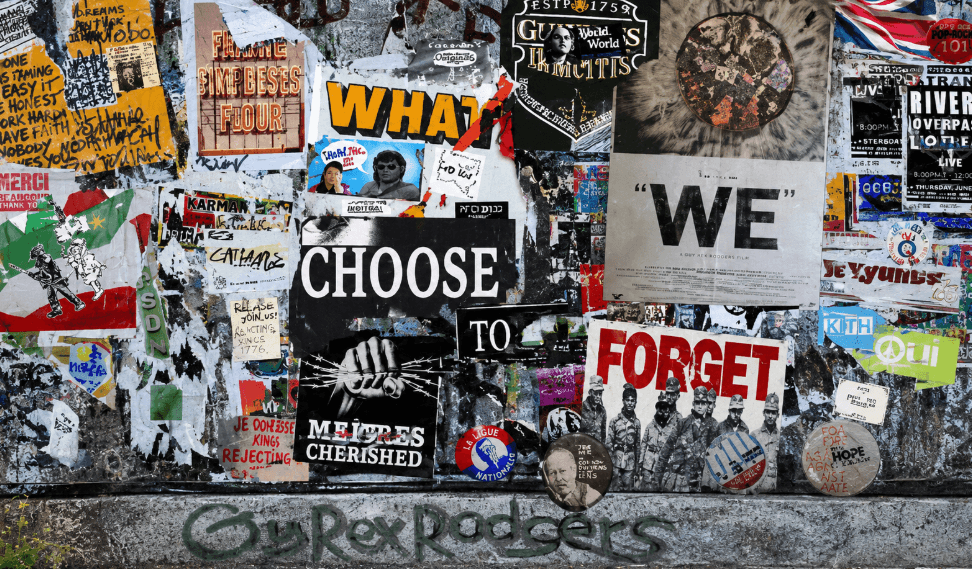
New book by filmmaker Guy Rex Rodgers documents conversations across Quebec following the release of his immigration documentary
MONTREAL — Quebec filmmaker and community activist Guy Rex Rodgers is releasing a new book that examines the province’s evolving linguistic and cultural identity through the voices of people often left out of mainstream historical narratives.
Titled What We Choose To Forget, the book follows Rodgers’ three-year tour across Quebec after the release of his 2022 documentary film What We Choose To Remember, which explored immigration waves in the province from the British Conquest to the arrival of international students in the 21st century.
The release of the documentary coincided with renewed political debate over language and identity in Quebec. In June 2022, shortly after the film’s debut, the Coalition Avenir Québec government passed Bill 96, legislation aimed at strengthening protections for the French language in the province.
Over the next 30 months, Rodgers travelled through 55 Quebec communities, screening the film and inviting audiences to discuss their own experiences and perspectives on identity, language and belonging. The resulting book brings together those conversations and reflections into what Rodgers describes as a portrait of modern Quebec.
A Human Story Beyond Political Divides
Rodgers says the project seeks to move beyond simplified political narratives and instead focus on the lived realities of Quebecers from different linguistic and cultural backgrounds.
Challenging Traditional Narratives
“This is not a tale of unspeakable violence. There are no horrifying villains and, sadly, few inspiring heroes,” says Rodgers. “This is a simple human story about fear, vulnerability and tribal defences. This is a story of loveable underdogs, all struggling to preserve their histories, languages and cultures. Their tragedy is what they have chosen to forget — about themselves and about each other.”
The book highlights stories from anglophone, francophone and allophone communities, including accounts from English-speaking Catholic families who expected to attend French Catholic schools but were denied access.
Rodgers argues that Quebec’s history is more layered than the traditional French-English divide often portrayed in political and historical discussions.
“The heartland of Nouvelle France was the Saint-Lawrence Valley, but it was never pure Catholic or francophone,” Rodgers writes. “Scottish and Irish soldiers fought on both sides of the Plains of Abraham. The first English school established after the Conquest was not in Quebec City or Montreal, but in the Gaspésie.”
He also points to demographic shifts during the 20th century that reshaped Quebec society through immigration from countries outside the traditional French-English framework.
“The reality is far more interesting than Two Solitudes,” he states.
Giving Voice to Allophone Communities
Rodgers says one of the central aims of the book is to amplify the experiences of allophone Quebecers — residents whose first language is neither French nor English.
“These ‘immigrants’ — who come from many countries and speak a variety of languages — are proud to be Quebecers,” says Rodgers. “What We Choose To Forget gives them a voice, and they have a lot to say about Quebec and their place in it!”
The book documents hundreds of conversations gathered during Rodgers’ extensive travels across the province, which included four flights, two train trips and thousands of kilometres by road.
Scholars and Community Leaders Praise the Work
Advance reviews and endorsements for the book have highlighted its contribution to discussions surrounding Quebec identity and contemporary history.
Frank Baylis, co-executive chairman of Baylis Medical Technologies and former federal MP for Pierrefonds—Dollard, said Rodgers’ work captures the complexity of Quebec society in an accessible way.
“Guy Rex Rodgers has a remarkable ability to reveal the humanity that lies beneath Quebec’s complex history and politics. Ours is a complex society that resists simple explanations, yet Rodgers opens this world with clarity and grace, helping us better understand ourselves while offering the rest of the country a window into our lived reality.”
Raymond Jess, a scholar with Concordia University’s School of Irish Studies, positioned the work within a broader historical context.
“Rodgers’ work updates the historical conversation first established by Ronald Rudin’s The Forgotten Quebecers and Clift and McLeod’s The English Fact in Quebec. The inclusion of allophone voices is especially pertinent given the changing demographics of the province. For future historians, What We Choose To Forget will doubtless become indispensable to a historical understanding of Anglo-Quebec in the first half of the 21st century.”
Reviewers have also responded positively to the project’s exploration of Quebec’s English-speaking communities.
“Guy Rex Rodgers is telling English Quebecers our history in a novel way,” wrote Christopher Neal of Accenti Magazine. “If you are part of it, the stories will make you proud and remind you that this is your home.”
Mike Cohen of The Suburban described the book as essential reading across political and linguistic divides.
“I could not put this book down. In fact, I would go so far as saying it should be mandatory reading for every person in Quebec, anglophone and francophone, especially the politicians.”
Upcoming Events and Availability
Rodgers will discuss the book during the Atwater Library Lunchtime Series on May 14, with participation available both in person and via Zoom. A Quebec City launch event featuring readings and a question-and-answer session is scheduled for May 24 at the Morrin Centre.
What We Choose To Forget is available through Paragraphe Bookstore and can also be downloaded free in digital formats through the project website. Additional details about the book and upcoming events are available at What We Choose.