

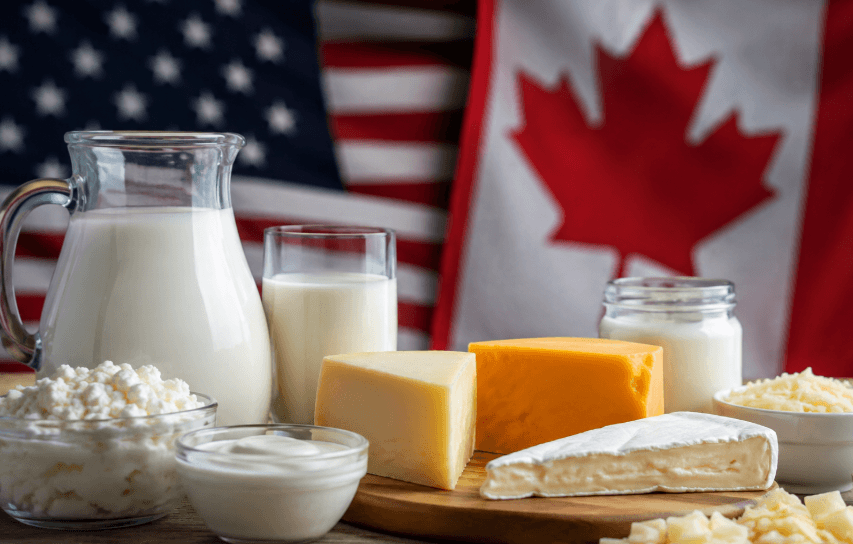
U.S. dairy industry organizations are calling on Canada to return to trade negotiations and address long-running concerns over dairy market access under the United States-Mexico-Canada Agreement, as a 50 per cent U.S. tariff on certain Canadian imports is set to take effect Saturday.
The National Milk Producers Federation (NMPF) and U.S. Dairy Export Council (USDEC) said they support the Trump administration’s continued use of trade measures to press Canada over what the organizations describe as unresolved USMCA dairy commitments. The groups warned that further escalation could be avoided if the two countries reach an agreement on disputed market-access provisions.
U.S. Dairy Groups Back Continued Trade Pressure on Canada
USDEC and NMPF argue that American dairy farmers and exporters have not received the level of Canadian market access envisioned when USMCA entered into force.
“We appreciate the Administration’s persistence in standing up for American dairy producers and exporters who have waited far too long for Canada to live up to its promises,” said Krysta Harden, president and CEO of USDEC. “Canada has had plenty of chances to fix its unfair market access practices and close the loopholes it’s used to dodge its dairy commitments under USMCA. This weekend’s action makes clear that patience has run out. We look forward to continuing to work with the Administration until Canada resolves these issues and America’s dairy farmers and exporters see the full benefits USMCA promised.”
The organizations’ comments come as trade tensions between Canada and the United States remain a significant concern for businesses operating across the highly integrated North American economy. Agriculture has historically been among the most sensitive areas of bilateral trade, particularly Canada’s supply-managed dairy sector.
NMPF Warns Against Canadian Retaliation
NMPF said the latest U.S. action should encourage negotiations rather than trigger additional retaliatory measures.
“This action sends an unmistakable message that Canada’s ongoing disregard for its USMCA dairy commitments carries real consequences,” said Gregg Doud, president and CEO of NMPF. “It’s time for Canada to stop looking for workarounds and instead sit down in good faith to resolve these outstanding USMCA dairy implementation issues. Canadian retaliation would only serve to force the United States’ hand in escalating its leverage. The objective should be for both our countries to prevent increased friction and build on the progress made through weeks of negotiations.”
The statement underscores the potential economic risks of a prolonged dispute. Canada and the United States maintain extensive agricultural supply chains, meaning additional tariffs or retaliatory measures could affect producers, processors, exporters and other businesses on both sides of the border.
USMCA Dairy Tariff-Rate Quotas Remain Central to Dispute
At the centre of the disagreement are Canada’s tariff-rate quotas, or TRQs, for dairy products. Under USMCA, Canada committed to providing additional duty-free access to its dairy market for U.S. exporters through a series of these quotas.
TRQs generally permit specified quantities of imported products to enter a market at lower tariff rates, while imports above those thresholds can face substantially higher duties.
NMPF and USDEC maintain that Canada’s administration of the dairy quotas has resulted in chronic underfill, meaning available import volumes have not been fully used. The organizations contend that this has limited the commercial benefits U.S. dairy exporters expected to receive under the continental trade agreement.
Dairy Protein Exports Add Another Point of Tension
The two U.S. organizations have also raised concerns about Canadian dairy protein exports. They argue that Canada has continued to use loopholes that allow it to sidestep USMCA disciplines governing those products.
Both issues have become priorities for NMPF and USDEC as governments and industry groups focus on the ongoing USMCA Joint Review process. The organizations have repeatedly urged the U.S. administration to seek a negotiated resolution that expands practical market access rather than leaving commitments unused.
Industry Calls for Negotiated Canada-U.S. Solution
Despite supporting increased U.S. pressure, the dairy organizations indicated that their preferred outcome remains a negotiated settlement that prevents a wider trade confrontation.
For Canadian businesses, the dispute adds another layer of uncertainty to cross-border trade at a time when tariffs can quickly affect costs and investment decisions across interconnected supply chains.
NMPF and USDEC continue to call on Canada to negotiate over both tariff-rate quota administration and dairy protein export rules. Whether those discussions produce a compromise could determine if the latest tariff action becomes temporary leverage or develops into a broader Canada-U.S. trade dispute.
Discover more from Wire Service Canada
Subscribe to get the latest posts sent to your email.