

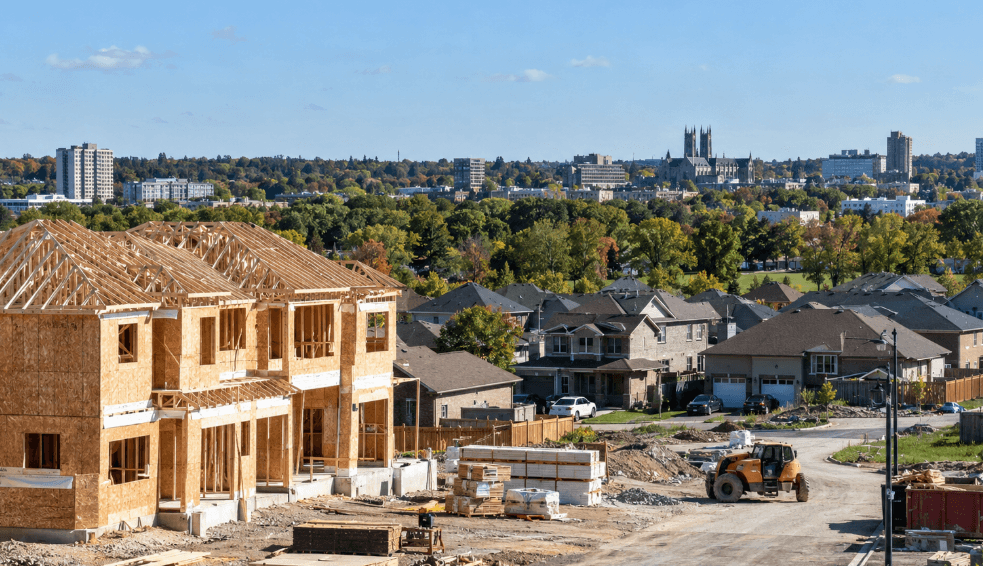
GUELPH, Ontario — October 16, 2026 — The governments of Ontario and Canada have announced up to $48.3 million in infrastructure funding for Guelph as part of an agreement aimed at reducing residential development costs, supporting new housing construction and improving affordability.
The funding, provided through the Development Charge Reduction Program (DCRP), follows Guelph’s commitment to reduce development charges by 30 per cent across all residential housing types from March 30, 2026, to March 31, 2029.
Development Charge Reductions Could Save Homebuyers Up to $151,623
The three-year reduction in development charges is expected to lower new-home construction costs in Guelph by as much as $21,623 per unit.
Combined with expanded Harmonized Sales Tax (HST) relief for eligible new homes, the measures could generate total savings of up to $151,623 for qualifying homebuyers.
“For far too long, we’ve seen the cost of housing go up,” said Rob Flack, Minister of Municipal Affairs and Housing. “We’re addressing this head-on through our Partnership to Build with the federal government, an agreement that delivers both the Development Charge Reduction Program and HST rebate. These two measures alone could save families in Guelph well over six figures, bringing the dream of homeownership further within reach for young professionals, growing families and seniors alike.”
The HST relief applies to eligible new homes between April 1, 2026, and March 31, 2027, with potential savings reaching $130,000.
Federal and Provincial Governments Expand Housing Partnership
The funding forms part of the Canada-Ontario Partnership to Build, established in March 2026.
Under the agreement, both governments committed to a cost-matched investment framework providing a combined $8.8 billion over 10 years for infrastructure projects throughout Ontario.
Federal contributions will flow through the Build Communities Strong Fund (BCSF), subject to the required agreements and approvals.
“Building more homes, more easily and affordably needs strong partnerships and investments,” said Dominique O’Rourke, Member of Parliament for Guelph. “Through the Development Charge Reduction Program, we are working with the City of Guelph and Ontario to lower the cost of new housing and supporting the infrastructure needed to build complete, thriving communities. This investment will make housing more affordable for families in Guelph to support our growing economy.”
Guelph Infrastructure Projects Target Water and Wastewater Capacity
The proposed $48.3 million investment will support infrastructure improvements considered essential for residential development and population growth.
Projects identified for funding include:
-
Upgrades to the Biosolids Facility at Guelph’s Water Resource Recovery Centre.
-
Improvements to the Verney Booster Pumping Station, including a new treated-water pumping facility and supporting watermains.
-
Construction of the Clythe Water Treatment Plant, Booster Pumping Station and Storage Facility, alongside additional water and wastewater infrastructure.
Funding remains conditional on federal-provincial agreements, government due diligence and a transfer payment agreement with Guelph.
City Estimates Infrastructure Investment Could Enable 27,675 Homes
Guelph estimates that reduced development costs and infrastructure investments could help unlock 27,675 new homes.
“We’ve been actively working on solutions to support new housing in Guelph, and this announcement is an important part of that work,” said Cam Guthrie, Mayor of the City of Guelph. “Guelph is committing to reduce development charges by 30 per cent to help encourage housing development, and this federal and provincial investment helps fund the vital water and wastewater infrastructure needed to support those new homes. It’s a great example of how different levels of government can work together to support housing while continuing to invest in the services residents rely on every day. Thank you to the federal and provincial governments for making this possible.”
The estimate represents potential housing capacity rather than confirmed construction starts or completed homes.
Housing Industry Welcomes Development Charge Reform
Industry representatives have welcomed the initiative, emphasizing its potential to improve project economics and encourage residential investment.
“Reducing development charges can significantly improve project viability and unlock greater investment in new housing. Programs like this create better conditions for more homes to move forward, including purpose-built rental housing, giving people more choice in where and how they live. We welcome continued collaboration between governments and municipalities such as Guelph to reduce barriers, support growth and help increase housing supply across Ontario.” said Tony Irwin, President and CEO of the Federation of Rental-housing Providers of Ontario.
Municipal Contributions and Funding Requirements
Municipalities participating in the DCRP must contribute at least 10 per cent of eligible project costs and maintain qualifying development charge reductions for at least three years.
The program prioritizes municipalities reducing residential development charges by 30 to 50 per cent or more.
More than 200 of Ontario’s 444 municipalities currently impose development charges.
For Guelph, the investment represents a significant opportunity to expand essential infrastructure while lowering housing development costs. Its eventual impact on affordability will depend on project approvals, construction activity and how much of the cost reduction reaches homebuyers.
Discover more from Wire Service Canada
Subscribe to get the latest posts sent to your email.