

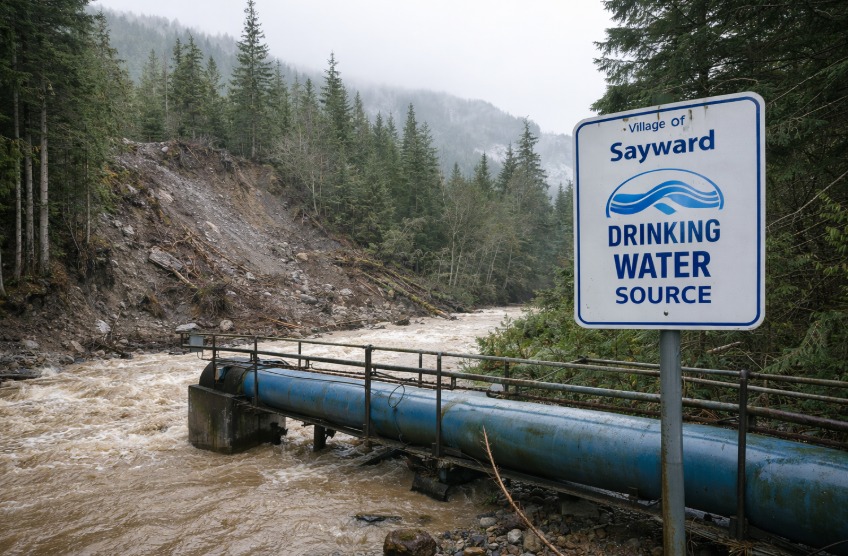
The Village of Sayward and the Strathcona Regional District (SRD) are seeking additional provincial assistance to address ongoing water quality challenges stemming from a landslide in the Newcastle Creek watershed, underscoring the growing infrastructure and climate resilience pressures facing small communities across British Columbia.
In an update issued Tuesday, local officials said they are working with the Ministry of Emergency Management and Climate Readiness (EMCR) to secure support for a comprehensive geotechnical assessment following the landslide that occurred on Oct. 23, 2025. The slide has continued to affect turbidity levels in water drawn from Newcastle Creek, a key source of drinking water for the North Island village.
While Sayward’s water treatment systems remain operational, officials say further technical analysis is needed to understand long-term risks and identify remediation options that will protect both public health and municipal infrastructure.
Under the proposed next steps, EMCR funding would allow the Village of Sayward and the SRD to commission a detailed assessment of the Newcastle Creek watershed. The study would examine slope stability, sediment movement and hydrological impacts linked to the landslide, and would culminate in a report outlining potential mitigation and remediation measures.
If approved, the assessment would be supported by a LiDAR (Light Detection and Ranging) survey of the watershed, anticipated in early 2026. LiDAR technology uses laser-based mapping to generate high-resolution terrain data, offering significantly more detailed insight than traditional surveying methods. Officials say this data would be critical in identifying areas of instability and guiding future engineering or environmental interventions.
The move reflects a broader trend among local governments seeking advanced technical tools to respond to climate-related events, including landslides, flooding and erosion. Smaller municipalities such as Sayward, which have limited tax bases and staff resources, often rely on provincial partnerships to manage complex natural hazard risks.
Despite the ongoing turbidity issues, the Village of Sayward and the SRD emphasized that the community’s water system is currently functioning well. Public Works crews continue to monitor and maintain the Water Treatment Plant, Newcastle Creek intake and reservoir, and no service disruptions have been reported.
Local officials also acknowledged the role residents have played in helping stabilize the system. A public advisory remains in effect, encouraging continued water conservation while crews complete their work and while longer-term solutions are assessed.
At this time, there are no new operational updates, and water quality remains within acceptable parameters due to treatment measures already in place. However, officials cautioned that conditions in the watershed can change quickly, particularly during periods of heavy rainfall or freeze-thaw cycles.
Should circumstances shift, residents will be notified through Alertable, the regional emergency notification platform, as well as through the official communication channels of both the Village of Sayward and the Strathcona Regional District.
From a business and governance perspective, the situation highlights the financial and operational challenges that infrastructure-dependent communities face following natural disasters. Beyond immediate response costs, municipalities must often plan for long-term capital investments, regulatory compliance and environmental monitoring — all while maintaining essential services.
For Sayward, securing EMCR support could help mitigate future risks and reduce the likelihood of repeated disruptions, which can carry economic consequences for residents, local businesses and public institutions. Reliable water supply is a foundational service that underpins community growth, housing stability and commercial activity.
The SRD and the Village of Sayward said they remain committed to transparency as the process moves forward and expressed appreciation for the patience and cooperation shown by the community to date.
As provincial authorities review the request for additional support, the case serves as a reminder of the increasing intersection between environmental risk management and municipal finance — particularly in rural and coastal regions of British Columbia where climate impacts are becoming more frequent and severe.
For now, officials say the focus remains on conservation, monitoring and planning, with the goal of ensuring a safe and sustainable water supply for Sayward in the years ahead.
