

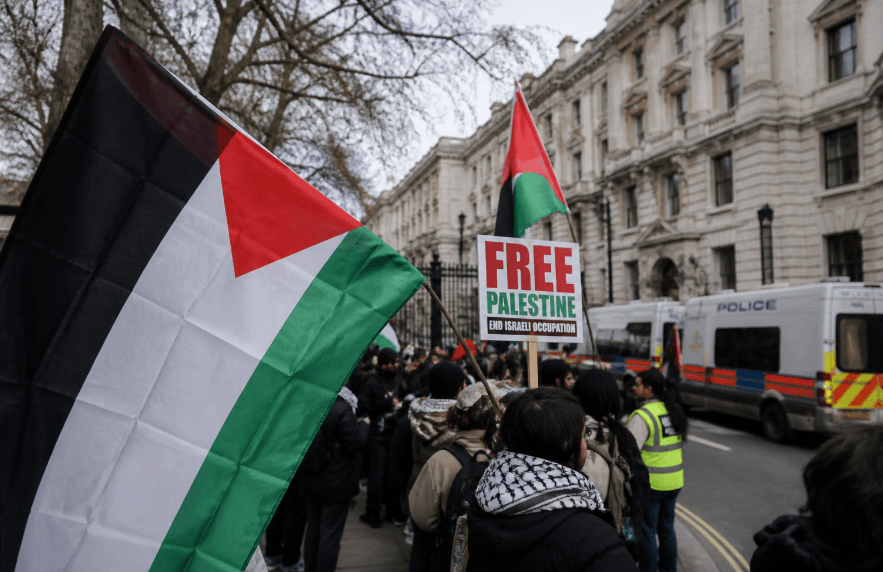
Dispute escalates over protest route allegations in London
A coalition of pro-Palestinian advocacy groups has formally called on Metropolitan Police Commissioner Sir Mark Rowley to withdraw remarks they describe as “incomprehensible and defamatory,” intensifying a public dispute over the organisation of recent demonstrations in London.
In a letter addressed directly to Rowley, the Palestine Coalition rejected claims that protest organisers intended to route marches near synagogues, arguing the statements misrepresent their actions and risk inflaming tensions during an already sensitive period.
Coalition rejects allegations of antisemitic intent
The controversy centres on public comments made by the police chief suggesting that initial plans for the marches “involved walking by a synagogue,” which he said conveyed a message that “feels like antisemitism.”
The coalition strongly disputes that characterization.
“We are very concerned to see that you have publicly stated that the organisers’ initial suggestion for the Palestine marches have ‘involved walking by a synagogue’ and that this sends a message that ‘feels like antisemitism’. These claims are incomprehensible and defamatory,” the letter states.
The groups argue that such claims are not only inaccurate but potentially damaging, particularly given the heightened political and social sensitivities surrounding Middle East-related protests in the United Kingdom and beyond.
Disagreement over proposed protest routes
At the core of the dispute is the question of proposed march routes for demonstrations commemorating the Nakba. According to the coalition, their initial proposal—submitted in writing on December 18—outlined a route from Embankment to Whitehall via Westminster and Waterloo bridges.
“Our first route suggestion for the next demonstration to commemorate the Nakba, made in writing on 18 December last year, was for a march from Embankment to Whitehall, via Westminster and Waterloo bridges, a route which we have used at least twice before and on which there are no synagogues,” the letter states.
The coalition claims that after several months without response, police authorities rejected this proposal, citing logistical considerations tied to another demonstration.
“After three months of silence we were finally told by your officers that this route was disallowed on the grounds that Tommy Robinson’s far right demonstration – a real hate march – was inexplicably going to be granted the whole political centre of London, and that we would have to march elsewhere.”
Second proposal also rejected
Following the initial rejection, organisers say they submitted an alternative route, which they maintain also avoided religious sites.
“Our second suggestion, made after much protest, was that we march from the Israeli Embassy via Knightsbridge to Trafalgar Square – again, a route that does not go past a synagogue, and one previously agreed by the police. This too has been disallowed, and a shorter route has been arbitrarily imposed.”
The coalition contends that both proposals demonstrate a consistent effort to avoid routes that could be perceived as provocative or insensitive.
Call for retraction and clarification
In the letter, the organisations emphasize that at no point did they request to march past synagogues and assert that official records can corroborate their position.
“The truth is that at no point have we ever requested to ‘walk by’ a synagogue on any of our marches. We have no interest in doing so. Police recordings of our meetings with you will confirm this.”
They further note that documentary evidence exists to support their claims.
“We can and will provide the email evidence to back up these facts. It is completely unacceptable for a senior public official to make these false claims and accusations, which can only raise the level of tension in the current situation.”
The coalition is urging the Metropolitan Police to publicly correct the record.
“We urge a speedy public retraction of your statement and the accompanying scurrilous claim of antisemitism.”
Broader implications for public trust and policing
The dispute highlights broader challenges facing law enforcement agencies in managing large-scale demonstrations tied to international conflicts. In Canada and other Western countries, similar tensions have emerged around balancing freedom of expression with public safety and community cohesion.
For business leaders and policymakers, the situation underscores the reputational and operational risks associated with public protests in major urban centres. Demonstrations can disrupt transportation, commerce and tourism, while also influencing public sentiment and investor confidence.
Conclusion
As the disagreement between the Palestine Coalition and the Metropolitan Police unfolds, attention is likely to remain focused on how authorities communicate and justify decisions around protest management. The coalition’s demand for a retraction signals a deepening rift that could have implications not only for future demonstrations in London but also for broader debates around policing, accountability and public trust.