

Province says appeal is needed to protect public safety and keep major infrastructure project on track
Transit hub project tied to housing growth and regional economic development
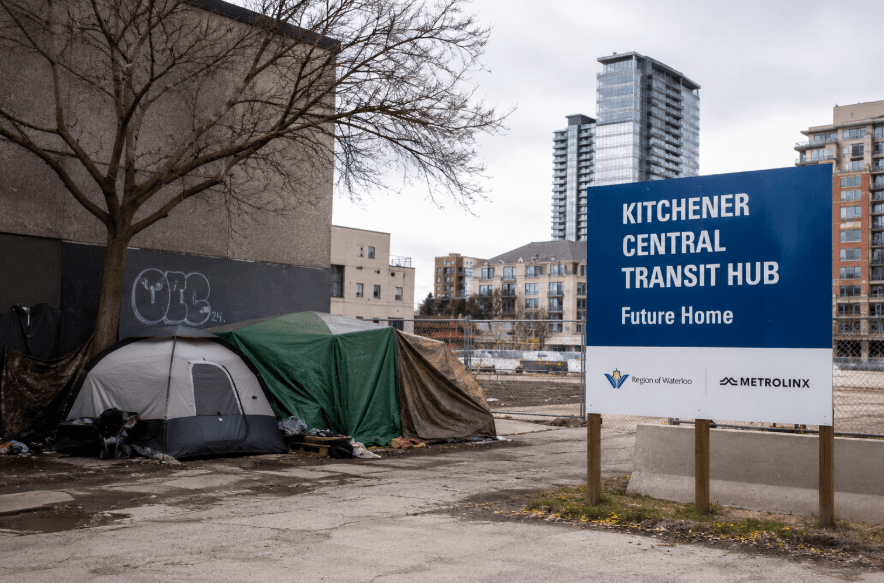
WATERLOO REGION — The Ontario government and the Region of Waterloo are moving to appeal a recent Ontario Superior Court ruling related to the encampment at 100 Victoria Street in downtown Kitchener, arguing the decision could delay a major transit infrastructure project considered critical to the region’s long-term growth.
The encampment occupies land designated for the planned Kitchener Central Transit Hub, a multi-modal transportation project intended to integrate regional and intercity transit services in Waterloo Region. Provincial and municipal officials say the appeal is necessary to ensure construction can proceed while balancing broader concerns around homelessness and public safety.
The decision under appeal was issued May 21, 2026, in the case Regional Municipality of Waterloo v. Named Respondents.
“Our government is appealing this decision in order to provide the certainty and stability needed to advance critical infrastructure projects here in Waterloo Region and across Ontario,” said Attorney General Doug Downey. “As we continue making record investments in homelessness prevention, we will also continue delivering on our commitment to keep communities safe and to advance our $236 billion plan to build the transit, homes, highways and other infrastructure that our growing province needs.”
The Kitchener Central Transit Hub is planned for the intersection of King Street West and Victoria Street North and is expected to connect GO Transit, VIA Rail, the ION light rail transit system, local bus routes, cycling infrastructure and pedestrian access points into a single transit centre.
Provincial and regional officials say the project is intended to accommodate population growth in Waterloo Region while strengthening transportation links along the Toronto–Waterloo Innovation Corridor. The corridor has emerged as a major economic and technology hub in Ontario, with governments increasingly investing in transit and housing infrastructure to support labour mobility and economic development.
According to the province, the transit hub will improve access to employment centres, educational institutions and housing while increasing regional transit capacity.
“The Region of Waterloo has worked hard to support people experiencing homelessness while also planning for the needs of a growing community,” said Region of Waterloo Chair, Karen Redman. “The Kitchener Central Transit Hub is a transformative project that will serve residents for generations, improving connections to jobs, housing, education and transit throughout our region and beyond. At the same time, Waterloo Region has significantly increased its investment in housing and homelessness supports over the past several years because we recognize that building strong communities requires both social supports and critical infrastructure. This appeal is about ensuring municipalities have clarity on how to move forward with both of these important responsibilities.”
Province highlights homelessness and housing investments
The appeal comes as Ontario continues to emphasize increased spending on homelessness prevention and housing support programs across the province.
The province said Waterloo Region currently receives more than $17.8 million annually through Ontario’s Homelessness Prevention Program. Additional funding has also flowed through joint federal-provincial housing initiatives.
In the 2025–26 fiscal year, Waterloo Region received more than $9.5 million through the Canada-Ontario Community Housing Initiative and the Ontario Priorities Housing Initiative, according to the province. Ontario also allocated more than $1 million in additional Canada-Ontario Housing Benefit rent supplements aimed at helping households at risk of homelessness.
“As we continue making record investments to support those facing homelessness, we are also going to continue delivering on our commitment to keep communities safe and get people the help they need in the appropriate environment, instead of a dangerous and disruptive encampment,” said Rob Flack, Minister of Municipal Affairs and Housing. “Supporting municipalities with homelessness prevention remains a top priority, as does working with them to advance the key infrastructure projects required to build Ontario.”
Ontario also noted that Waterloo Region is among communities selected for a new Homelessness and Addiction Recovery Treatment Hub, part of the province’s broader $560 million commitment to establish 29 so-called Hart Hubs across Ontario. The facilities are intended to expand access to addiction treatment, mental health care and housing-related support services.
The dispute over the encampment reflects broader tensions facing municipalities across Ontario as governments attempt to address rising homelessness while advancing housing and infrastructure priorities. Encampments in urban areas have increasingly become the subject of legal and political debate, particularly where proposed evictions intersect with Charter rights and public land use.
Ontario says its broader infrastructure strategy includes a planned $236 billion investment program, with approximately $70 billion earmarked for transit expansion projects across the province.