

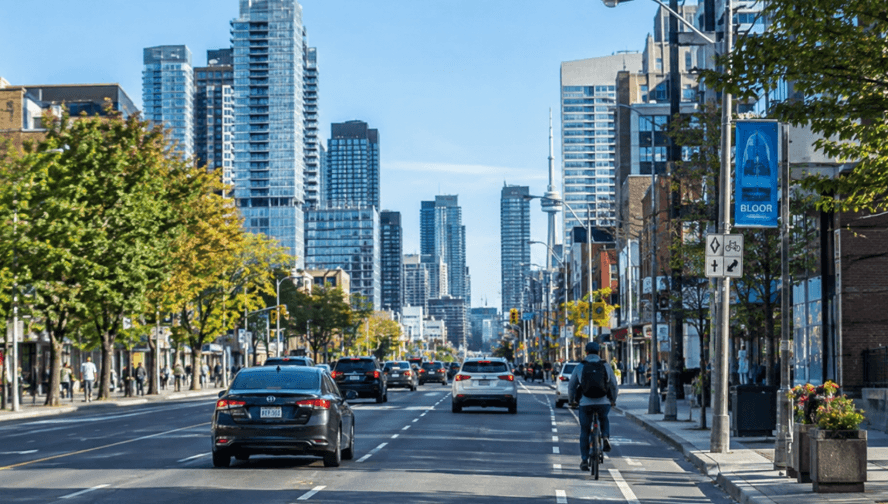
TORONTO — The Ontario government is moving ahead with plans to restore motor vehicle lanes on several of Toronto’s busiest streets, launching a request for proposals to examine design options while immediately beginning additional work on Bloor Street West.
The provincial initiative covers sections of Bloor Street, Yonge Street, University Avenue, Queen’s Park, Queen’s Park Crescent and Avenue Road, where vehicle lanes had previously been removed to accommodate bicycle infrastructure.
The move follows a recent Ontario Court of Appeal decision concerning the province’s bike lane framework. According to the government, the court unanimously determined that decisions over the design of public roads are policy matters for the elected Legislature.
Province Launches RFP for Toronto Vehicle Lane Restoration
Ontario’s request for proposals will seek design options for restoring vehicle capacity along the identified Toronto corridors. The process will also examine whether existing bike lanes can be retained or reconfigured in locations where the province determines they can operate without worsening traffic congestion.
Transportation Minister Prabmeet Sarkaria said the government is following through on its commitment to address gridlock.
“Our government was given a clear and direct mandate by the people of Ontario to fight gridlock, including by restoring motor vehicle lanes that are needed to keep drivers moving,” said Prabmeet Sarkaria, Minister of Transportation. “We’re keeping our promise. Under Premier Ford’s leadership, we’re getting people and goods moving again and giving commuters back more of their time.”
The government is not waiting for the broader design process before beginning work on Bloor Street West. Vehicle lane restoration will start immediately east of Clissold Road, where the province says relatively little design work is required.
Bloor Street West Work Builds on 2025 Project
The latest work follows an earlier lane restoration project completed in December 2025.
That project restored a vehicle lane while maintaining a bike lane along a 600-metre section of Bloor Street West between Resurrection Road and Clissold Road.
The broader restoration program is tied to the Reducing Gridlock, Saving You Time Act, 2024 and the Plan to Protect Ontario Act, 2025. The legislation requires motor vehicle lanes to be restored on specified sections of Toronto roads.
The policy has been the subject of legal and political debate over how Toronto streets should balance motorists, cyclists, public transit, businesses and other road users.
Ontario’s successful appeal provides the province with a clearer legal path to proceed with its framework. The government said the Court of Appeal concluded that roadway design decisions fall within the Legislature’s policy-making authority rather than the courts.
Ontario Points to Economic Cost of Traffic Congestion
The Ford government has framed its lane restoration strategy as part of a broader effort to reduce congestion and improve the movement of commuters and commercial goods.
A report from the Canadian Centre for Economic Analysis cited by the province estimated that gridlock costs Ontario $56 billion annually.
The Residential and Civil Construction Alliance of Ontario said transportation planning should account for different forms of mobility while maintaining an effective overall network.
“RCCAO supports infrastructure solutions that recognize the diverse ways Ontarians move through our communities. Well-planned infrastructure is about creating transportation networks that serve everyone. The Province’s efforts to restore vehicle capacity while maintaining bike lanes where possible strikes an important balance between mobility, safety, and accessibility. RCCAO supports investments and policies that advance integrated infrastructure solutions and meet the needs of residents, businesses, and communities.”
– Nadia Todorova
Executive Director, Residential and Civil Construction Alliance of Ontario (RCCAO)
Businesses React to Planned Bloor Street Changes
The lane changes are also being closely watched by businesses operating along the affected corridors, particularly on Bloor Street.
Sam Pappas, owner of The Crooked Cue, welcomed the province’s decision and said the changes would address concerns raised by the community.
“I would like to thank the Ford Government for taking the time to listen to the community and responding to our concerns. The removal of the bike lanes on Bloor Street will restore access and beauty that was lost. As a business owner and a long-time resident, I am grateful that we will get back to a system that works for the majority.”
– Sam Pappas
Owner, The Crooked Cue
Design Process to Determine Next Steps on Toronto Streets
The RFP process will now determine potential configurations for the other affected streets and assess where bicycle infrastructure could remain or be redesigned alongside restored vehicle lanes.
While the broader design work proceeds, the immediate construction activity on Bloor Street West marks the next phase of Ontario’s implementation of its Toronto road policy.
The eventual changes could reshape some of the city’s most heavily travelled corridors, with the province positioning the initiative as a way to increase vehicle capacity, reduce congestion and improve the movement of people and goods across Toronto.
Discover more from Wire Service Canada
Subscribe to get the latest posts sent to your email.