

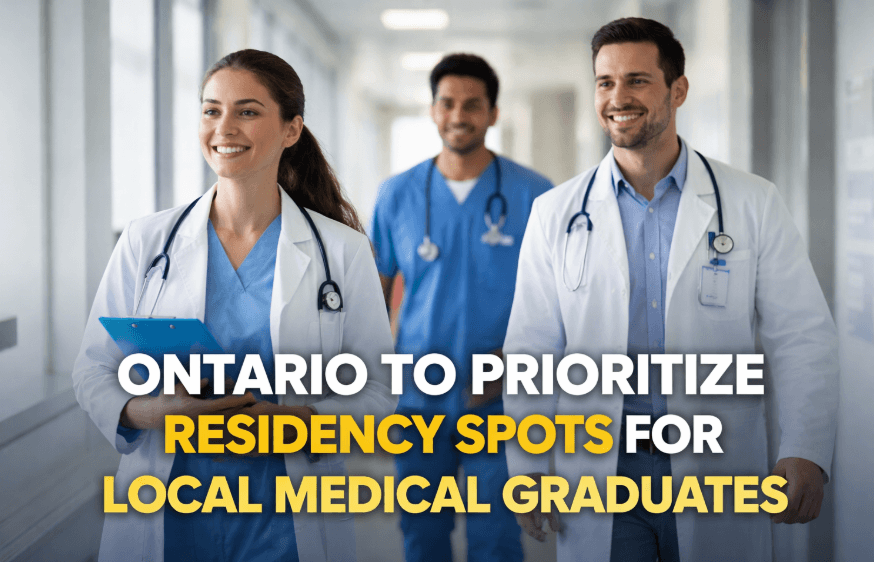
Proposed legislation aims to retain more doctors and strengthen provincial health-care workforce
The Ontario government is preparing to introduce legislation that would give priority access to medical residency positions to internationally trained doctors with strong ties to the province, a move aimed at addressing ongoing physician shortages and retaining more talent within its health-care system.
Announced April 17 by the Ministry of Health, the proposal would create a dedicated pathway within the Canadian Resident Matching Service (CaRMS) for international medical graduates (IMGs) who are from Ontario but studied medicine abroad. The change is intended to make it easier for these graduates to return to the province, complete their required training, and ultimately practise as physicians in Ontario.
“Our government is protecting Ontario’s health-care system by taking bold action to strengthen Ontario’s physician workforce now, and into the future,” said Sylvia Jones. “This proposed change to the matching process would make it easier for Ontarians studying medicine abroad to attend residency and have a career as a doctor back home in Ontario.”
Aligning with other provinces
If passed, the legislation would bring Ontario in line with policies already adopted in provinces such as Nova Scotia, New Brunswick and Prince Edward Island, which have implemented similar measures to retain locally connected medical graduates.
Currently, residency placements in Canada are administered through CaRMS, which runs a two-round national matching system for both Canadian and international graduates. Under the proposed changes, Ontario would maintain priority access for graduates of its own medical schools while introducing a distinct stream for Ontario-linked IMGs.
Provincial officials argue that graduates with established ties to Ontario are significantly more likely to remain in the province long term, helping stabilize the health-care workforce.
Defining “Ontario IMGs”
The proposed regulations would establish clear eligibility criteria for what constitutes an Ontario IMG. Candidates would qualify if they meet at least one of the following conditions:
- Completion of at least two years of full-time secondary school in Ontario
- Attendance at an Ontario university full-time and in-person for at least two years
- Continuous residence in Ontario for a minimum of 24 weeks within a defined eligibility period
For the 2027 residency match cycle, that residency period would begin on January 1, 2025.
The province plans to begin consultations and coordination with medical schools and CaRMS in summer 2026, with implementation targeted ahead of the September 2026 application cycle.
Expanding training capacity
The residency prioritization plan is part of a broader effort by Government of Ontario to expand medical training and address physician shortages, particularly in primary care.
Ontario recently announced the addition of more than 270 new residency seats, bringing the total number of positions to 1,739 across the province. This represents nearly a 50 per cent increase since 2018.
The province has also launched its largest medical education expansion in over a decade, including the development of two new medical schools: one at Toronto Metropolitan University in Brampton and another at York University in Vaughan, the latter focused on training family doctors.
Existing institutions—including the University of Toronto, McMaster University, the University of Ottawa, and the Northern Ontario School of Medicine University—are also expanding their training capacity.
Broader workforce strategy
The government says the residency changes complement other efforts to bolster the health-care workforce, including initiatives to recruit internationally trained professionals.
In 2025 alone, more than 2,300 nurses and over 570 physicians from the United States chose to practise in Ontario following regulatory changes designed to streamline licensing.
Since 2018, Ontario has added nearly 20,000 physicians overall, including a more than 14 per cent increase in family doctors.
The measures fall under the province’s broader health-care strategy, “Your Health: A Plan for Connected and Convenient Care,” which focuses on improving access to services and reducing wait times.
Reducing barriers to care
Ontario officials emphasize that the residency prioritization initiative is also intended to cut administrative barriers and accelerate the training pipeline for new doctors.
“We need more doctors, and this is yet another way to help connect Ontarians to the health-care services they need, like primary care. We can’t afford red tape when it comes to training more medical students here. By training more medical students in Ontario we can help ensure they stay local and can plant their own roots as doctors serving the communities where they grew up,” said Andrea Khanjin.
Outlook
If approved, the legislation could mark a significant shift in how Ontario manages its physician training pipeline, with a sharper focus on retaining talent with local ties. For policymakers, the expectation is that the approach will not only increase the number of practising doctors but also improve long-term workforce stability in communities across the province.
Discover more from Wire Service Canada
Subscribe to get the latest posts sent to your email.