

Funding targets training, equipment and rapid deployment through Ontario Corps network
TORONTO — The Government of Ontario is investing more than $6.5 million to strengthen emergency preparedness and response capabilities across the province, directing funds to 13 partner organizations within Ontario Corps as part of a broader strategy to improve disaster readiness.
The funding, announced Monday by Jill Dunlop, will support the acquisition of equipment, operational supplies and specialized training to ensure faster and more coordinated responses to emergencies ranging from floods to wildfires.
“We are delivering on our plan to protect Ontario by bringing together Ontario Corps partners, skilled professionals, trained volunteers and equipment that can be deployed quickly when emergencies occur,” said Jill Dunlop, Minister of Emergency Preparedness and Response. “These partners support Ontarians who answer the call to help communities in their moment of need.”
Building capacity across a growing network of partners
The latest funding brings total provincial investment in Ontario Corps to $21.5 million, reflecting a sustained effort to expand the province’s emergency response infrastructure. Equipment secured through previous funding includes debris removal machinery, flood mitigation barriers, drones, mobile shelters, food distribution resources and personal protective equipment.
According to the ministry, these assets can typically be deployed within 24 to 72 hours following an emergency, a timeline intended to reduce response gaps and improve on-the-ground coordination.
Organizations receiving funding in this round include 211 Ontario, Attachment and Trauma Treatment Centre for Healing (ATTCH) Niagara, Feed Ontario, GlobalMedic, Habitat for Humanity, Independent First Nations Alliance, Kenora Chiefs Advisory – Ogimaawabiitong, Ontario Federation of Indigenous Friendship Centres, Ontario Search and Rescue Volunteer Association, Radio Amateurs of Canada, St. John Ambulance, The Salvation Army Canada and Team Rubicon Canada.
The announcement coincides with Emergency Preparedness Week, a national awareness campaign running May 3 to May 9 that encourages households to prepare for potential emergencies.
Focus on readiness, coordination and community resilience
Provincial officials say the funding is designed not only to enhance immediate response capacity but also to strengthen long-term resilience through training and coordination among partners.
“As President of Radio Amateurs of/du Canada (RAC), I am proud of our ongoing partnership with the Ontario Corps through the Auxiliary Communications Services Program. Being part of this network reflects our deep commitment to public service and to ensuring that reliable communications are available when they are needed most. Amateur radio operators have a long-standing history of stepping up in times of crisis, and with the continued support through the ERaCB program, we are strengthening our ability to assist communities and emergency management partners across the province. Together with the leadership of Minister Jill Dunlop and her Ministry, we will continue to enhance Ontario’s emergency preparedness and response capacity, helping to safeguard the well-being of all Ontarians.”
- Allan Boyd
President of Radio Amateurs of/du Canada
“Through this grant The Salvation Army is able to focus on preparedness’ and mitigation, strengthening recruitment and training to respond when emergencies happen in real time. Most recently, we deployed to Minden during the flooding, demonstrating that Ontario Corps Emergency Preparedness and Response remains committed to protecting and serving those affected by disasters across Ontario. We are grateful to Minister Dunlop for her support and for the Emergency Preparedness and Response Community Emergency Preparedness Grant, which helps make this critical work possible.”
- Major Rick Zelinsky
Territorial Director of Emergency Disaster Service, The Salvation Army
“The 211 Ontario system partners are pleased to receive Emergency Readiness and Capacity Building funding to continue the important work that has taken place over the last two years. Working alongside MEPR and our Ontario Corps partners to coordinate response efforts will improve our ability to protect Ontarians when disasters occur, and new threats arise. We look forward to continuing this partnership with Minister Dunlop, Premier Ford, and the entire MEPR team.”
- Karen Milligan
Executive Director, Ontario 211 Services
Expanding partnerships and operational scope
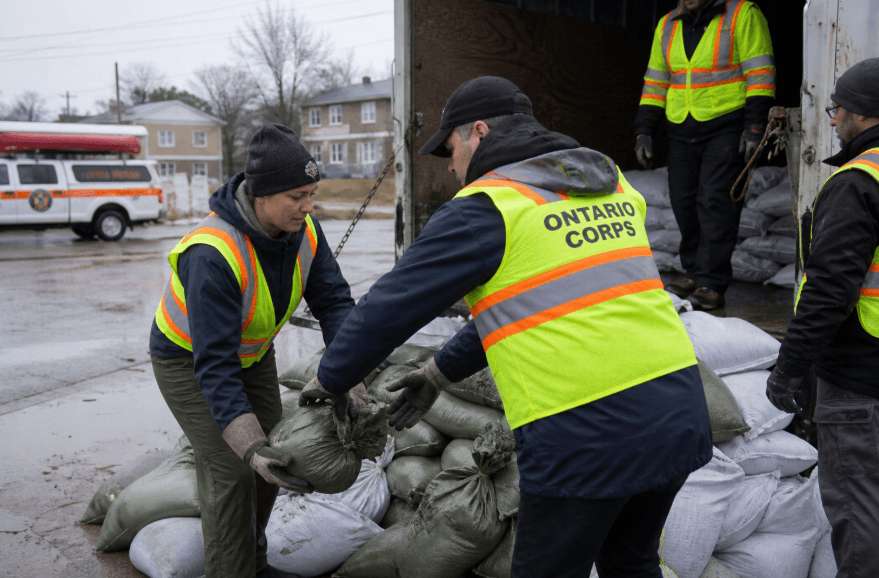
Ontario Corps has played a role in recent emergency responses, including spring flooding in multiple municipalities such as Minden Hills, Whitewater Region, Chapleau, French River and Greater Sudbury, where partners assisted with sandbagging operations and emergency shelter support.
The province is also expanding the initiative’s reach by onboarding new partners, including Labatt Breweries of Canada, the Ontario Chamber of Commerce, Ontario Mine Rescue and the Ontario Road Builders’ Association. Additional organizations are expected to join in the coming months.
“Being an Ontario Corps partner is both a privilege and a profound responsibility. This support enables us to advance a provincial network of trauma-trained therapists and emergency response professionals who can offer timely, integrated psychosocial care when emergencies arise. As we deepen our commitment to truth and reconciliation and to addressing systemic inequities, we are working alongside the Province and Ontario Corps partners to ensure that communities across Ontario have access to compassionate, expert trauma support—before, during, and after times of crisis.”
- Lori Gill
Executive Director, ATTCH Niagara
“Being an Ontario Corps partner is a meaningful step for Ontario Search and Rescue Volunteer Association (OSARVA) and affirms the vital role we play in protecting communities across Ontario. Support through the Emergency Readiness and Capacity Building Fund enables us to strengthen training, resources, and operational readiness, ensuring OSARVA teams are well prepared to respond alongside provincial and local partners during emergencies. We are proud to continue contributing our expertise and commitment to a safer, more resilient Ontario.”
- Emilie Kissler
Vice President & Northeast Director, Ontario Search and Rescue Volunteer Association (OSARVA)
Supporting Indigenous and community-led response efforts
Several partners emphasized the importance of culturally informed and community-led emergency response, particularly in Indigenous communities.
“Kenora Chiefs Advisory has been leading supports in Social Emergency Management alongside its affiliated First Nation communities, including my community of Wauzhushk Onigum, since well before the pandemic. We are thankful, through this partnership with Ontario Corps, we’ve been able to provide direct, on-the-ground support to several First Nations during emergencies, while also building long-term capacity for community-led response. This funding has made a real difference in how we support people during times of crisis, and it allows us to continue strengthening emergency preparedness in a way that reflects the needs and realities of the communities we serve.”
- Chief Chris Skead
Acting Board President, Kenora Chiefs Advisory
“Being part of Ontario Corps means showing up for Ontarians during their time of need. At GlobalMedic, we understand the importance of collaboration between experienced organizations and those looking to support their community, which is why we are proud to be a part of this program. We have been able to provide training, personnel and life-saving equipment to support impacted communities during severe storms, fires and floods. GlobalMedic is committed to strengthening the province’s emergency preparedness and response, and we look forward to continuing to support communities across Ontario.”
- Rahul Singh
Executive Director, GlobalMedic
Encouraging public preparedness
Alongside institutional investments, the province is urging residents to take personal preparedness measures, including developing household emergency plans, assembling supply kits with at least three days’ worth of essentials and maintaining access to battery-powered or crank radios for communication during outages.
Emergency resources across Ontario are coordinated through the Provincial Emergency Operations Centre, with a new centralized headquarters planned to further enhance response capabilities and serve as a 24/7 command centre.
Officials say the combined approach — strengthening institutional capacity while promoting individual readiness — is key to improving resilience as climate-related and other emergency risks continue to evolve.