

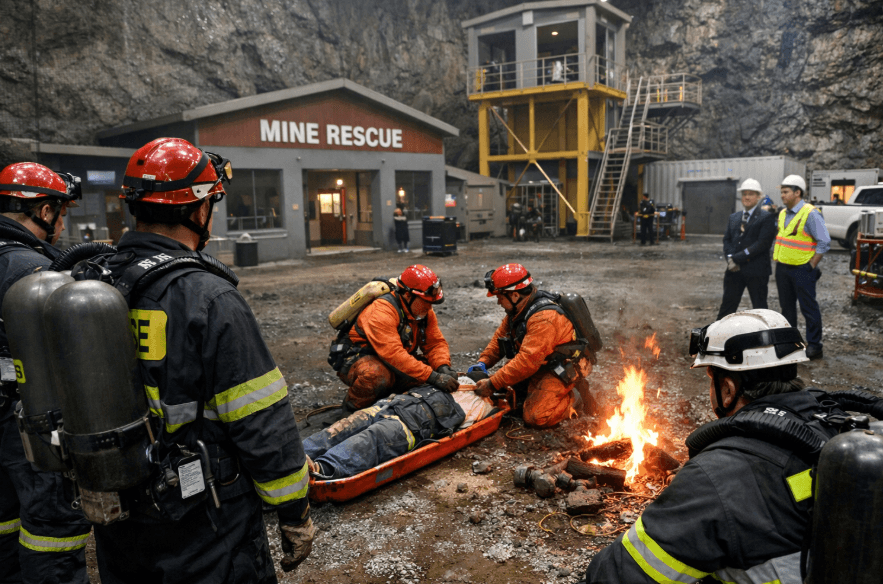
New Sudbury facility aims to strengthen emergency preparedness and support mining sector growth
SUDBURY, Ont. —
The Ontario government is committing $125 million to build a new, state-of-the-art mine rescue training institute in Sudbury, a move aimed at enhancing worker safety and reinforcing the province’s position in the global mining sector.
Funded through the Workplace Safety and Insurance Board (WSIB), the proposed Ontario Mine Rescue Training Institute will provide advanced, hands-on training for emergency responders in mining environments. The facility is expected to train more than 540 volunteers annually and support Ontario’s existing 1,000-person mine rescue workforce.
The investment comes as demand for critical minerals continues to rise globally, placing increased pressure on mining jurisdictions like Ontario to maintain high safety standards while expanding production.
“Ontario’s mine rescue volunteers are among the best-trained emergency responders in the world, and this facility will attract international talent to bring them here,” said David Piccini, Minister of Labour, Immigration, Training and Skills Development. “This is what modern worker safety looks like; a permanent, world-class home for the expertise that mining communities across Ontario, and countries around the globe, have come to rely on.”
Expanding Training Capacity and Reducing Barriers
The 120-acre institute will feature both underground and surface training environments designed to simulate real-world mining emergencies. Planned capabilities include high-angle rescue, fire response, hazardous materials handling, confined space operations and structural collapse scenarios.
The facility will also incorporate smart classrooms equipped with virtual and augmented reality technologies, as well as accommodations for trainees attending multi-day programs.
Operated by Ontario Mine Rescue, a division of Workplace Safety North, the institute builds on more than 90 years of mine rescue expertise in the province.
“For more than 90 years, Ontario Mine Rescue has set the standard for excellence in mine safety and emergency response,” said Shawn Rideout. “This investment is transformational. It will expand training capacity, strengthen readiness across the province and ensure Ontario has the tools and expertise needed to be a leader in mining industry for generations to come.”
By centralizing training in northern Ontario, the province aims to reduce travel burdens for volunteers while improving access to advanced instruction.
Economic and Industry Implications
Beyond safety improvements, the investment is expected to deliver economic benefits for Sudbury and the broader mining sector. Industry leaders and government officials say the facility will enhance Ontario’s competitiveness as a reliable supplier of critical minerals.
“We are so proud to partner with Workplace Safety North and Ontario Mine Rescue to bring this project to life. This is an investment in health and safety in mining and also an investment in our economy, the Sudbury community, and in the mining industry,” said Jeff Lang, President and CEO of the WSIB.
Vic Fedeli, Minister of Economic Development, Job Creation and Trade, emphasized the broader economic context: “As global demand for critical minerals continues to surge, Ontario stands ready as a reliable and secure supply chain partner. The new state-of-the-art Ontario Mine Rescue Training Institute will ensure our province’s rescue and emergency preparedness capabilities keep pace, enabling industry to invest with confidence and positioning our world-class workforce for new opportunities.”
Supporting Workforce Development and Safety Standards
The initiative also aligns with Ontario’s broader strategy to expand its skilled labour pipeline while maintaining high safety standards in mining operations.
“To ensure we emerge more self reliant, Ontario is building mines faster to create tens of thousands of jobs and boost Canadian supply chains,” said Stephen Lecce, Minister of Energy and Mines. “To build those mines, we are investing in a pipeline of talented and skilled workers that always return home after a day of work. Safety and responsibility is what defines Ontario’s ethical mining sector. This historic investment in Canada’s largest mining training centre will expand capacity, train more volunteers, and strengthen emergency response so we keep miners and communities safe.”
Officials say the institute will also function as a hub for collaboration, supporting training for municipal fire services, industrial teams and other emergency responders.
“This investment is truly transformative for mine rescue and emergency preparedness in Ontario,” said Mike Parent. “A world class mine rescue training academy in Sudbury will strengthen our ability to deliver leading edge training, ensure we are ready for the future growth of mining in the province, and position Ontario as a global leader in mine safety and emergency response. This facility will also allow advanced emergency preparedness and response training to be delivered here at home, rather than requiring organizations to seek this expertise outside of Canada, reinforcing Ontario’s reputation as a world class mining jurisdiction.”
Reinforcing Sudbury’s Role as a Mining Hub
Local officials say the project further cements Sudbury’s reputation as a global centre for mining innovation and safety.
“This investment by the Workplace Safety Insurance Board, supported by the Government of Ontario, reinforces Greater Sudbury’s position as a global centre of excellence in mining innovation and safety,” said Paul Lefebvre. “As the only facility of its kind in Canada, the new Mine Rescue Training Academy will strengthen worker safety, create new economic opportunities, and attract talent and expertise from around the world, helping ensure our community remains at the forefront of responsible mining for decades to come.”
Ontario Mine Rescue has historically delivered more than 65,000 hours of underground training and supported hundreds of rescue operations, underscoring the importance of continued investment in safety infrastructure.
With construction expected to proceed in the coming years, the province is positioning the new institute as both a safety cornerstone and a strategic asset in Canada’s evolving mining economy.
Discover more from Wire Service Canada
Subscribe to get the latest posts sent to your email.