

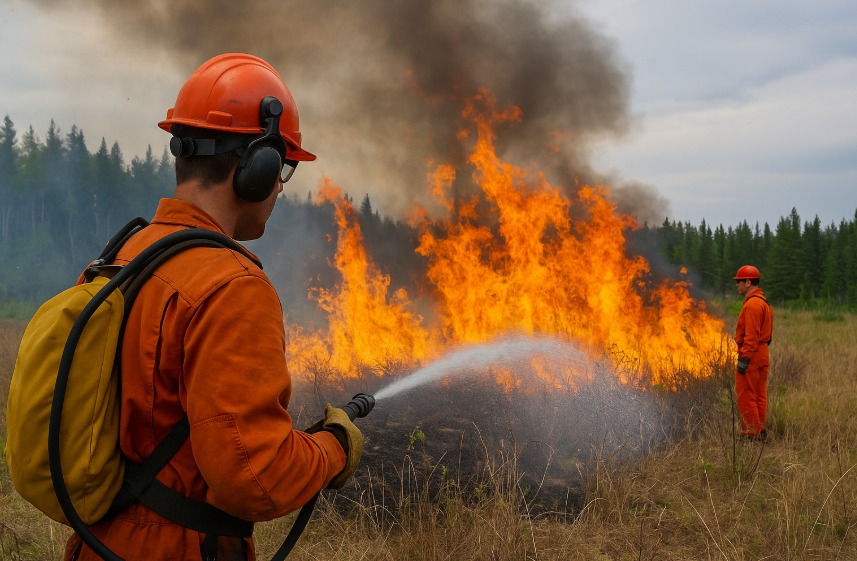
TORONTO — Ontario has officially concluded its 2025 wildland fire season, marking one of the most demanding years in recent memory with 643 fires recorded between April and October and nearly 600,000 hectares burned. In response, the province has announced new measures to strengthen its firefighting capabilities, including 68 new permanent positions and a major investment in six new waterbombers to bolster its air fleet for future seasons.
The announcement came as the Ministry of Natural Resources confirmed that, despite an early and active start to the season, coordinated action by frontline crews, aviation services, Indigenous communities, and local authorities ensured effective protection for residents and infrastructure across Ontario.
A challenging fire year met with rapid response
Ontario’s 2025 season was defined by intense and fast-moving wildfires across northern and central regions, exacerbated by dry conditions and rising temperatures. Despite the scale of the challenge, provincial fire teams mounted what officials described as a “rapid and coordinated” response effort.
“I am grateful to every single member of our wildland fire response team, the heroes that dedicate their lives to protecting Ontario during fire season,” said Mike Harris, Minister of Natural Resources. “From battling fires on the ground to coordinating evacuations by air, our government is proud of the FireRangers, pilots and those behind the scenes who demonstrated bravery and dedication while responding to fires in Ontario and across the country.”
In total, 597,654 hectares were affected by fire across the province, substantially higher than the 480 fires and 90,000 hectares recorded in 2024. However, the Ministry said that lessons learned from previous years and improved coordination contributed to faster containment and reduced damage to populated areas.
Expanding permanent firefighting capacity
As part of a long-term strategy to strengthen Ontario’s wildland fire programme, the government is adding 68 new permanent firefighting and support staff positions ahead of the 2026 season. This builds on the 100 permanent roles created in 2024 and 2025, reflecting growing investment in the province’s emergency preparedness infrastructure.
Ontario will also invest over $500 million to purchase six new De Havilland DHC-515 waterbombers, due to arrive in the early 2030s. The aircraft will expand the province’s ability to conduct aerial fire suppression, complementing existing fleets used in large-scale operations across rugged and remote areas.
Officials said the investment demonstrates the province’s commitment to ensuring that both equipment and personnel are in place to meet future fire risks amid increasingly unpredictable weather conditions.
National and international cooperation
Ontario’s crews not only handled domestic fires but also played a key role in interprovincial support. Over 400 personnel and six aircraft were deployed to assist firefighting operations in British Columbia, Manitoba, Saskatchewan, Nova Scotia, Newfoundland and Labrador, New Brunswick, and even Minnesota in the United States.
In return, Ontario also benefited from mutual aid during peak periods, receiving reinforcements from British Columbia and Wisconsin crews, along with firefighting aircraft and equipment from Quebec, Alberta, and New Brunswick.
“Each season brings lessons that help us strengthen our response and preparedness. I’m especially proud of how everyone came together to protect Ontario and help our neighbours across the country during this year’s wildland fires,” said Jill Dunlop, Minister of Emergency Preparedness and Response. “Alongside fire crews and emergency responders, Ontario Corps volunteers assisted with evacuations and shipped vital equipment to affected communities. By working together, we showed we are ready to face whatever challenge comes our way.”
Strengthening readiness for 2026 and beyond
Ontario’s next fire season is scheduled to begin on April 1, 2026, though officials note that climate conditions mean activity could continue beyond the legislated end date of October 31. Crews will remain on standby for late-season flare-ups and emerging risks.
The province is also advancing legislative reforms. In May 2025, it reintroduced the Resource Management and Safety Act, 2025, which, if passed, will strengthen collective responsibility for fire management, improve risk awareness, and enhance prevention, mitigation, and compliance frameworks.
Ontario continues to partner with the federal government, investing $64 million in upgraded equipment, modern fire suppression tools, and enhanced training for response teams.
Officials said these measures reflect a wider shift toward sustained readiness and long-term resilience in the face of more severe and frequent wildfires.
