

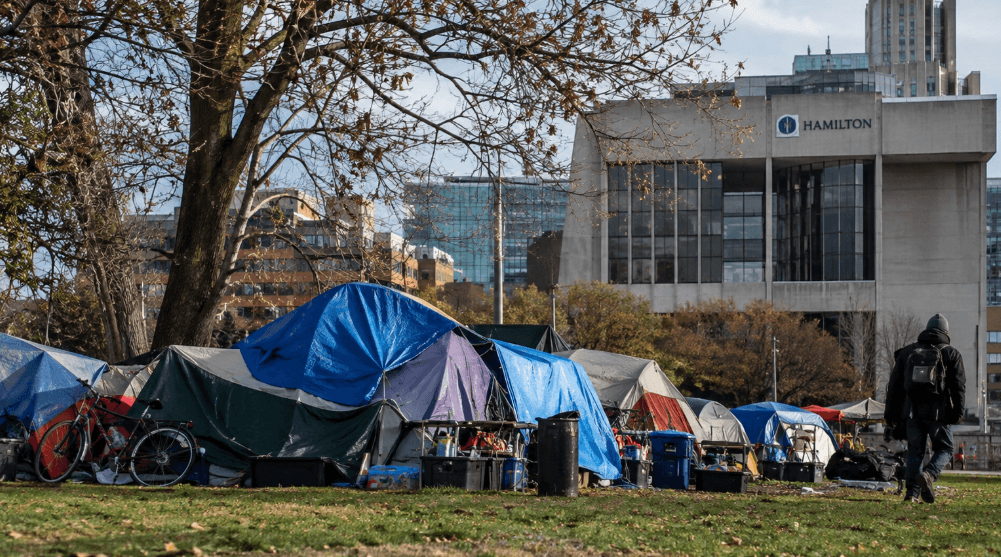
The Court of Appeal for Ontario has overturned a lower court ruling involving the eviction of unhoused residents from public parks in Hamilton, ordering a new trial in a case examining municipal enforcement powers, discrimination and constitutional rights.
The BC Civil Liberties Association (BCCLA), which intervened in the proceedings, welcomed the appellate decision in Heegsma et al. v. City of Hamilton, saying it addresses significant errors in the original judgment and reinforces the importance of properly considering evidence presented by people experiencing homelessness.
The ruling also reopens legal questions about whether municipalities can be required to pay damages when their actions violate rights protected under the Canadian Charter of Rights and Freedoms.
Ontario Appeal Court Identifies Errors in Original Charter Rights Decision
According to the BCCLA, the Court of Appeal identified several deficiencies in the Ontario Superior Court of Justice’s handling of the case, including its failure to apply the appropriate Charter analysis.
The association said the trial judge had also dismissed evidence from unhoused individuals based on stereotypes concerning mental health and substance use.
The appellate court determined that the legal question of Charter damages arising from municipal rights violations required further examination. It subsequently ordered a new trial rather than allowing the original decision to stand.
The outcome represents an important development in litigation concerning homelessness, public-space regulations and the constitutional responsibilities of local governments.
Hamilton Encampment Evictions Sparked Legal Challenge in 2021
The case originated in 2021 when several individuals experiencing homelessness challenged the City of Hamilton after being removed from encampments in municipal parks.
The plaintiffs argued that provisions of Hamilton’s bylaws, together with the discretionary manner in which municipal authorities enforced them, infringed rights protected under sections 7 and 15 of the Charter.
Section 7 protects the rights to life, liberty and security of the person, while Section 15 guarantees equality before and under the law without discrimination.
The plaintiffs maintain that encampment evictions can produce discriminatory consequences based on race, Indigenous identity, sex, disability and marital status, either individually or through overlapping forms of disadvantage.
They are also seeking financial compensation for alleged harms associated with the evictions, including medical consequences, the loss of personal belongings and sexual assault.
These allegations remain subject to judicial examination through the new trial.
BCCLA Calls for Greater Accountability Over Municipal Charter Violations
The BCCLA participated as an intervener specifically to address the legal standards governing Charter damages when municipalities infringe constitutional rights.
The organization supported the plaintiffs’ position that damages should be available where municipal authorities demonstrate “clear disregard” for individuals’ Charter protections.
Drawing on Supreme Court of Canada jurisprudence, the BCCLA argued that the applicable standard for municipal bylaws should be recalibrated toward a negligence-based approach.
Such an interpretation, the association maintains, could make constitutional remedies more accessible to individuals harmed by municipal government conduct.
The question carries implications beyond Hamilton because Canadian municipalities regularly exercise enforcement authority over public spaces, including parks where people experiencing homelessness may establish temporary shelters.
BCCLA Lawyer Welcomes Opportunity for New Trial
Ga Grant, staff counsel for the BCCLA, said the appellate ruling reinforces the obligation of courts to examine constitutional claims without relying on discriminatory assumptions.
“This decision reaffirms that unhoused people — like everyone — deserve to have their rights and their evidence taken seriously in court. It is just to overturn biased decisions like these that fail to apply Charter law and meaningfully engage with fundamental rights. We hope that the new trial will provide full and proper recognition of the violations of Charter rights these individuals have experienced.”
The BCCLA is represented in the proceedings by Samara Secter and Tabir Malik of Adario Law Group LLP.
New Trial Could Clarify Municipal Responsibilities Across Canada
The appeal decision does not resolve the underlying constitutional allegations or determine whether the plaintiffs are entitled to damages. Those matters will require further consideration during the new proceedings.
However, the ruling creates another opportunity to examine how municipalities balance public-space management and bylaw enforcement with their obligations under the Charter.
For local governments across Canada, the case highlights the potential legal consequences of encampment enforcement decisions and the importance of evaluating their effects on vulnerable residents.
The new trial is expected to revisit the plaintiffs’ constitutional claims and the legal framework governing potential compensation for alleged municipal rights violations.
Discover more from Wire Service Canada
Subscribe to get the latest posts sent to your email.