

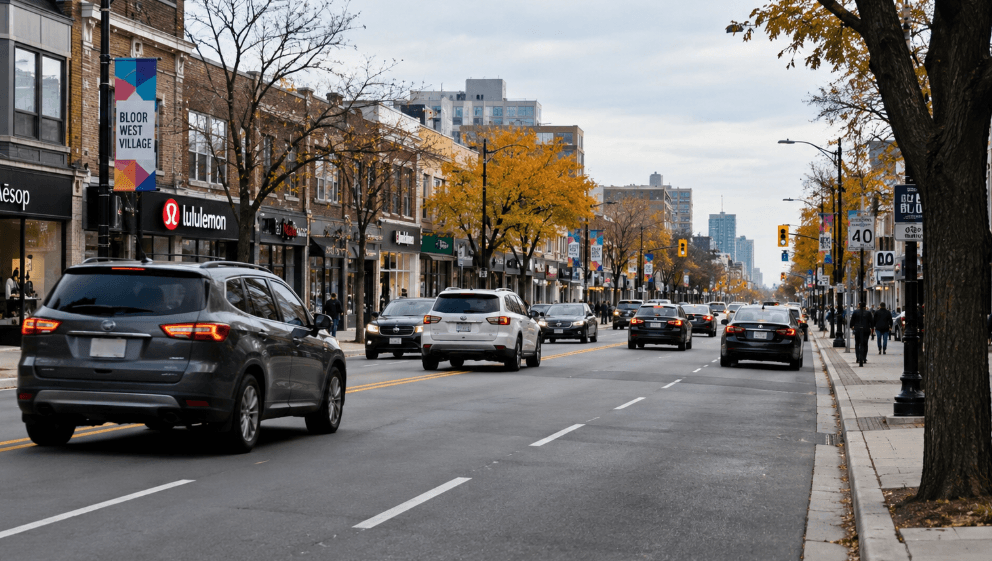
TORONTO, The Ontario government has completed the removal of bike lanes along a 1.2-kilometre stretch of Bloor Street West in Toronto, restoring motor vehicle lanes in both directions as part of its broader strategy to reduce traffic congestion and improve access to local businesses.
The completed project covers the section between Clissold Road and Royal York Road, a busy corridor serving commuters, residents and commercial establishments in Toronto’s west end.
The province says the changes are intended to increase road capacity, improve traffic movement and support economic activity by making it easier for motorists to reach businesses along the route.
Ontario Restores Traffic Capacity on Bloor Street West
The Ministry of Transportation confirmed that construction work included removing existing cycling infrastructure and completing road improvements necessary to accommodate the restored vehicle lanes.
Crews removed precast concrete curbs, traffic delineators, signs and bus pads associated with the former bike lanes. Additional work involved pavement repairs, resurfacing, updated road markings and new traffic signage.
Ontario Transportation Minister Prabmeet Sarkaria said the completed project reflects the government’s commitment to addressing congestion on major urban roads.
“We were elected with a clear mandate to fight gridlock, restore traffic lanes and get drivers moving again, and that’s exactly what we’re doing,” said Prabmeet Sarkaria, Minister of Transportation. “We’ve been clear that bike lanes belong where they make sense, not where they make congestion worse. Today, we’re delivering on our commitment to restore road capacity on Bloor Street West and get traffic moving on one of Toronto’s busiest streets.”
The government maintains that restoring vehicle capacity will improve travel conditions and accessibility for businesses operating along the corridor.
However, the announcement did not provide updated traffic measurements demonstrating how the completed changes have affected congestion or travel times.
Court Ruling Clears Path for Road Changes
Ontario Court of Appeal Decision Supports Provincial Authority
The project follows an August 2026 ruling by the Ontario Court of Appeal concerning the province’s authority over roadway design.
According to the Ministry of Transportation, the court unanimously determined that decisions involving public roadway design are policy matters within the responsibility of the elected Legislature rather than the courts.
The ruling provided legal clarity for the government’s plans to restore motor vehicle lanes on designated Toronto streets.
The province’s approach is supported by the Reducing Gridlock, Saving You Time Act, 2024 and the Plan to Protect Ontario Act, 2025, which establish requirements for restoring vehicle lanes on specified road sections.
The legislation forms part of Ontario’s broader transportation policy, which prioritizes reducing congestion while determining where cycling infrastructure can be maintained or reconfigured.
Traffic Congestion Carries Significant Economic Costs
Ontario Cites $56 Billion Annual Gridlock Burden
The government has highlighted the economic consequences of congestion as a justification for its road capacity initiatives.
A report from the Canadian Centre for Economic Analysis estimated that traffic gridlock costs Ontario approximately $56 billion annually.
Congestion can affect businesses through longer delivery times, reduced transportation efficiency, increased operating expenses and delays affecting employees and customers.
For commercial corridors such as Bloor Street West, the province argues that improved vehicle access could help support local retailers, restaurants and service providers.
The actual economic impact of removing the bike lanes on this particular section has not yet been quantified in the government’s announcement.
Additional Toronto Road Projects Under Review
Province Examining Changes to Other Major Corridors
The latest project follows an earlier modification to Bloor Street West completed in December 2025.
That work restored a vehicle lane along a 600-metre section between Resurrection Road and Clissold Road while retaining a bike lane.
In September 2026, Ontario also issued a request for proposals seeking design options for restoring vehicle lanes on additional Toronto corridors.
The proposed study covers sections of Bloor Street, Yonge Street, University Avenue, Queen’s Park, Queen’s Park Crescent and Avenue Road.
The review will also examine opportunities to preserve or reconfigure cycling infrastructure where doing so would not increase traffic congestion.
Balancing Road Capacity and Urban Transportation Needs
The completion of the Bloor Street West project represents another step in Ontario’s effort to reshape transportation infrastructure on selected Toronto roads.
While the government expects restored vehicle lanes to improve traffic flow and business accessibility, the longer-term effects on motorists, cyclists and local commercial activity will depend on actual travel patterns following the changes.
Further transportation studies and project assessments are expected to inform decisions about additional roadway modifications across Toronto.
Discover more from Wire Service Canada
Subscribe to get the latest posts sent to your email.