

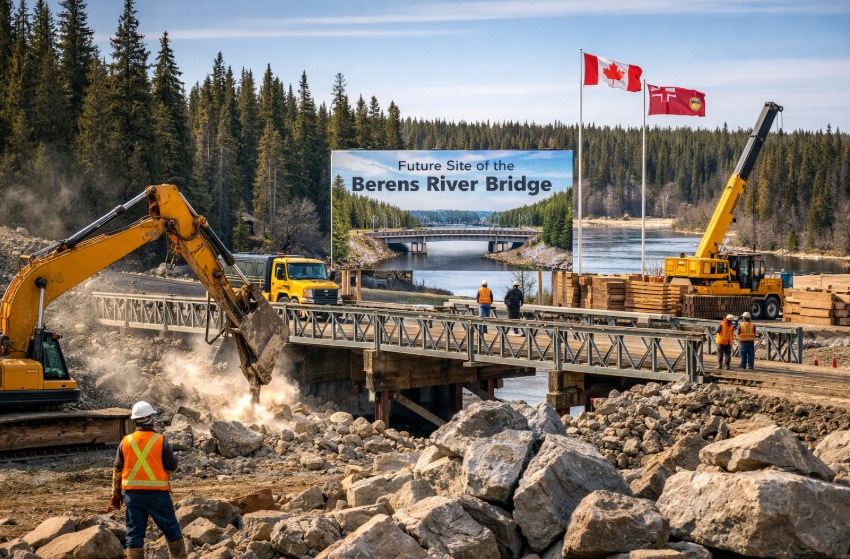
Construction has begun on a long-planned bridge across the Berens River in northwestern Ontario, a project provincial and federal officials say will improve supply chains, create jobs and unlock economic opportunities for several remote First Nations.
The Ontario government, alongside Pikangikum First Nation, the Whitefeather Forest Community Resource Management Authority and the federal government, has entered the construction phase of a permanent bridge that will connect Pikangikum First Nation to year-round road access for the first time. The project is also expected to improve winter road connections for six additional remote communities north of Red Lake and eliminate the need for a seasonal ice crossing.
“Working in partnership with the federal government and the Whitefeather Forest Community Resource Management Authority, our government is investing in critical infrastructure to build a better transportation network that will improve safety and unlock economic opportunities for communities in the North,” said George Pirie, Ontario’s Minister of Northern Economic Development and Growth. “Breaking ground on this bridge marks an important step toward delivering reliable access for remote communities, creating good-paying jobs and building a stronger, more resilient North.”
Toronto-based contractor M.D. Steele has been selected to lead construction of the mass-timber bridge, an engineered design that provincial officials say will be the first of its kind in Canada to incorporate structural mass timber into major transportation infrastructure.
Pre-construction activities are already underway, including subcontractor procurement, site mobilization and preparation of technical drawings. Aggregate blasting to produce construction materials began this week, with further work planned through spring, including installation of a temporary bridge to support construction. The permanent structure is scheduled for completion in 2028.
Once finished, the bridge is expected to serve as a key transportation link in Ontario’s remote northwest, enabling year-round access to Pikangikum First Nation while strengthening winter road routes to Poplar Hill, McDowell Lake, Deer Lake, North Spirit Lake, Sandy Lake and Keewaywin First Nations.
Provincial officials say the project is part of a broader effort to strengthen northern infrastructure, improve access to essential goods and services, and support resource development and economic growth in Indigenous communities.
Greg Rickford, Ontario’s Minister of Indigenous Affairs and First Nations Economic Reconciliation, described the project as transformational for the region.
“Through the leadership of Pikangikum First Nation, and partnerships with the federal government and Whitefeather Forest Community Resource Management Authority, we mark a milestone on regional legacy infrastructure – the Berens River Bridge. This is about improving the safety and connectivity of seven isolated First Nations communities, while unlocking the economic opportunities for future generations.”
Federal Indigenous Services Minister Mandy Gull-Masty said the project demonstrates the impact of collaboration between governments and communities.
“Reaching the pre-construction phase in the Berens River Bridge project is a significant milestone. This initiative is a prime example of what happens with the strength and vision of communities working together. Projects like this represent the kind of infrastructure we need to make winter travel safer and to support economic opportunities in Indigenous communities.”
Beyond transportation benefits, the project is also expected to support forestry-related economic activity in the Whitefeather Forest, aligning with Pikangikum First Nation’s community-based land use strategy known as Keeping the Land.
Alex Peters, president of the Whitefeather Forest Community Resource Management Authority, said the bridge reflects a long-standing vision developed by community Elders.
“The Berens River bridge was part of the vision of Pikangikum Elders for the Whitefeather Forest Initiative. It fulfills the direction they gave as they guided the development of Keeping The Land, the official land use strategy for the Whitefeather Forest. Planning included all of our clans and involved our Elders, Head Trappers, and Indigenous Knowledge experts. The Elders always began every meeting by starting with a prayer to the Creator. Planning was carried out in partnership with Ontario. The Berens River Bridge will really benefit Pikangikum and our neighbouring First Nations by providing improved access to our communities.”
Richard Wilson, president of M.D. Steele, said the project presents both engineering challenges and long-term regional benefits.
“Delivering a project of this scale and complexity in a remote environment takes creativity, partnership and commitment. This bridge is a unique engineering achievement, but its true value lies in what it enables — connecting Pikangikum, Deer Lake, Keewaywin, McDowell Lake, North Spirit Lake, Poplar Hill and Sandy Lake First Nations to dependable ground access. We’re grateful to work alongside the communities and leadership of these First Nations, whose guidance and partnership are essential to doing this work the right way. As the first phase of a larger vision, this project helps lay the foundation for long-term connectivity, opportunity and shared progress.”
The bridge project was first announced in August 2024 as part of a joint commitment to build an all-season road to Pikangikum First Nation. Provincial officials say the investment is intended to strengthen northern supply chains, improve safety and expand economic participation across Ontario’s remote northwest.