

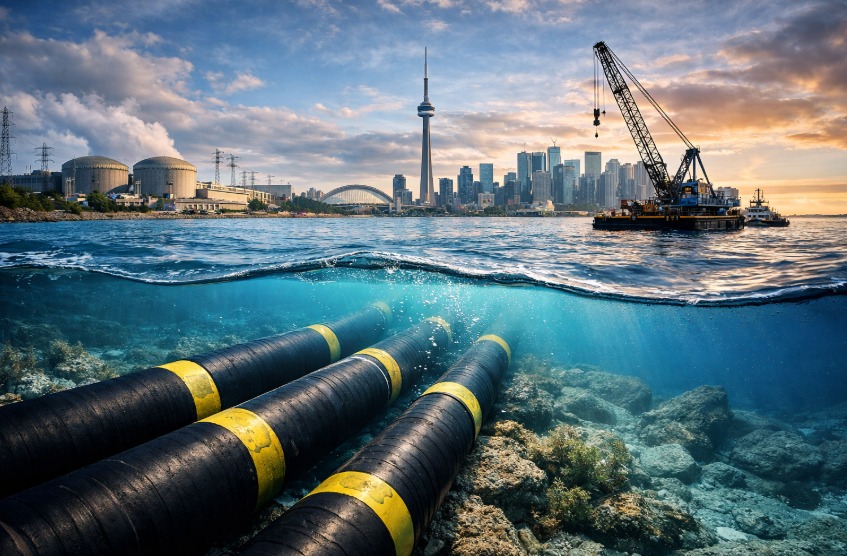
The Ontario government has approved plans for a new high-voltage underwater electricity transmission line into Toronto, a project it says is essential to sustaining economic growth, enabling housing construction and ensuring reliable power as demand in the city accelerates over the coming decades.
The decision follows a recommendation from the Independent Electricity System Operator (IESO) and marks the province’s first IESO-led competitive transmission procurement process. The proposed line would run underwater from near the Darlington Nuclear Generating Station to Toronto’s downtown core and eastern areas, delivering up to 900 megawatts of clean, reliable electricity. Provincial officials say that capacity will be critical as Toronto’s electricity demand is projected to roughly double by 2050.
“As we start 2026, we are focused on strengthening Ontario’s economy and creating jobs,” said Stephen Lecce, Minister of Energy and Mines. “Without a new transmission line, Toronto would have to turn down job-creating investments and reduce housing, which is simply unacceptable. We are thinking ahead and building for the future by approving a new transmission line that will enable 285,000 new homes, power new businesses, and create thousands of jobs. We are also initiating the first IESO-led competitive transmission procurement to reduce costs and maximize benefits for families.”
Toronto is currently supplied by two major transmission lines, one from the west through Manby Transmission Station and one from the east through Leaside Transmission Station. According to the province, both pathways are expected to begin reaching their capacity limits in the 2030s, even as the city experiences record population growth, intensified downtown development and expanding transit electrification. A third transmission line would add 900 megawatts of capacity—an amount the government says is equivalent to the output of three small modular reactors or enough electricity to power approximately 900,000 homes.
Mayor Olivia Chow welcomed the announcement, framing the project as a cornerstone of Toronto’s long-term infrastructure planning. “Toronto is the fastest-growing city in North America, and that growth means we need more power to fuel our homes, transit, and businesses,” she said. “I want to applaud the Ontario government for moving forward with this first-of-its-kind underwater transmission line. It’s an exciting example of the province and city working together to build resilient, clean energy infrastructure that keeps costs down, supports good-paying jobs, and powers the projects that will shape Toronto’s future.”
The government plans to have the IESO lead a competitive procurement process to select a transmitter, informed by consultations on procurement design. Officials say the approach is intended to drive value for ratepayers while accelerating timelines and creating opportunities for Indigenous participation and employment across Ontario.
Beyond capacity, the underwater route is being promoted as a resilience measure. Provincial estimates suggest that extreme weather events such as flooding or ice storms have previously resulted in electricity supply disruptions costing between $100 million and $200 million in lost productivity. An underwater cable would be less exposed to such risks and could reduce the need for additional bulk system reinforcements elsewhere in the Greater Toronto Area, with preliminary estimated savings of $100 million to $300 million.
Development, construction and commissioning of the third line are expected to take between seven and 10 years, underscoring the province’s emphasis on early action. The IESO’s recommendation follows extensive technical analysis of multiple options, with a focus on minimizing land-use impacts by leveraging existing corridors, underground infrastructure and established pathways. Details of the proposal are outlined in the 2025 Toronto Integrated Regional Resource Plan.
Energy and housing stakeholders broadly endorsed the decision, citing its implications for investment certainty and affordability. “Building out transmission infrastructure is a key piece of our long-term integrated energy plan to meet the rapidly growing electricity demand in Ontario,” said Sam Oosterhoff, Associate Minister of Energy-Intensive Industries. “This investment will not only enhance Ontario’s energy self-reliance and grid security, but will create good-paying jobs, keep rates competitive for industries, and support foundational projects in Toronto for decades to come.”
Business and development groups echoed that view, arguing that electricity capacity has become a binding constraint on growth. Industry leaders from the Toronto Region Board of Trade, Toronto Hydro, the Ontario Energy Association and housing organizations said the new line would provide the reliability and scale needed to unlock housing supply, transit expansion and private investment.
The project forms part of Energy for Generations, Ontario’s integrated energy plan aimed at ensuring the province has sufficient, affordable power to support population growth, electrification and industrial competitiveness. With Toronto accounting for roughly 20 per cent of Ontario’s peak electricity demand, provincial officials say the new transmission line is not only a local infrastructure project, but a strategic investment in the province’s broader economic future.
