

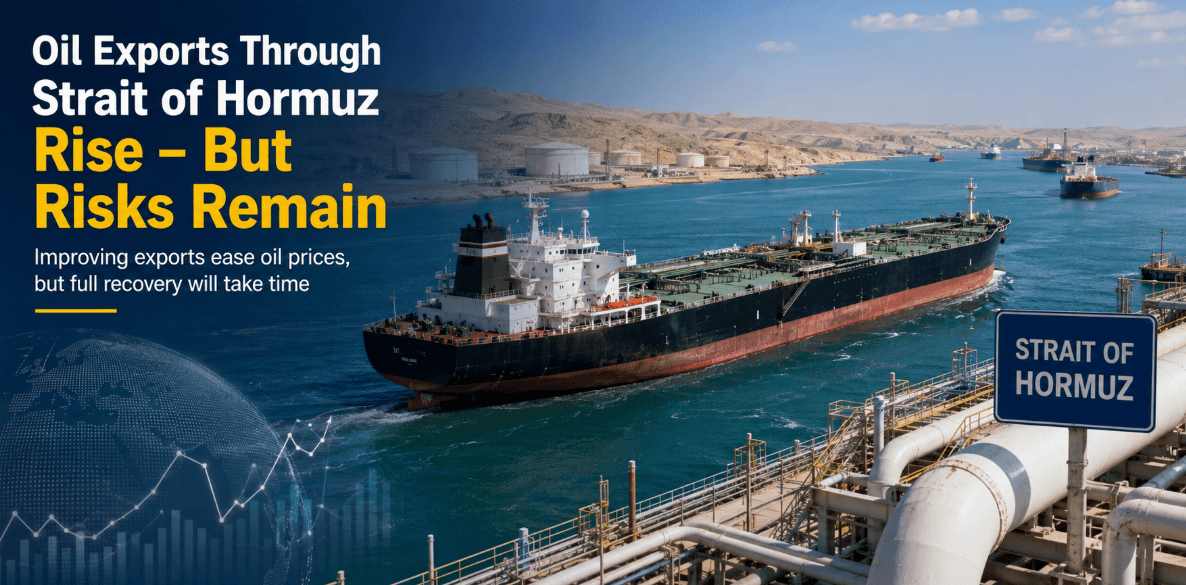
Oil Market Stabilizes, but Risks Persist
Global oil markets are showing signs of stabilization after months of disruption caused by the Strait of Hormuz crisis, with fuel exports through the vital shipping corridor beginning to recover. The improvement follows an interim agreement reached between the United States and Iran in mid-June aimed at reopening the Strait and establishing a framework for a longer-term peace process.
According to the latest International Energy Agency (IEA) Oil Market Report, the return of oil flows has helped ease pressure on global energy markets and contributed to a significant decline in oil prices in recent weeks. However, the agency cautions that a full recovery remains some distance away.
Mines still need to be cleared from shipping lanes, while tanker traffic, logistics networks and supply chains require time to return to normal operating conditions. Even so, expectations of increased export volumes are providing some relief to energy markets ahead of the peak summer demand season.
Global Oil Demand Falls Sharply
The crisis has significantly altered global energy consumption patterns. Rising prices and supply concerns prompted many consumers to reduce energy usage, while governments introduced measures designed to shield households and businesses from higher costs, particularly across the Asia-Pacific region.
The IEA now forecasts that global oil demand in the second quarter of 2026 will be nearly five million barrels per day lower than during the same period last year, reflecting the scale of the market adjustment.
One of the most significant shifts came from China, where crude oil imports dropped dramatically between February and May. Imports fell by 40 per cent, equivalent to 4.6 million barrels per day, helping to ease pressure on global supplies during the height of the disruption.
Supply Chains Adapt to Historic Disruption
The agency highlighted several major developments that helped the market absorb what has been described as the largest oil market disruption in history.
Higher oil prices encouraged companies to draw down inventories at record rates, while the IEA coordinated its largest-ever release of emergency oil stocks to bring additional supply to market.
At the same time, Gulf producers increased exports through alternative routes that bypassed the Strait of Hormuz. Additional crude shipments from other producing nations, particularly the United States, also helped offset losses.
Refiners around the world rapidly adjusted operations to compensate not only for reduced Middle Eastern crude supplies but also for the sharp decline in exports of refined petroleum products from the region.
Despite these adjustments, the IEA warned that the market outlook remains highly uncertain and that developments in the region will continue to be monitored closely.
Southeast Asia Faces Growing Energy Security Challenges
The crisis has also highlighted deeper structural vulnerabilities in Southeast Asia’s energy system.
In its newly released Southeast Asia Energy Outlook 2026, the IEA argues that the disruption of oil and gas flows through the Strait of Hormuz has underscored the region’s dependence on imported energy and the need for greater diversification.
While governments have introduced short-term measures to curb energy consumption, including work-from-home initiatives, the report suggests more fundamental changes are needed to strengthen long-term energy security and affordability.
Under current policy settings, Southeast Asia’s annual energy import bill is projected to reach US$400 billion by 2050, equivalent to roughly five per cent of the region’s economy.
The report indicates that diversifying energy sources and strengthening resilience will become increasingly important as energy demand continues to grow across the region.
Energy Efficiency Moves to the Forefront
The ongoing crisis is also shaping policy discussions far beyond the Middle East and Asia.
Energy efficiency has emerged as a central focus for governments seeking to reduce vulnerability to future supply shocks while lowering costs and emissions.
That issue is taking centre stage at the 11th IEA Global Conference on Energy Efficiency, which opened in Montreal. The event is co-chaired by Canada’s Minister of Energy and Natural Resources Tim Hodgson, Minister of Environment and Climate Change Julie Dabrusin, and IEA Executive Director Fatih Birol.
More than 600 participants, including energy ministers, corporate executives and international policy leaders, are attending discussions focused on accelerating energy efficiency improvements across economies.
Critical Minerals and Hydrogen Security Gain Attention
Beyond oil markets, policymakers are increasingly focused on broader energy security concerns.
G7 leaders recently announced new commitments aimed at strengthening critical mineral supply chains, including a request for the IEA to help establish a cooperative mechanism to address potential supply disruptions and price volatility.
Meanwhile, the agency’s latest Global Hydrogen Review found that the Middle East conflict has exposed vulnerabilities in hydrogen-related supply chains that support fertilizer production, refining and chemical manufacturing worldwide.
Although global demand for hydrogen exceeded 100 million tonnes in 2025 and low-emissions hydrogen production continued to grow, the report notes that high costs, uncertain demand, regulatory challenges and infrastructure gaps continue to slow development.
As oil exports gradually recover and markets adapt, the broader energy crisis is prompting governments and industry leaders to reassess supply chain resilience, energy diversification and long-term security strategies. While immediate pressures have eased, policymakers remain focused on reducing vulnerabilities that the Strait of Hormuz disruption exposed across the global energy system.
Discover more from Wire Service Canada
Subscribe to get the latest posts sent to your email.