

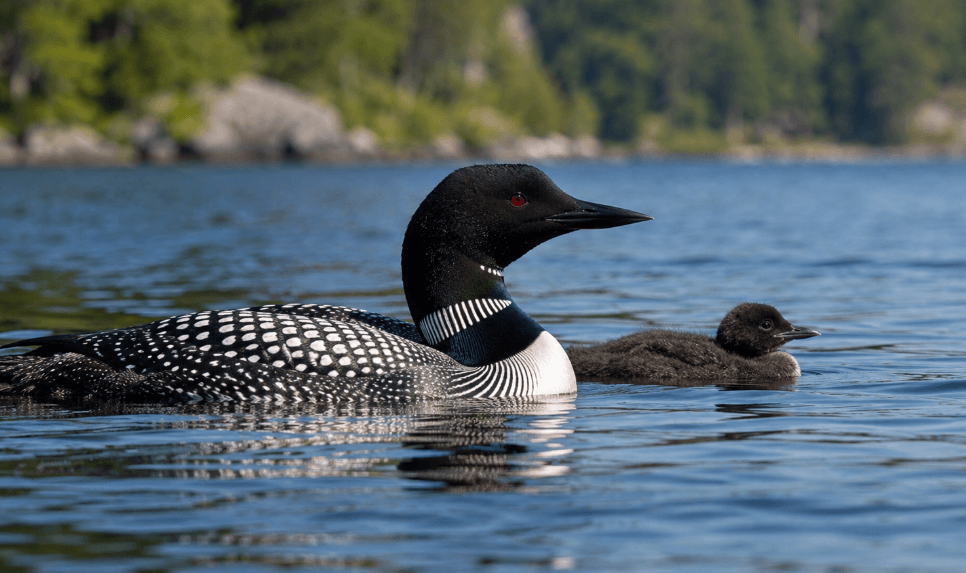
PORT ROWAN, Ontario, A major international study has revealed a substantial decline in Common Loon chick production across much of North America, raising concerns about the long-term future of one of Canada’s most recognizable waterbirds.
Published in the scientific journal FACETS, the research found that Common Loon productivity has fallen by approximately 40% on average over several decades across 10 of the 12 regions examined. Researchers identified climate change, human disturbance and habitat loss as potential contributors to the widespread declines.
The findings highlight growing environmental pressures on a species closely associated with Canada’s freshwater ecosystems and northern wilderness.
Common Loon Populations Face Significant Reproductive Declines
The study examined more than 45,000 Common Loon nesting records collected across Canada and the United States, providing one of the most comprehensive assessments of the species’ reproductive performance.
Researchers documented long-term declines in British Columbia, the Prairie provinces, Ontario, the Atlantic provinces, Washington, Wisconsin, New York, Vermont, New Hampshire and Massachusetts.
Québec and Maine were the only regions where chick production remained relatively stable or showed modest improvements.
“By analyzing more than 45,000 Common Loon nesting records from 12 regions across Canada and the U.S., we found that productivity has been declining steadily in many regions over the past several decades.” – co-author, Dr. Doug Tozer, Birds Canada
The research represents a large-scale international collaboration involving scientists and conservation organizations working to understand the challenges affecting Common Loon breeding populations.
Atlantic and Prairie Provinces Record Steepest Declines
The most significant reductions were recorded in Canada’s Atlantic and Prairie provinces.
In Atlantic Canada, Common Loon productivity declined by an average of 2.39% annually between 1992 and 2023, representing a cumulative reduction of 74%.
The Prairie provinces experienced an annual decline of 2.09% over the same period, resulting in an overall decrease of 65%.
Ontario also recorded a substantial reduction, with chick production falling 45% between 1981 and 2023.
British Columbia and Québec experienced comparatively smaller long-term changes, although the broader findings indicate persistent reproductive challenges across much of the species’ breeding range.
Climate Change and Habitat Pressures Raise Conservation Concerns
Researchers identified climate change as the most likely major factor contributing to declining chick production, although multiple environmental pressures may be involved.
Changes in freshwater ecosystems, disturbance from recreational activities and habitat loss associated with development are among the challenges affecting Common Loons.
Birds Canada is investigating whether changes in lake water clarity can help explain declining chick production across the southern portion of the species’ breeding range.
The findings carry particular significance for Canada, which supports approximately 94% of the world’s estimated 254,000 breeding pairs of Common Loons.
That concentration places considerable responsibility on Canadian conservation programs and freshwater habitat management.
Volunteer Monitoring Plays a Central Role in Research
Citizen scientists made a substantial contribution to the study, with approximately half of the research data collected through Birds Canada’s Canadian Lakes Loon Survey.
Thousands of volunteers participated in monitoring loon nesting activity and chick production, helping researchers build long-term datasets across geographically diverse regions.
Their involvement demonstrates the importance of community-based environmental monitoring in identifying ecological changes that might otherwise remain difficult to measure.
“Even though chick production has decreased substantially over the past several decades all is not lost, some lakes still have high loon chick production and one reason for this is the care and management local volunteers provide to encourage healthy lake habitats and recreational behaviours that are beneficial to Common Loons. ” – lead author, Dr. Matthew Fuirst, Birds Canada
Conservation Measures Could Help Protect Common Loons
Despite the declines, researchers say practical conservation measures can improve conditions for breeding Common Loons.
Birds Canada encourages residents and recreational lake users to participate in monitoring programs, use non-toxic lead-free fishing tackle and dispose of fishing lines and plastics responsibly.
Boaters are also encouraged to reduce their speed and maintain sufficient distance from loons to minimize disturbance.
The organization and its research partners are continuing to investigate the causes of declining chick production and identify additional conservation strategies.
Although the study documents a substantial reduction in reproductive success, it does not establish an equivalent decline in the overall adult population.
Nevertheless, sustained reductions in chick production could have long-term implications for population stability, reinforcing the importance of continued monitoring, habitat protection and coordinated conservation efforts across North America.
Discover more from Wire Service Canada
Subscribe to get the latest posts sent to your email.