

Landmark Monsanto v. Durnell Case Raises Questions on Public Health and Corporate Accountability
WASHINGTON — A closely watched U.S. Supreme Court case examining whether pesticide manufacturers can avoid liability for failing to warn consumers about health risks is drawing sharp attention from legal advocates, scientists and industry stakeholders.
At the centre of the dispute is Monsanto v. Durnell, a case that could redefine the balance between federal pesticide regulations and the rights of individuals and states to pursue stronger safety standards. The Center for Food Safety (CFS), a U.S.-based nonprofit focused on food and agriculture policy, is directly involved in the litigation and has filed a supporting brief alongside allied organizations.
The case was argued before the Supreme Court on Tuesday, with a ruling expected by late June.
Potential Implications for Consumers and State Authority
Legal observers say the outcome could have sweeping consequences for Americans’ ability to access information about pesticide risks and seek compensation for alleged harm.
The case tests whether federal pesticide law can override state-level requirements for warning labels or legal claims tied to health impacts. If the court rules in favour of Monsanto, it could limit states’ authority to impose stricter protections and potentially shield manufacturers from liability.
CFS argues that such a decision would undermine public health protections and erode long-standing rights to transparency.
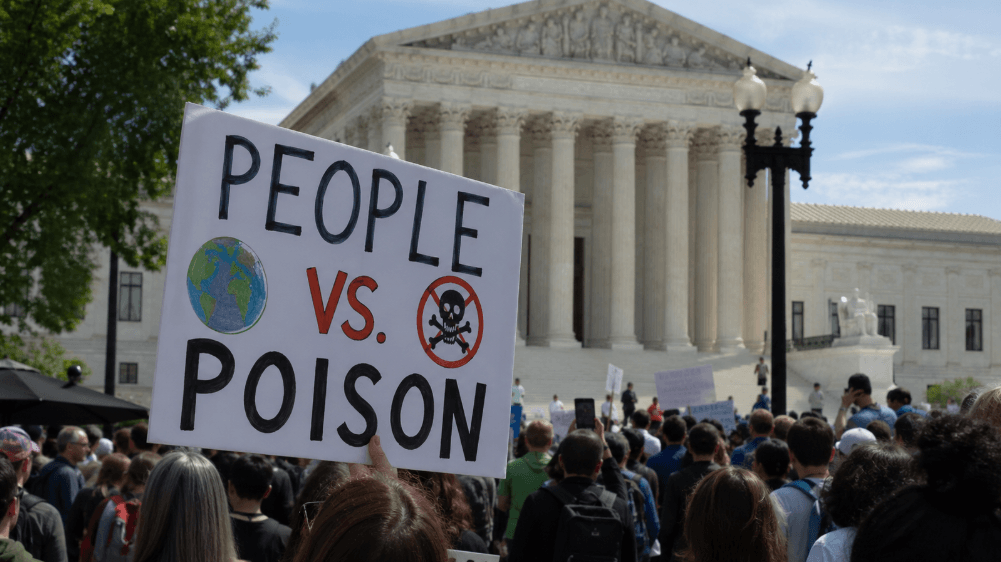
The organization has also sought to elevate public awareness through advocacy campaigns and participation in the “People vs. Poison” rally held in conjunction with the court hearing.
Scientific Concerns Highlighted in Court Filings
Ahead of the hearing, CFS released a scientific analysis supporting its legal arguments, asserting that U.S. regulators have approved pesticide ingredients despite identifying potential cancer risks.
According to the analysis, the U.S. Environmental Protection Agency (EPA) has classified approximately 200 pesticide active ingredients over the past four decades as either “likely” or “possible” carcinogens. Despite this, warning labels indicating cancer risks are rarely included on approved pesticide products.
The report further claims that some approved substances pose cancer risks as high as 7 in 1,000 among exposed individuals.
Glyphosate at the Centre of the Dispute
While the legal issues extend beyond any single chemical, the case is closely tied to glyphosate, the active ingredient in Monsanto’s widely used herbicide Roundup.
Glyphosate use has surged since the 1990s, following the introduction of genetically engineered crops designed to withstand the chemical. Today, it is one of the most heavily applied pesticides in the United States, with hundreds of millions of pounds used annually across vast agricultural areas.
Due to its widespread use, glyphosate residues have been detected in food, soil, water and even human bodies, according to multiple studies.
In 2015, the International Agency for Research on Cancer classified glyphosate as “probably carcinogenic to humans,” citing evidence from both human and animal studies.
Ongoing Litigation and Financial Exposure
Monsanto, now owned by Bayer following a 2018 acquisition, has faced extensive litigation over claims that it failed to warn users about cancer risks associated with Roundup.
Juries in several cases have sided with plaintiffs, finding that exposure to the herbicide contributed to non-Hodgkin lymphoma and that the company did not adequately disclose potential dangers.
Bayer has already paid roughly $10 billion to settle approximately 100,000 cases. However, tens of thousands of claims remain active, and earlier this year the company proposed an additional $7.25 billion settlement to address ongoing litigation.
Regulatory Disputes Continue
The case also intersects with broader disagreements over federal regulatory assessments.
In 2020, the EPA concluded that glyphosate was “not likely to be carcinogenic to humans” and did not identify significant health risks. That determination was challenged by CFS and other groups.
In 2022, a federal court struck down the EPA’s assessment, citing inconsistencies with scientific evidence and violations of the agency’s own cancer evaluation guidelines.
Broader Industry Impact
Legal experts note that the Supreme Court’s ruling could extend far beyond glyphosate.
A decision favouring Monsanto may establish a precedent limiting state-level warning requirements and reducing manufacturers’ exposure to lawsuits over health risks. Conversely, a ruling against the company could reinforce states’ rights to impose stricter safety standards and expand legal avenues for individuals seeking compensation.
For now, the agricultural and chemical industries, along with public health advocates, are closely monitoring the case, which could reshape regulatory and legal frameworks governing pesticide use for years to come.