

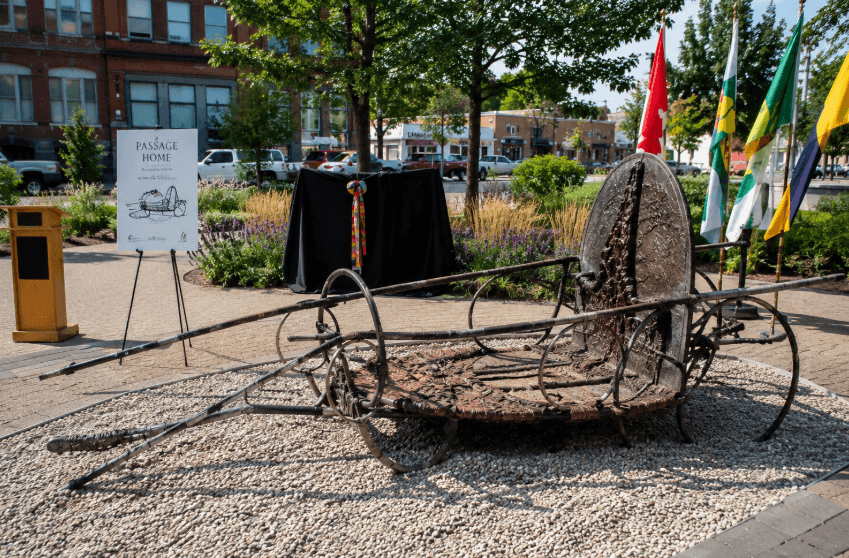
The City of Prince Albert has formally dedicated Passage Home and Healing Park, a new public artwork and community gathering space at Scarrow Plaza that commemorates Indigenous children who died away from home and honours Survivors and families affected by day schools, residential schools and the Sixties Scoop.
The dedication was held alongside a commemoration marking the 150th anniversary of the signing of Treaty Six. The event was presented by Common Weal Community Arts and the City of Prince Albert Public Art Working Group.
Passage Home Creates a Space for Remembrance and Healing
The public art project was developed through the City of Prince Albert’s Public Art Policy and Public Art Working Group in collaboration with Mary Longman (Askîypiyêsiwiskwêw), a Saulteaux artist from Gordon’s First Nation.
At the centre of the project is Passage Home, a bronze memorial sculpture situated within a public healing park. Together, the artwork and surrounding space are intended to function as a memorial, a place for reflection and a gathering site for the wider community.
The project is dedicated to Indigenous children who died away from their families and home territories, as well as those who continue to find their way home as a result of Canada’s day school and residential school systems and the Sixties Scoop.
It also recognizes Survivors and family members who continue to experience grief and pursue healing from the lasting effects of those policies.
Bronze Sculpture Draws on Traditional Akotâpân
Travois Symbolizes a Safe Journey Home
Longman’s bronze sculpture is based on the form of a traditional akotâpân, or travois. Within the memorial, the form symbolically offers safe passage for children to return to their families and territories of origin and to rest in peace.
For generations, Indigenous Peoples of the Plains used the akotâpân to transport children and belongings. The structure was originally pulled by an atim, or dog, and later by a misatim, or horse.
Traditionally lined with bison hides, the travois provided children with a soft and secure place while families travelled.
By incorporating the form into the memorial, Passage Home connects the contemporary public artwork with Indigenous traditions while emphasizing themes of family, belonging and returning home.
City Says Understanding History Is Essential to Reconciliation
Judy MacLeod Campbell, Arts & Culture Manager, said the installation carries significant meaning for Prince Albert and its residents.
“Passage Home is an incredibly meaningful public artwork for our city. It serves as a commemoration of the Survivors of residential schools, day schools, and the Sixties Scoop and their families. Understanding the truths of our history is vital to reconciliation and creating a better future for generations to come,” said Judy MacLeod Campbell, Arts & Culture Manager. “Together, the sculpture and healing park create a space for remembrance, reflection, grief, and healing.”
The dedication coinciding with the Treaty Six anniversary also places the artwork within a broader historical context for Saskatchewan and the Prairies.
Treaty Six remains an important part of the relationship between First Nations and the Crown, while the new installation provides a permanent location in Prince Albert where residents and visitors can consider both historical experiences and their continuing impact.
Public Art Project Receives Support From Canadian Organizations
The project received assistance from several arts, cultural and community organizations.
Supporters include the Canada Council for the Arts, Canadian Heritage, SK Arts, Sask Lotteries, SaskCulture, Northern Lights Community Development Corporation and Common Weal Community Arts.
The City of Prince Albert said the contributions of those organizations, along with Longman’s artistic work, were important to completing a project of this scale and significance.
Healing Park Becomes a Permanent Community Gathering Place
With the dedication complete, Passage Home and Healing Park becomes part of Prince Albert’s public art collection and a permanent space for remembrance and community reflection at Scarrow Plaza.
The city is encouraging residents and visitors to spend time at the sculpture and consider its meaning, particularly the experiences of Indigenous children, Survivors and families affected by Canada’s residential and day school systems and the Sixties Scoop.
Through the combination of Longman’s bronze sculpture and the surrounding healing park, the project establishes a lasting public space intended to support remembrance, reflection, grief and healing.
Discover more from Wire Service Canada
Subscribe to get the latest posts sent to your email.