

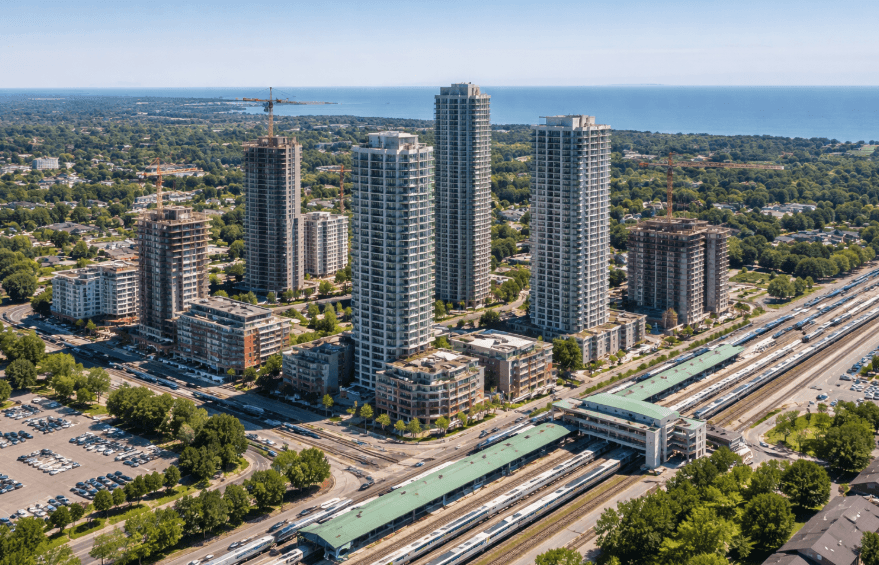
Ontario moves ahead with Oakville GO transit-oriented community plan
The Ontario government has issued four Minister’s Zoning Orders (MZOs) to advance a major transit-oriented development near Oakville GO Station, a project expected to deliver more than 6,800 new homes and support thousands of jobs as the province pushes to accelerate housing construction across the Greater Golden Horseshoe.
The development, planned for Midtown Oakville, is intended to create a mixed-use community surrounding one of the busiest GO Transit stations in the region. In addition to new housing, the project will include public spaces, parks, bike paths, a day care and improved pedestrian access to the station.
Ontario said the project is expected to generate nearly 4,000 construction jobs and approximately 400 long-term jobs once completed.
Province cites housing crisis as driver for accelerated approvals
The zoning orders mark the latest step in Ontario’s broader strategy to address what it has described as a generational housing crisis by increasing density near major transit hubs.
The province said the Oakville transit-oriented community aligns with the municipality’s target of building 33,000 new homes by 2031 and follows consultations with the Town of Oakville dating back to 2024, along with public meetings and community engagement sessions.
“As a key partner in delivering the Oakville TOC, we have been working closely with the Town of Oakville and value their feedback as we work on making refinements to the TOC design, including opportunities for adjustments to the building heights to better reflect local input,” said Todd McCarthy, Acting Minister of Infrastructure. “We look forward to continuing to work with the town as part of our government’s plan to deliver faster, more reliable and seamless transit with more housing, jobs and community amenities near transit stations across the Greater Golden Horseshoe.”
Building heights revised after community feedback
Ontario said it is continuing to refine the development plan in response to concerns raised by residents and municipal officials, including reducing proposed building heights to 38 storeys while maintaining the planned number of housing units and community amenities.
The province said the revisions are being developed in partnership with the municipality and other stakeholders.
Stephen Crawford, Oakville’s Member of Provincial Parliament, said the province has responded to local concerns while preserving the project’s housing objectives.
“As Oakville’s MPP, I’ve been strongly advocating for a balanced approach to the Midtown Transit-Oriented Community — one that delivers much-needed new homes and jobs while clearly responding to feedback from residents and the Town. I’m encouraged that the province has heard those concerns and is committed to working with the town to further refine the project while maintaining the number of homes and benefits to the community. I will continue working closely with the province, Mayor Burton and Council to ensure this development is shaped in a way that works for Oakville today and for generations to come.”
Oakville Mayor Rob Burton also welcomed the province’s willingness to adjust the project.
“I want to thank Premier Ford, Minister McCarthy, Minister Sarkaria, Minister Flack, Minister Crawford and Deputy Speaker Triantafilopoulos for their commitment to working with the Town to ensure the TOC better reflects the concerns of our community. This is an important step forward, and our work and advocacy on behalf of residents will continue.”
Infrastructure investments support broader housing push
Ontario said it has invested more than $44 million in Oakville since 2024 through housing-enabling and community infrastructure programs, including the Building Faster Fund and Municipal Housing Infrastructure Program.
That funding includes support for the expansion of the Oakville Water Treatment Plant, a project the province said will increase water production capacity and enable the construction of approximately 25,000 new homes.
The Oakville GO Station development is part of Ontario’s wider transit-oriented communities strategy, under which the province is planning similar projects along subway, GO Transit and light rail corridors across the Greater Golden Horseshoe.
According to the government, those developments could collectively deliver up to 292,000 homes and support more than 84,000 jobs.
Partnership model aimed at offsetting transit costs
The province is partnering with Distrikt Developments on the Oakville project, part of a model Ontario says helps offset the cost of expanding transit infrastructure by leveraging private-sector investment.
Oakville GO Station is the second busiest stop on the Lakeshore West Line after Union Station, making it a key site for intensified residential development tied to public transit access.
The Oakville transit-oriented community also forms part of the broader Canada-Ontario housing partnership, under which the province and federal government are pursuing measures including the removal of HST on new home construction, reductions to development charges and infrastructure funding for major transit projects.
Outlook
With zoning approvals now in place, the Oakville GO Station development moves closer to construction as Ontario seeks to accelerate housing starts and intensify development around transit hubs.
The province has not yet provided a construction timeline for the project.
If you want, I can make it even more Reuters-style/Canadian Press-style by tightening the wording further for a more wire-service newsroom tone.
Discover more from Wire Service Canada
Subscribe to get the latest posts sent to your email.