

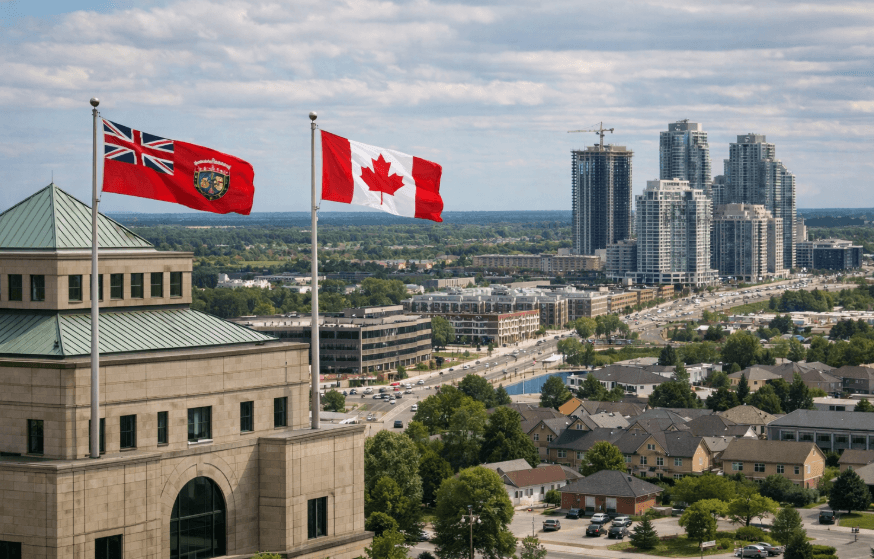
Proposed “strong chair” powers and council reductions aim to accelerate housing and cut municipal costs
TORONTO — Ontario government tables Better Regional Governance Act, 2026
The Ontario government has introduced new legislation aimed at reshaping how regional governments operate across several of the province’s fastest-growing areas, with a focus on speeding up decision-making, reducing costs and supporting housing and infrastructure development.
The proposed Better Regional Governance Act, 2026, tabled Thursday, would grant the province expanded authority over upper-tier municipal leadership and restructure council compositions in select regions. The move reflects Queen’s Park’s broader push to align local governance more closely with provincial priorities, particularly in housing supply and economic growth.
“We will always support our municipal partners, both lower- and upper-tier, in delivering locally led solutions that offer better value for taxpayers and speed up decision-making,” said Rob Flack, Minister of Municipal Affairs and Housing. “These changes provide the necessary tools for local leadership to advance our shared priorities and better serve our communities, including by expediting housing and infrastructure development.”
Expanded provincial authority over regional leadership
At the centre of the proposed legislation is a significant shift in how regional chairs are selected. The bill would allow the Minister of Municipal Affairs and Housing to appoint regional chairs in Durham, Halton, Muskoka, Niagara, Peel, Waterloo and York, along with the warden of Simcoe County.
Previously, the province’s authority to appoint chairs was limited to Niagara, Peel and York, and only for the 2022–2026 council term.
Under the new framework, appointed chairs would also receive “strong chair” powers, similar to those granted to certain mayors in Ontario. These enhanced powers are designed to streamline governance by enabling chairs to advance provincial priorities more efficiently, particularly in areas such as housing construction and infrastructure planning.
The government argues that consolidating authority in this way will reduce delays often associated with multi-tiered municipal decision-making processes.
Council size reductions in Niagara and Simcoe
The legislation also proposes structural changes to regional councils in Niagara Region and Simcoe County, where the province says governance has become costly and inefficient due to large council sizes.
Niagara Region currently has 126 elected officials across its upper- and lower-tier governments, while Simcoe County’s upper-tier council has 32 members. By comparison, Toronto’s city council has 26 members serving a population of more than three million.
To address this disparity, the province is proposing to reduce Simcoe County Council from 32 members to 17. The restructured council would include the mayors of the county’s 16 lower-tier municipalities and the warden.
In Niagara, the regional council would shrink from 32 members to 13, composed of the mayors of the region’s 12 lower-tier municipalities plus the regional chair.
The government maintains that these changes will lower administrative costs for taxpayers while improving decision-making efficiency.
Weighted voting to balance representation
To ensure representation remains equitable despite smaller councils, the province plans to work with municipalities to implement or refine weighted voting systems. Under such systems, council members may carry different voting weights based on factors such as population or number of electors.
Weighted voting is already in place in Simcoe County and would be introduced in Niagara Region as part of the transition.
The proposed legislation would also grant the Minister authority to establish rules governing weighted voting for upper-tier councils beginning with the term following the 2026 municipal election.
Transition timeline and municipal response
All upper-tier municipalities in Ontario are required to review their council composition following the 2026 municipal election. However, Niagara Region would be exempt from this requirement until after the 2034 election to allow time for the new structure to stabilize.
The province said it is introducing the legislation ahead of the May 1, 2026 nomination deadline to give prospective candidates and municipalities time to prepare for the fall election.
The changes follow previous attempts by municipalities such as Simcoe County to reduce council size independently. In that case, despite support from both county council and a majority of lower-tier municipalities representing most eligible voters, the proposal failed due to a tie vote among municipalities.
Broader economic and housing implications
The Ontario government frames the proposed reforms as part of a broader strategy to support population growth, housing supply and economic development.
By centralizing leadership authority and reducing governance complexity, the province aims to accelerate infrastructure projects and housing approvals—key priorities as Ontario continues to face housing affordability challenges.
Officials say the legislation represents an effort to modernize regional governance structures to better reflect the needs of rapidly expanding communities, while ensuring closer alignment between municipal actions and provincial objectives.
If passed, the Better Regional Governance Act, 2026 would mark one of the most significant overhauls of Ontario’s regional governance framework in recent years.
Discover more from Wire Service Canada
Subscribe to get the latest posts sent to your email.