

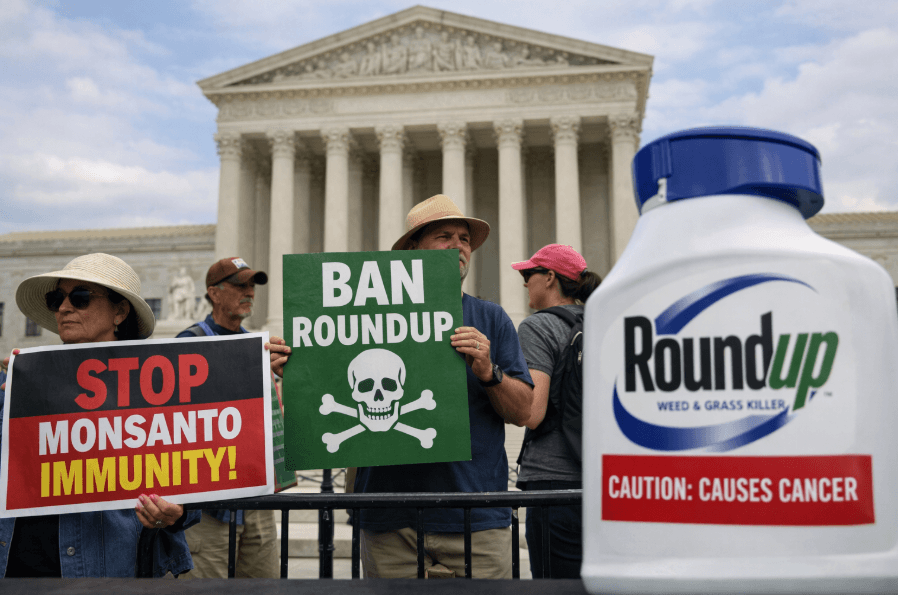
Nonprofits warn ruling could undermine public health protections and state authority
WASHINGTON, D.C. — A coalition of consumer advocacy, public health, and environmental organizations is urging the U.S. Supreme Court to reject an effort by pesticide manufacturer Monsanto to limit its liability over cancer-related warnings tied to its flagship herbicide, Roundup.
In a legal brief filed this week in the case Monsanto v. Durnell, the groups argue that granting the company immunity would weaken longstanding state-level protections designed to inform the public about potential health risks. The coalition, represented by the Center for Food Safety (CFS), contends that state warning requirements play a critical role in safeguarding consumers and workers.
For more than a decade, juries across the United States have found Monsanto liable for failing to warn users about the cancer risks associated with Roundup, awarding billions of dollars in damages. Monsanto, now owned by Bayer, is seeking a Supreme Court ruling that would shield it from future claims.
Legal challenge centres on federal versus state authority
At the heart of the case is whether federal oversight by the Environmental Protection Agency (EPA) preempts state-level requirements for warning labels.
Monsanto argues that the EPA’s safety assessments are sufficient and should override state-imposed obligations. However, the nonprofit coalition points to a 2022 federal court ruling that struck down the EPA’s review of glyphosate — Roundup’s active ingredient — as inconsistent with legal and scientific standards.
“Monsanto’s self-interested desire that it and EPA be the sole arbiters of pesticides’ safety would vitiate the long tradition of cooperative federal-state roles in protecting the public health,” said George Kimbrell, Legal Director at Center for Food Safety. “Their position seeking to escape accountability for their toxic products is wrong every possible way: legally, scientifically, and factually.”
Health concerns and regulatory gaps highlighted
The coalition’s filing underscores broader concerns about pesticide exposure, linking it to cancer, neurological disorders, immune system damage, and reproductive health issues.
Two recent studies cited in the brief found that the EPA has frequently approved pesticides it acknowledges carry cancer risks, while rarely requiring warning labels. The groups argue this regulatory gap makes state-level action essential.
“The science is clear: cancer-causing chemicals in our food, consumer products, and environment are driving rising rates of breast cancer,” said Janet Nudelman, Senior Director of Program and Policy at Breast Cancer Prevention Partners. “People have an absolute right to know when these same chemicals are in their weed killer and migrating into their food and then into their bodies. And the companies making these dangerous products have the responsibility to tell them. Yet Monsanto wants to strip states of the power to warn the public and workers about these unsafe exposures. That’s not just legally wrong — it’s dishonest and a betrayal of every person who has ever been diagnosed with cancer and never knew why.”
Advocates also emphasized the risks faced by agricultural workers.
“Farmers and farmworkers are on the frontlines of our food system,” said Lorette Picciano, executive director of Rural Coalition, “They have the right to be protected from dangerous chemicals that cause cancer, reproductive harms, and even autoimmune diseases while they do their jobs to put food on our tables.”
Industry accountability and ongoing litigation
The case carries significant financial and legal implications for Bayer, which acquired Monsanto in 2018. The company has already paid roughly $10 billion to settle approximately 100,000 lawsuits related to non-Hodgkin lymphoma (NHL), with tens of thousands of cases still pending.
“With this case, Bayer/Monsanto seeks to undermine a foundational principle of law and commerce—that people using hazardous pesticides linked to cancer and other illness must be warned on product labels,” said Jay Feldman, executive of Beyond Pesticides. “The company wants to reverse billions of dollars in jury verdicts to victims of devastating illness by hiding behind weak regulatory standards advanced by the chemical industry that put its profits ahead of people’s health, despite safer, cost effective alternatives.”
Earlier this year, Bayer proposed an additional $7.25 billion settlement to address remaining claims.
Glyphosate use and scientific debate
Glyphosate is the most widely used pesticide in the United States, with hundreds of millions of pounds applied annually across agricultural and non-agricultural settings. Its use expanded significantly following the introduction of genetically engineered “Roundup Ready” crops in the 1990s.
The International Agency for Research on Cancer classified glyphosate as “probably carcinogenic to humans” in 2015, a finding that has been central to many lawsuits against Monsanto.
Despite this, the EPA concluded in 2020 that glyphosate is “not likely to be carcinogenic to humans,” a determination later invalidated by a federal court.
Decision expected by mid-year
Although Monsanto v. Durnell represents just one of many ongoing cases, its outcome could set a precedent affecting thousands of similar claims and the broader regulatory landscape for pesticides.
Oral arguments are scheduled for April 27, with a decision expected by the end of June. Legal observers say the ruling could redefine the balance of power between federal regulators and state authorities — and determine whether companies can be held accountable for failing to warn consumers about potential health risks.
Discover more from Wire Service Canada
Subscribe to get the latest posts sent to your email.