

Civil liberties group warns decision may erode privacy protections on private property
OTTAWA — The BC Civil Liberties Association (BCCLA) has expressed disappointment following a recent Supreme Court of Canada decision that permits police to enter private property without a warrant under certain circumstances, raising concerns about the potential erosion of constitutional protections.
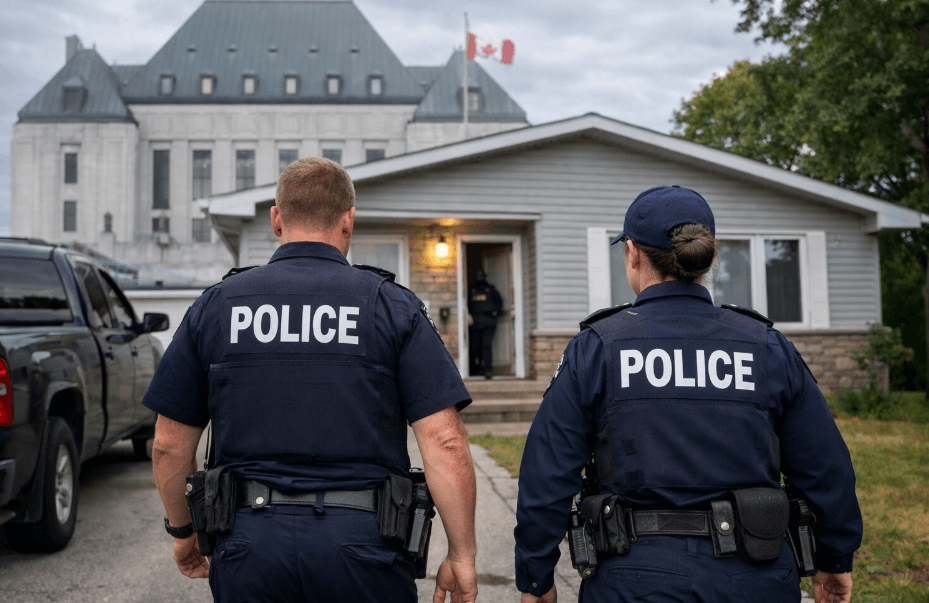
In its ruling on R v. Singer, the country’s highest court allowed the Crown’s appeal, concluding that police officers were justified in entering a private driveway to investigate a suspected impaired driving incident. The decision hinges on the legal concept known as the “implied license to knock,” a common-law doctrine that allows members of the public—such as delivery workers or neighbours—to approach a residence and knock on the door without legal consequence.
Court balances public safety and Charter protections
The majority of the Supreme Court determined that officers acted within the bounds of this doctrine when they entered the driveway of the accused, Mr. Singer, after receiving a witness report بشأن possible impaired driving. However, the Court also found that police overstepped their authority when they opened the door of Mr. Singer’s truck without reasonable grounds, constituting an unlawful search.
Despite this breach, the majority ruled that the evidence obtained should remain admissible, citing the public’s strong interest in the effective enforcement of impaired driving laws. As a result, the Court reinstated Mr. Singer’s conviction, which had previously been overturned by the Saskatchewan Court of Appeal on the basis that his Section 8 Charter right—protection against unreasonable search and seizure—had been violated.
Court rejects expansion of police powers, dissent raises caution
Notably, the Crown had sought recognition of a new common-law police power that would explicitly authorize officers to enter private property to investigate impaired driving offences. This request was unanimously rejected by the Court.
In dissenting reasons, Justice Martin offered a more restrictive interpretation of police authority, emphasizing limits on judicial expansion of law enforcement powers. Her opinion is being viewed by civil liberties advocates as an important counterbalance within the ruling.
BCCLA raises concerns over implications for marginalized communities
The BCCLA, which intervened in the case, argued for a clear legal boundary preventing state agents from trespassing on private property without a warrant. The organization maintains that existing police powers are sufficient and that expanding them risks disproportionate impacts on marginalized groups.
In a statement, the association said it is troubled by how the ruling broadens the application of the “implied license to knock” doctrine, potentially weakening individuals’ privacy rights within their own property.
At the same time, the BCCLA acknowledged Justice Martin’s dissent as a positive element, suggesting it may serve as a safeguard against further expansion of police authority in future cases.
Legal and social implications moving forward
Vibert Jack, Litigation Director for BCCLA, underscored the broader implications of the decision for civil liberties and public safety.
“We must reject the idea that sacrificing our civil liberties is a solution to public safety concerns. Giving police unnecessary powers does nothing to make anyone safer, but instead poses a threat to communities that are already heavily policed.”
The case highlights an ongoing tension in Canadian law between ensuring public safety—particularly in the context of impaired driving—and upholding constitutional protections against state intrusion.
Representation and next steps
The BCCLA was represented in the case by Nikolas De Stefano and Samara Secter of Addario Law Group LLP.
While the ruling provides clarity on the application of the “implied license to knock” doctrine, it is likely to prompt continued debate among legal experts, policymakers, and civil society groups بشأن the appropriate limits of police authority in Canada.
As courts continue to interpret the scope of Charter protections in evolving contexts, the balance between individual rights and collective security remains a central issue in the country’s legal landscape.
Discover more from Wire Service Canada
Subscribe to get the latest posts sent to your email.