

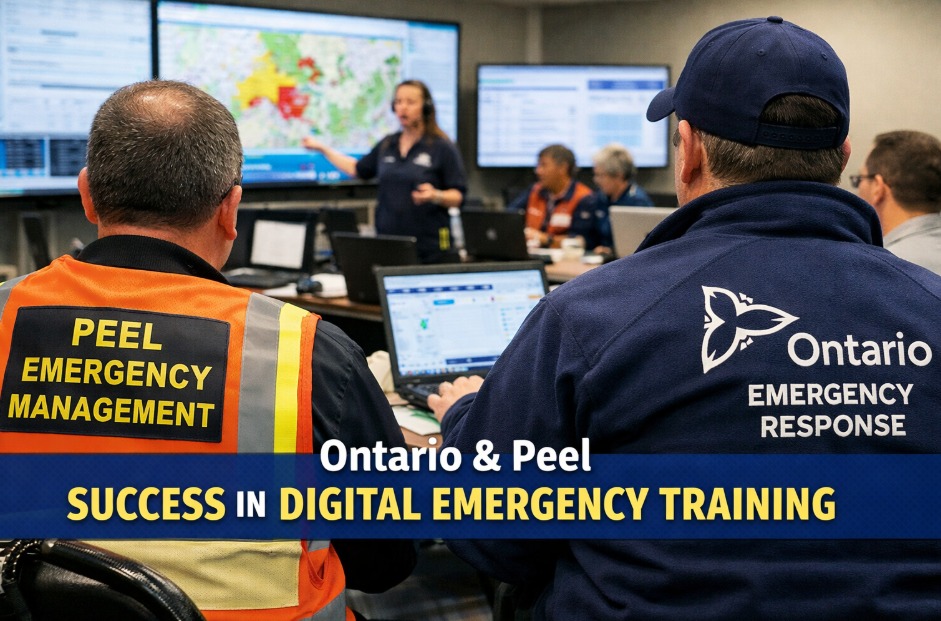
The Ontario government and the Regional Municipality of Peel are highlighting the results of a new digital emergency management training initiative that officials say could serve as a model for municipalities across the province.
In a news release issued March 5, the Ministry of Emergency Preparedness and Response announced that more than 3,380 Peel Region staff have completed the province’s first fully digital emergency management training course. The program, delivered over four months, is designed to improve local emergency response capacity while reducing the administrative burden and cost of training for municipalities.
Provincial officials say the initiative demonstrates how digital learning can expand access to essential emergency preparedness training and strengthen coordinated responses during crises.
“Our partnership with the Regional Municipality of Peel shows what is possible when we modernize practices and embrace digital learning tools,” said Jill Dunlop, Minister of Emergency Preparedness and Response. “The success of this project proves that digital delivery works, and we encourage municipalities across Ontario to take part and build stronger, more resilient communities.”
Peel was selected as the first municipality in Ontario to host and deliver the ministry’s new online Incident Management System (IMS) 101 course. The program introduces participants to Ontario’s incident management framework, which is designed to coordinate response efforts across multiple agencies and jurisdictions during emergencies.
Officials say the digital format allowed a large number of employees to complete the training quickly while maintaining consistent instruction standards.
Through the initiative, 3,384 Peel staff members — including frontline personnel and support staff — successfully completed the IMS 101 course. The training provides foundational knowledge for individuals who play a role in emergency response operations, helping them understand the processes and structures used to manage incidents ranging from natural disasters to public safety emergencies.
According to the ministry, the course aims to ensure that personnel across different departments and organizations can work together effectively during emergencies. By establishing a common framework and terminology, the training is intended to reduce confusion and improve coordination when rapid response is required.
Provincial officials say expanding access to such training is an important component of Ontario’s broader emergency preparedness strategy. The government has increasingly turned to digital platforms to deliver training programs, allowing municipalities to reach more employees without the logistical challenges associated with in-person instruction.
The Peel initiative is now being presented as a scalable model that other municipalities can adopt.
The Ministry of Emergency Preparedness and Response said municipalities interested in offering the training are encouraged to contact the ministry to explore participation. The province also plans to expand its digital learning offerings, providing additional courses and resources to support municipalities and other emergency management partners.
Emergency management training remains a central part of Ontario’s preparedness framework. The ministry reported that during the 2023–2024 period it delivered 724 emergency management courses, training 30,396 people across the province.
Those programs are part of the Provincial Emergency Management Strategy and Action Plan, which outlines measures aimed at ensuring communities are prepared before, during and after emergencies. The strategy emphasizes training, coordination and preparedness planning as key elements in strengthening local resilience.
Regional officials in Peel say the training initiative reinforces the municipality’s efforts to maintain reliable public services during emergencies.
“Building a resilient community starts with preparedness. By strengthening Peel Region’s emergency readiness, we ensure that essential services we provide remain strong and reliable – no matter the challenges ahead.”
Peel Region, located in the Greater Toronto Area and home to more than 1.5 million residents, operates a range of critical services including public health, emergency management coordination and municipal infrastructure.
Provincial officials say the results from Peel demonstrate that digital training can help municipalities rapidly expand preparedness capacity among staff who may be called upon to assist during emergencies.
As Ontario continues to develop additional digital training tools, the government says similar programs could be rolled out across the province, enabling municipalities of varying sizes to strengthen their emergency response capabilities while keeping training accessible and cost-effective.