

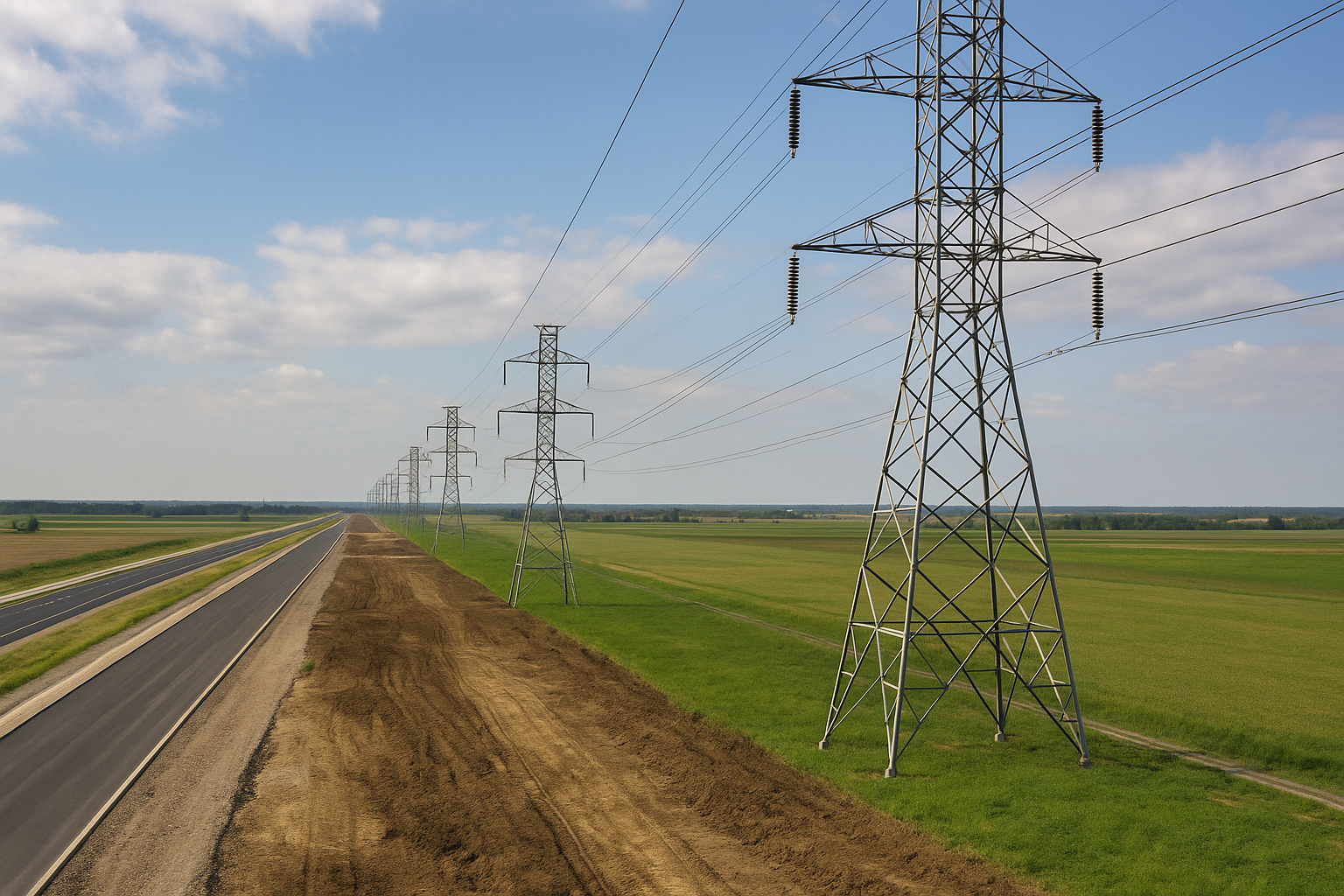
Ontario’s government says it has reached a major step forward in planning new energy infrastructure for the fast-growing communities of the Greater Toronto Area’s northwest. The province is proposing to release nearly 40 per cent of the land originally reserved for the Northwest GTA Transmission Corridor, citing updated studies showing a narrower corridor will meet future electricity needs.
The move comes as part of the Ministry of Energy and Mines’ ongoing Northwest GTA Transmission Corridor Identification Study, which began in 2019. The refined plan will see the corridor aligned alongside the proposed Highway 413, reducing the amount of protected land and paving the way for new infrastructure that supports Ontario’s long-term Energy for Generations strategy.
“As Ontario’s population and economy continue to grow in the GTHA, we are planning ahead and building for future generations,” said Stephen Lecce, Minister of Energy and Mines. “This milestone reflects our government’s commitment to deliver reliable, cost-effective energy infrastructure that meets growing energy demand, while keeping energy affordable for families.”
Supporting Growth and Energy Demand
Halton, Peel, and York regions are among Ontario’s fastest-growing areas, with electricity demand rising faster than the provincial average. The Independent Electricity System Operator (IESO) has confirmed that new transmission capacity is essential to deliver power into these expanding communities, which are located farther from existing infrastructure.
The proposed corridor is designed to accommodate both 230-kilovolt and 500-kilovolt transmission lines — large-scale systems that will help move electricity efficiently across the region. Technical analyses completed by the ministry identified the narrowest viable route that can support future energy needs while minimizing environmental impacts and avoiding built-up areas.
The province says this milestone will reduce uncertainty for landowners and municipalities while freeing up land previously set aside for potential infrastructure use. Updated maps and a proposal are now available for public review through the Environmental Registry of Ontario, with final land-use decisions expected in December 2025.
Integrating Transportation and Energy Planning
Ontario is also using the project to coordinate major infrastructure development. The transmission corridor runs parallel to the Highway 413 route, part of a $30-billion provincial plan to expand transportation capacity across southern Ontario.
“Our government is fighting gridlock and unlocking Ontario’s full economic potential by building Highway 413, which will provide much-needed relief along one of the busiest highway corridors in North America as part of our $30-billion plan to expand transportation infrastructure across the province,” said Prabmeet Sarkaria, Minister of Transportation. “Aligning the Northwest GTA Transmission Corridor with Highway 413 means we’re keeping Ontarians moving while meeting electricity demand for generations to come.”
The approach aims to consolidate two major infrastructure projects within a shared corridor — minimizing the overall footprint on communities and natural areas. The ministries of Energy and Mines and Transportation have coordinated throughout the study to ensure that the corridor design allows for both power lines and highway construction.
Collaboration and Consultation
Throughout the planning process, provincial officials have engaged municipalities, Indigenous communities, and other stakeholders. The government says these consultations have shaped the proposal and will continue through the public comment period.
“This milestone creates the conditions for more homes to be built by making it easier for communities to grow,” said Rob Flack, Minister of Municipal Affairs and Housing. “Working across government, we are bringing the dream of homeownership within reach for more hardworking families in Halton, Peel, and York Region.”
The province expects that releasing excess lands will support local housing and development objectives by opening up more parcels for community and economic growth, particularly in areas under pressure from rising demand.
A Long-Term Vision for Infrastructure
Ontario’s Energy for Generations plan aims to ensure that energy supply remains reliable and affordable while positioning the province for industrial and residential expansion. By integrating transmission and transportation projects, the government says it is delivering a coordinated approach that encourages investment and creates skilled jobs.
“Backed by record investments in energy infrastructure, Ontario’s integrated approach is giving Indigenous communities, municipalities, businesses and industry partners the confidence to invest, grow and build here in Ontario,” the Ministry of Energy and Mines said in a statement.
The province notes that lands within the refined study area will continue to be protected under the Provincial Planning Statement, 2024, ensuring they remain available for future infrastructure needs. Environmental impacts are expected to be minimal, as most of the revisions affect areas already designated for transportation or utility use.
Final decisions on the corridor’s alignment, as well as the release of surplus lands, are expected before the end of 2025 — setting the stage for the next phase of design and permitting.
With population growth in the Greater Toronto and Hamilton Area expected to exceed 15 million by 2051, Ontario officials say projects like the Northwest GTA Transmission Corridor are critical to keeping pace with energy demand and economic expansion.
