

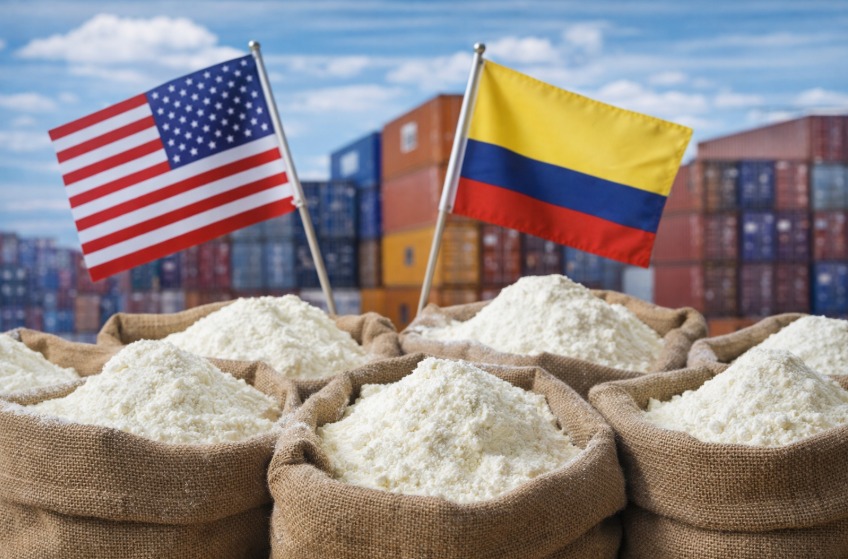
The United States dairy industry has secured continued tariff-free access to the Colombian market after Colombian authorities formally dismissed a trade investigation into U.S. milk powder imports, a decision welcomed by industry groups as a significant affirmation of existing trade commitments.
The National Milk Producers Federation (NMPF) and the U.S. Dairy Export Council (USDEC) said the Colombian government terminated a Subsidies and Countervailing Measures investigation after determining the case lacked merit. The probe, launched in 2024, alleged that U.S. milk powder exports were unfairly subsidized and caused harm to Colombian dairy producers. Colombian officials concluded that those claims could not be substantiated.
Industry representatives credited close coordination between U.S. dairy organizations, member companies, cooperatives and U.S. government officials for the outcome. NMPF and USDEC said they mounted a comprehensive response to rebut the allegations, demonstrating that Colombia’s investigative methodology was flawed, that purported subsidies were miscalculated and that there was no evidence of injury to Colombia’s domestic dairy sector.
“The U.S. dairy industry secured hard-won access to the Colombian market more than a decade ago, and as of this year tariffs have now fully phased out,” said Gregg Doud, president and CEO of NMPF. “Attempts to restrict U.S. access through bogus claims and misused trade tools set a dangerous precedent not only for dairy exports but for all U.S. trade. We commend the U.S. government and our members for working with us to coordinate a strong, credible defense and to send a clear message that efforts to evade trade agreement commitments will not be tolerated.”
The investigation had raised concerns among U.S. exporters about potential disruptions to a key Latin American market. Colombia is a growing destination for U.S. dairy products, with exports exceeding US$128 million in 2024, according to industry data. Milk powder represents an important component of that trade, particularly for U.S. processors seeking diversified export markets.
USDEC president and CEO Krysta Harden said the decision reinforces expectations that trading partners will respect agreed market access rules. “U.S. dairy producers and processors expect our trading partners to honor their market access commitments,” she said. “USDEC thanks the U.S. government in Washington and Bogota, as well as our members, for their support in presenting overwhelming evidence to rebut Colombia’s politically driven investigation. We welcome Colombia’s decision to abandon the case and maintain zero-tariff access for U.S. dairy exports in this important market.”
As part of the case, Colombian authorities initially imposed preliminary countervailing duties of 4.86 per cent on U.S. milk powder imports. Those temporary measures were allowed to lapse in January 2025 and were not renewed, following sustained engagement by NMPF and USDEC with Colombian officials and industry stakeholders.
Jaime Castaneda, executive vice president for policy development and strategy for both NMPF and USDEC, testified on behalf of the U.S. dairy sector at an October 2024 hearing. During his testimony, Castaneda outlined how U.S. Department of Agriculture programs operate, countering claims that such programs constituted unfair subsidies to exporters.
The Colombian Ministry of Commerce, Industry and Tourism formally terminated the investigation on Dec. 30, 2025, concluding that no additional tariffs were warranted. The decision clears the way for continued duty-free access at a time when tariffs on U.S. dairy products have been fully eliminated under the U.S.-Colombia Free Trade Agreement.
That agreement, which entered into force in 2012, provided for the gradual phase-out of tariffs on dairy products, a process that concluded at the beginning of 2026. NMPF and USDEC said they worked closely with the U.S. government to secure the agreement and to ensure its provisions were implemented as intended.
Industry officials view the dismissal of the investigation as a broader signal to other trading partners considering similar actions. With global trade increasingly shaped by disputes over subsidies and market access, the case underscores the importance of technical evidence and adherence to trade rules.
For U.S. dairy exporters, the outcome removes a source of uncertainty and supports continued investment in the Colombian market. For policymakers, it reinforces the role of coordinated government-industry engagement in defending trade agreements and maintaining stable access for U.S. agricultural products abroad.
