

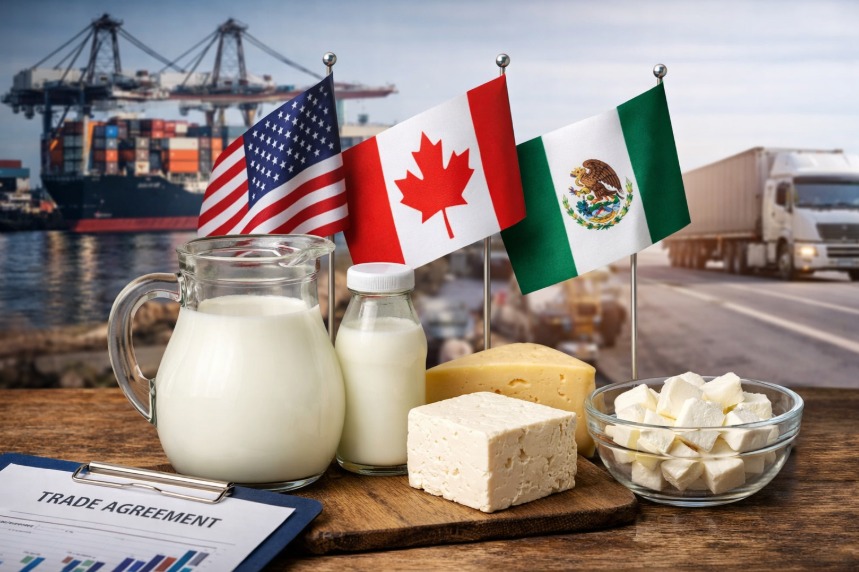
The U.S. dairy sector is intensifying its push to shape the upcoming review of the U.S.-Mexico-Canada Agreement, launching a new industry-wide coalition aimed at pressing trading partners to meet their obligations and at strengthening the pact ahead of a critical 2026 deadline.
The National Milk Producers Federation (NMPF) and the U.S. Dairy Export Council (USDEC) on Thursday co-led the launch of the Agricultural Coalition for USMCA, a group intended to coordinate agricultural industry input as the three member countries prepare for the agreement’s first mandatory joint review.
The USMCA, which governs trade among the United States, Canada and Mexico, replaced the North American Free Trade Agreement in 2020. Under its terms, the agreement requires a joint review in 2026 that allows the parties to assess performance and consider potential changes. That process has taken on added significance for U.S. agriculture, which relies heavily on the two neighbouring markets.
Since stakeholder consultations began in October 2025, the U.S. dairy industry has emphasized that while the agreement has delivered substantial export growth, unresolved issues continue to limit its full benefits. Industry leaders say the new coalition will provide a unified platform to press for stronger enforcement and targeted improvements during the review.
“USMCA has helped grow vital export opportunities that support dairy farm incomes across the country,” Gregg Doud, president and CEO of NMPF, said. “Unfortunately, Canada has clearly not upheld their end of the deal and Mexico needs to fully implement USMCA commitments to respect our use of common cheese names. We look forward to working with the Administration during the review to ensure our trading partners honor their commitments so the agreement can best deliver for dairy farmers.”
For U.S. dairy exporters, the stakes are significant. According to industry figures, exports of U.S. dairy products to Canada and Mexico totalled about US$3.6 billion in 2024, accounting for roughly 44 per cent of total U.S. dairy export value. Mexico, in particular, has been a major growth market for U.S. cheese, milk powders and other products.
“USMCA has been critical to maintaining strong export demand for U.S. dairy farmers, manufacturers and exporters, providing greater opportunities in the Mexican market in particular,” Krysta Harden, president and CEO of USDEC, said. “At the same time, persistent market access barriers, particularly in Canada, limit the full potential of the agreement and must be addressed to ensure that U.S. dairy exporters receive the benefits they were promised.”
At the centre of industry concerns is Canada’s administration of dairy tariff-rate quotas, which are intended to provide U.S. exporters with defined access to the Canadian market. U.S. dairy groups argue that Canada’s allocation practices favour domestic processors and restrict meaningful access for foreign suppliers, contrary to the spirit and letter of the agreement.
The industry is also pressing Canada over what it describes as circumvention of USMCA disciplines governing dairy protein exports. U.S. groups say Canadian policies have enabled the export of artificially low-priced dairy proteins, which they argue undercuts U.S. products in both domestic and international markets.
In Mexico, the focus is on enforcement of commitments related to the protection of common food names. U.S. dairy exporters want assurances that generic cheese names such as “feta” remain available for use, warning that ongoing European Union trade negotiations could otherwise lead to broader restrictions on such terms.
NMPF and USDEC say the Agricultural Coalition for USMCA will help align agricultural voices as trade negotiators move toward the July 1 joint review deadline. Both organizations indicated they will continue engaging with U.S. officials and industry partners to push for compliance and reforms that they say are essential for ensuring the agreement delivers on its original promises.
As the review approaches, U.S. dairy leaders are signalling that while they support the framework of USMCA, they expect tangible progress on long-standing issues before endorsing its renewal without changes.
