

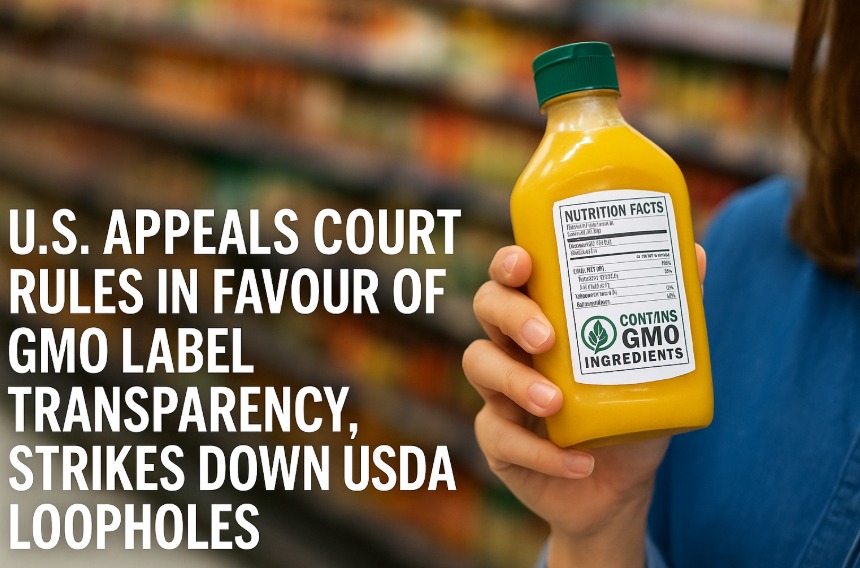
In a major victory for food transparency advocates, a U.S. federal court of appeals has struck down key parts of the U.S. Department of Agriculture’s (USDA) genetically modified organism (GMO) food labeling rule, declaring that several provisions violated federal law. The decision represents a landmark win for the Center for Food Safety (CFS) and its coalition of nonprofit and organic retail plaintiffs, who have fought for decades to ensure consumers have clear access to information about the foods they buy and eat.
The case challenged USDA’s implementation of the 2016 National Bioengineered Food Disclosure Standard, which requires labeling of genetically engineered (GE) or “bioengineered” foods. The agency had previously exempted so-called “highly refined” or ultra-processed GMO products — such as cooking oils and sweeteners derived from corn and soy — from mandatory disclosure. The court ruled this exemption unlawful, finding that USDA’s interpretation of the law failed to meet the statute’s requirements.
“Today’s decision is a landmark victory for the public’s right to know what they eat and feed their families,” said George Kimbrell, CFS’s Legal Director and lead counsel in the case. “We’ve fought for decades for GMO labeling, as required by more than 60 other countries, and today’s decision is a crucial culmination of those hard-fought efforts. QR codes alone do not provide meaningful access to all Americans, and USDA now will have to remedy that failing and provide accessible labeling.”
Court Rejects USDA’s “Highly Refined” Loophole
The appellate court’s detailed 50-plus page opinion concluded that USDA acted unlawfully by excluding ultra-processed GMO foods from mandatory disclosure. The court emphasized that the statute required labeling for any product that “contains” modified genetic material — not only those in which such material is detectable through current testing methods.
In its ruling, the court stated:
“There is an obvious and important difference between whether a substance is actually present and whether, using a particular method, one is able to detect that the substance is present.”
That distinction, the judges noted, invalidates the USDA’s narrow interpretation, which effectively excluded the majority of GMO-derived foods from labeling. According to CFS, such highly refined ingredients represent about 70 percent of all GMO food components found in U.S. grocery products, including sodas, cereals, and cooking oils.
QR Code Labeling Declared Inaccessible
The ruling also struck down USDA’s reliance on QR code-only labeling, a controversial provision that allowed food manufacturers to provide GMO disclosures through scannable smartphone links instead of on-package text or symbols.
A 2022 lower court ruling had found the practice unlawful because it failed to provide equitable access to information — particularly for consumers without smartphones or reliable internet access. However, that court had declined to remove QR code-only products from the market. The appeals court determined that failure to vacate the rule was “an abuse of discretion,” ordering that the QR code provision be nullified and remanded for a new rulemaking process.
“This is a major win for the American family,” said Alan Lewis, Vice President of Advocacy & Governmental Affairs for Natural Grocers, one of the plaintiffs. “They can now make informed shopping decisions instead of being forced to use detective work to understand what food labels are hiding. The public’s rejection of hidden GMOs has been weighed by the Court to be greater than the agrochemical industry’s desire to hide GMOs behind incomprehensible bureaucratic rules.”
The court’s decision means USDA must now rewrite its rule to include more accessible disclosure options for consumers, alongside clear on-package information.
Clarifying Language and Labeling Terms
While the appeals court struck down major portions of the rule, it upheld USDA’s use of the term “bioengineered” as the uniform disclosure standard, rejecting calls to replace it with the more familiar terms “genetically engineered” or “genetically modified.” However, the court clarified that manufacturers are free to include those well-known terms voluntarily in addition to “bioengineered.”
Broader Implications for Health and Policy
Consumer advocates have long argued that GMO labeling is a public health and transparency issue. The CFS points out that the majority of genetically engineered crops are developed for increased pesticide tolerance, leading to higher chemical use in agriculture. The most widely used herbicide, glyphosate — the active ingredient in Monsanto’s Roundup — has been linked to cancer and has been the subject of extensive litigation, resulting in billions of dollars in settlements and damages.
The ruling could also influence ongoing debates within the U.S. Department of Health and Human Services (HHS), which has recently prioritized the regulation of ultra-processed foods and pesticide exposure under Health Secretary Kennedy’s public health reform initiatives.
A Decades-Long Legal Battle
The Center for Food Safety filed the original lawsuit in 2020 on behalf of a coalition of nonprofits and organic retailers, including Natural Grocers, PCC Natural Markets, Good Earth Natural Foods, National Organic Coalition, Citizens for GMO Labeling, Label GMOs, and Rural Vermont. Together, these groups represent a cross-section of consumer, environmental, and organic food industry stakeholders.
Founded over two decades ago, the CFS has led a sustained campaign for GMO transparency. Earlier victories forced USDA to finalize long-delayed labeling rules and conduct a congressionally mandated study on the accessibility of QR codes — findings that confirmed such digital-only disclosures were insufficient for broad public access.
“This ruling sends a powerful message that corporate secrecy and bureaucratic shortcuts won’t stand in the way of consumer rights,” said Kimbrell. “For the first time, all Americans are one step closer to knowing what’s in the food they buy.”
Global Context
More than 60 countries, including the European Union, Japan, and China, already require GMO labeling. Polls consistently show that over 90 percent of Americans support mandatory GMO disclosure, making it one of the most widely supported consumer transparency measures in the United States.
The appeals court’s decision now requires the USDA to reopen the rulemaking process and develop new regulations that fully comply with the court’s findings. Until then, food manufacturers will face heightened scrutiny over labeling practices — and consumers can expect clearer standards in the years ahead.
