

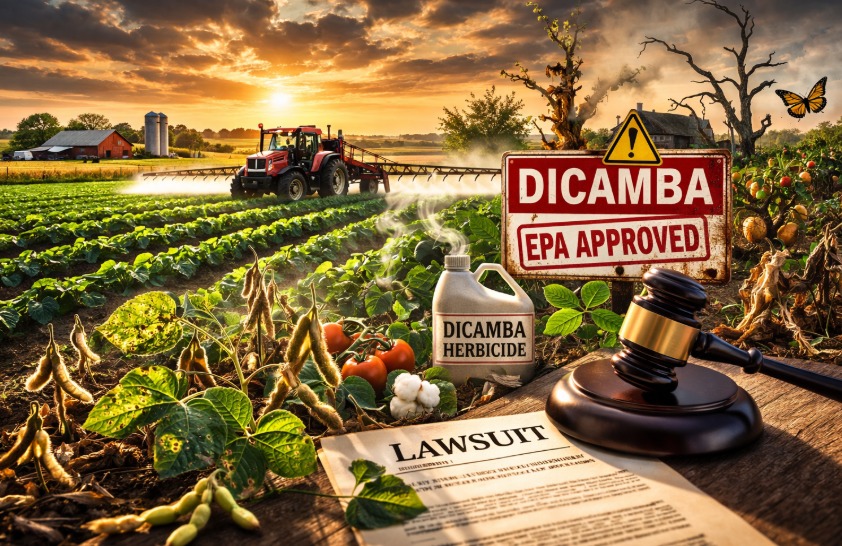
WASHINGTON — Farmers and environmental organizations have launched a new legal challenge against the Environmental Protection Agency, arguing its latest approval of the controversial herbicide dicamba ignores court rulings, scientific evidence and the interests of growers harmed by chemical drift.
The lawsuit, filed Friday in federal court by a coalition that includes the National Family Farm Coalition, the Center for Biological Diversity, the Center for Food Safety and Pesticide Action & Agroecology Network, challenges the EPA’s decision to re-register dicamba for use on genetically engineered soybeans and cotton.
The decision marks the latest chapter in a years-long dispute over dicamba, a weedkiller widely used in U.S. agriculture but criticized for its tendency to volatilize and drift, damaging nearby crops, orchards and natural vegetation.
“EPA’s re-registration of dicamba flies in the face of a decade of damning evidence, real world farming know-how and sound science, and, oh-by-the-way, the law,” said George Kimbrell, legal director of Center for Food Safety and counsel in the case. “In reality, the Trump administration has once again betrayed farmers and poisoned the environment to pad corporate pesticide profits. We will see them in Court.”
The EPA, now led by administrator Lee Zeldin, has said updated rules would reduce the risk of off-target damage. However, critics say the new approval removes several restrictions that were intended to limit harm.
Among the changes, the agency eliminated a June cutoff date for spraying, allowing dicamba use later into the summer, when higher temperatures can increase drift risk. It also dropped a 100-foot buffer requirement designed to protect endangered species habitat and loosened other safeguards, according to the lawsuit.
“Lee Zeldin’s hollow promises that new restrictions on dicamba will prevent damaging drift to nearby farms and backyard gardens is totally unsupported by the facts or common sense,” said Nathan Donley, environmental health science director at the Center for Biological Diversity. “Zeldin insists he’s working closely with the Make American Healthy Again movement to make pesticides safer. But his reckless reapproval of this dangerous, highly toxic pesticide shows his words to be nothing more than an attempt to ‘MAHA-wash’ the facts. No one in the healthy foods movement has been fooled by Zeldin’s pro-industry spin game.”
Dicamba has been at the centre of regulatory and legal battles for nearly a decade. The chemical was introduced for expanded use in 2016 alongside dicamba-tolerant crop seeds originally developed by Monsanto, now owned by Bayer. The seeds allowed farmers to spray dicamba directly over crops to kill weeds without harming yields.
But the herbicide’s volatility quickly sparked widespread complaints. The U.S. Department of Agriculture estimated that dicamba drift damaged up to 15 million acres of soybeans in 2018 alone. Beekeepers also reported declining honey production as flowering plants were affected.
Courts intervened twice. Federal judges struck down EPA approvals in 2020 and again in 2024, finding the agency failed to adequately assess the pesticide’s impacts.
“This is déjà vu all over again,” said Jim Goodman, president of the National Family Farm Coalition. “Despite an extensive history of failed weed management in genetically engineered crops, thousands of complaints by farmers about crop damage caused by drift, and two prior court bans, EPA is once again re-registering dicamba. There is no rationale for re-approving this incredibly harmful herbicide other than to line the pockets of the agri-chemical industry. National Family Farm Coalition is standing up for family farmers and rural communities everywhere in urging our courts to block this egregious, irresponsible and unjust reapproval.”
Farmers who grow crops not engineered to resist dicamba say the stakes are high.
“Dicamba’s tendency to volatilize and drift is well-documented and when dicamba was registered for over-the-top spraying our vegetable farm, like so many farms, saw a significant decline in marketable produce from damage,” said Rob Faux, an Iowa farmer and communications manager at Petitioner Pesticide Action & Agroecology Network. “Successful legal challenges removed dicamba’s prior registrations, and because of that we have had successful seasons without dicamba drift. A new dicamba registration will, once again, pit farmer against farmer, and some of us will be forced to exit food production.”
The EPA’s latest approval replaces calendar-based cutoffs with temperature-based restrictions and allows continued use of volatility-reducing agents, despite critics saying such measures have failed in the past.
The plaintiffs also raised concerns about potential conflicts of interest, noting that a former pesticide lobbyist now holds a senior role in the EPA’s chemical safety office.
The case could have significant implications for U.S. agriculture and agribusiness companies, including Bayer, which has already faced billions of dollars in litigation tied to dicamba-related crop damage.
For farmers, regulators and agricultural investors, the outcome will help determine whether dicamba remains a key tool in weed management — or becomes another flashpoint in the ongoing debate over pesticide safety, regulation and liability.