

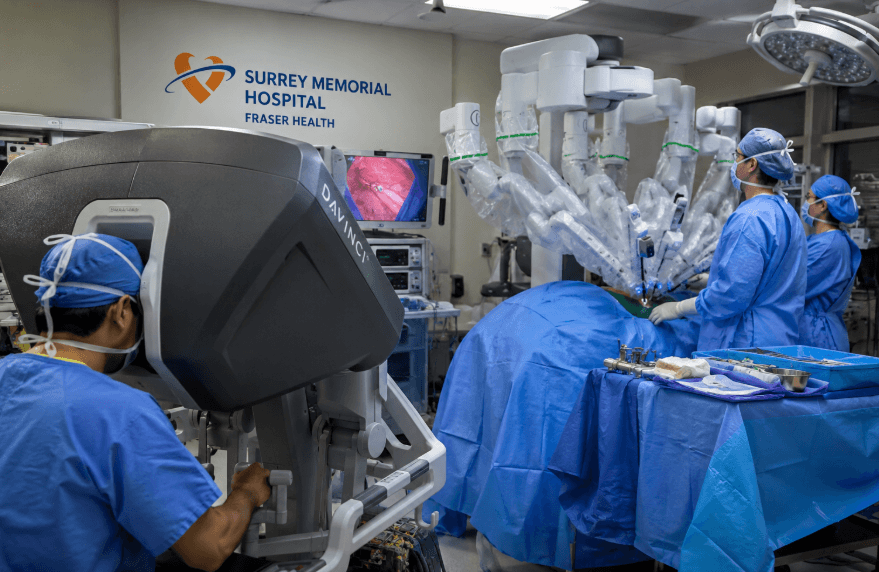
Da Vinci Xi System Expands Access to Advanced Thoracic and ENT Care in British Columbia
SURREY, B.C. — Surrey Memorial Hospital has launched Fraser Health’s first robotic surgery program, a development expected to strengthen specialized thoracic (chest) and ear, nose and throat (ENT) surgical services across the region while improving access to advanced care for patients throughout British Columbia.
The milestone was marked by Fraser Health’s first robotic-assisted surgery using the da Vinci Xi Surgical System, a technology funded through donations to the Surrey Hospitals Foundation. Hospital officials say the program represents a significant advancement in minimally invasive surgery and will help address growing demand for specialized procedures in one of Canada’s fastest-growing regions.
Based at Surrey Memorial Hospital, Fraser Health’s regional centre for thoracic and ENT care, the robotic surgery program is designed to expand access to complex surgical procedures while helping reduce wait times and improve patient outcomes.
The da Vinci Xi Surgical System is widely regarded as one of the most advanced platforms for minimally invasive surgery. Surgeons use robotic instruments that provide enhanced visualization, precision and dexterity during procedures that can be difficult to perform using traditional techniques.
Partnership Between Donors and Public Health Care
The initiative was made possible through a partnership between Surrey Hospitals Foundation donors and Fraser Health. Philanthropic contributions funded the purchase of the robotic surgical system, while Fraser Health invested in operating room upgrades, clinical implementation, recruitment and specialized staff training required to launch the program.
“From the beginning, our clinicians envisioned more than bringing a robot to Surrey – they envisioned building a centre of excellence that would advance patient care, attract world-class talent, and create new opportunities for research and innovation across British Columbia,” said Nicole Robson, President & CEO of Surrey Hospitals Foundation. “We are proud to support that ambition. Philanthropy played a critical role in helping bring this technology to Fraser Health, and it will continue to help drive the next generation of surgical innovation for patients throughout the region.”
The launch highlights the growing role philanthropy can play in supporting health-care innovation, particularly as health systems face increasing pressures from population growth and rising costs.
Improving Access to Specialized Procedures
Initially, the robotic surgery program will focus on thoracic procedures, with ENT surgeries expected to begin in the coming weeks. The technology will support patients undergoing complex operations involving the lungs, chest, throat, and head and neck.
Health officials say robotic-assisted surgery can offer several benefits for eligible patients, including smaller incisions, reduced pain, shorter hospital stays and faster recovery times.
“Robotic-assisted surgery expands what is possible for patients requiring complex thoracic procedures,” said Dr. Ashrafi, Regional Division Head and Chief of Thoracic Surgery. “It gives us enhanced precision, visualization and control, which can support a less invasive approach to surgery and help improve recovery for patients. This is an important step forward in building a leading thoracic and ENT program at Surrey Memorial Hospital.”
The introduction of robotic-assisted surgery is also expected to strengthen Surrey Memorial Hospital’s position as a centre for specialized care and clinical innovation.
“As we begin to introduce robotic-assisted surgery into ENT care, this technology creates new opportunities not only for patient care, but also for innovation in how we approach complex procedures,” said Dr. Anderson, Regional Head of Head, Neck, and Microvascular Surgery for Fraser Health. “It helps position Surrey Memorial Hospital to contribute to the next generation of surgical excellence through clinical learning, talent attraction, and future research.”
Addressing a Technology Gap in British Columbia
Fraser Health serves more than 1.9 million residents, representing over one-third of British Columbia’s population, making it the province’s largest health authority and the second largest in Canada.
Despite serving a large population, access to robotic-assisted surgery remains relatively limited in British Columbia. Surrey Memorial Hospital’s new system is among only a small number of active da Vinci surgical robots operating in the province. By comparison, Ontario had more than 17 such systems in operation last year, while Quebec had more than 10.
Health officials say the Surrey program is expected to free up more than 288 hospital bed days annually, improving efficiency while expanding patient access to advanced surgical care.
The hospital is also using the program to attract highly specialized clinicians. Among the newest recruits is Dr. Brent Chang, who joins Surrey Memorial Hospital from the Mayo Clinic to help support the growth of the hospital’s ENT services.
Part of a Broader Robotic Surgery Strategy
The Surrey launch represents the first phase of Fraser Health’s broader robotic surgery strategy. A second robotic surgery program is expected to become operational at Royal Columbian Hospital in the future, further expanding access to advanced surgical technology across the health authority.
Officials say the investment reflects a long-term commitment to improving specialized care as population growth continues across the Fraser Health region.
With increasing demand for complex surgical services and mounting pressure on health-care systems, the introduction of robotic-assisted surgery at Surrey Memorial Hospital marks a significant step toward expanding access to advanced treatment options while positioning the hospital as a leading centre for surgical innovation in British Columbia.
Discover more from Wire Service Canada
Subscribe to get the latest posts sent to your email.