

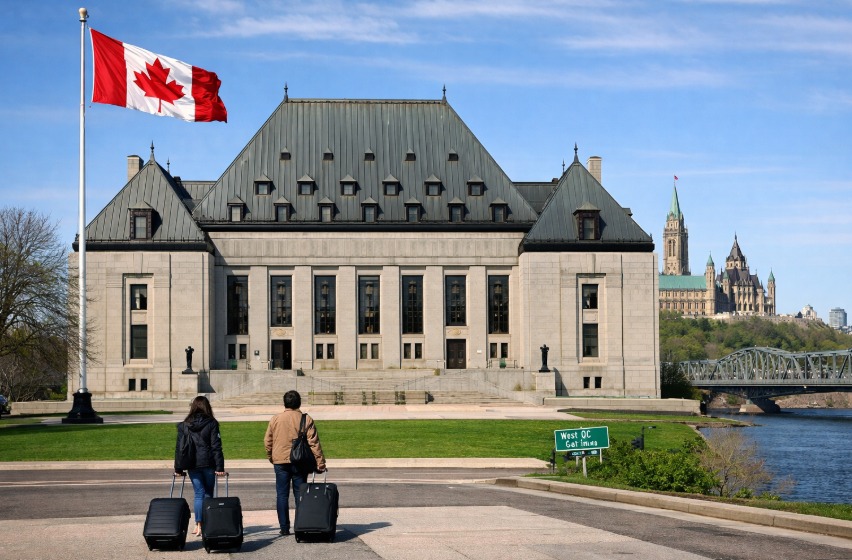
OTTAWA — The Supreme Court of Canada has issued a landmark decision affirming that Canadians and permanent residents have a constitutional right to move freely within the country for any purpose, marking the first time the nation’s top court has explicitly recognized such a broad interpretation of mobility rights under the Charter.
In its ruling in Taylor v. Newfoundland and Labrador, the Court concluded that section 6 of the Canadian Charter of Rights and Freedoms protects not only the right to reside and work in any province, but also the right to travel freely between and within provinces for any reason. The decision arises from a legal challenge to pandemic-era travel restrictions imposed by Newfoundland and Labrador in 2020.
The BC Civil Liberties Association (BCCLA), which intervened in the case, welcomed the judgment as a significant affirmation of civil liberties in Canada.
“The right to move freely within your country is critical to any democracy. Fundamental freedoms such as the rights to liberty, assembly and association would all be undermined without freedom of movement. This decision is a historic victory for civil liberties in Canada.”
— Vibert Jack, Litigation Director
The case centred on Ms. Taylor, a Nova Scotia resident who sought permission to enter Newfoundland and Labrador to attend her mother’s burial during the early months of the COVID-19 pandemic. At the time, the province had enacted strict travel restrictions aimed at limiting the spread of the virus. Non-residents were required to apply for exemptions to enter the province.
Ms. Taylor’s initial application was denied. Although a second request was eventually approved, the authorization came too late for her to attend the funeral. She subsequently challenged the restrictions, arguing that they violated her mobility rights under section 6 of the Charter.
Section 6 guarantees Canadian citizens the right to enter, remain in and leave Canada, and grants citizens and permanent residents the right to move to and pursue a livelihood in any province. However, prior to this ruling, the Supreme Court had not directly addressed whether the provision also protected a broader right to interprovincial travel for purposes unrelated to work or residence.
In a majority decision, the Court held that section 6 must be interpreted to include what it described as the “ancient right” to freedom of movement within one’s own country. The justices found that Newfoundland and Labrador’s travel restrictions did infringe Ms. Taylor’s Charter rights.
However, the Court also determined that the infringement was justified under section 1 of the Charter, which allows governments to impose reasonable limits on rights if they can be demonstrably justified in a free and democratic society. Given the unprecedented circumstances of the global pandemic in 2020, the majority concluded that the province’s measures met that threshold.
The BCCLA had argued that mobility rights under the Charter should extend beyond employment-related movement and apply to travel for any purpose. The organization also submitted that these rights should not be limited to Canadian citizens but should extend to permanent residents, consistent with Canada’s international legal obligations.
In siding with this broader interpretation, the Court’s ruling establishes a new constitutional baseline for assessing future government-imposed travel restrictions within Canada. Legal experts say the decision may have implications beyond pandemic-related measures, potentially affecting how provinces regulate internal borders during emergencies or other extraordinary circumstances.
The judgment clarifies that while governments retain the authority to restrict movement in exceptional situations, such limits must meet the rigorous standards set out in section 1. Courts will be required to closely scrutinize whether such restrictions are proportionate, minimally impairing and supported by sufficient evidence.
For businesses and workers, the decision reinforces the constitutional foundation of labour mobility and interprovincial commerce — principles that underpin Canada’s economic union. While the case arose in the context of public health, the Court’s recognition of a broad right to free movement could influence future disputes involving transportation, trade barriers and emergency powers.
The ruling also highlights the tension between individual rights and collective safety during times of crisis. By finding both that Ms. Taylor’s rights were infringed and that the infringement was justified, the Court underscored the delicate balance governments must strike when responding to public emergencies.
As Canada continues to reflect on the legal and economic lessons of the COVID-19 pandemic, the decision in Taylor v. Newfoundland and Labrador stands as a defining moment in the evolution of Charter jurisprudence. It affirms that freedom of movement is a core democratic value — one that may be limited in extraordinary circumstances, but one that now carries explicit constitutional recognition at the highest judicial level.