

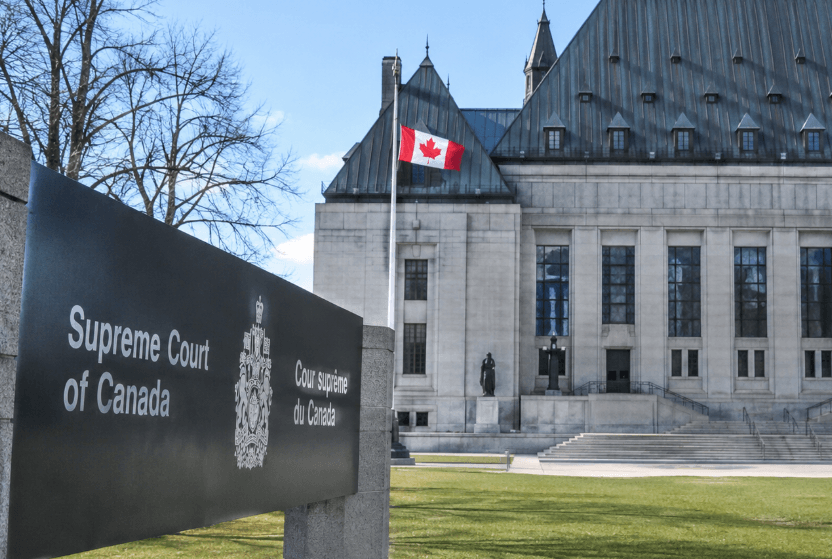
The Supreme Court of Canada is scheduled to deliver a landmark decision on Quebec’s secularism legislation, commonly known as Bill 21, with potentially far-reaching implications for constitutional rights, government accountability and the application of the notwithstanding clause across Canada.
The BC Civil Liberties Association (BCCLA), which intervened in the constitutional challenge, announced that its legal representatives would be available to provide analysis following the release of the ruling on November 27, 2026.
The case, English Montreal School Board, et al. v. Attorney General of Quebec, et al., examines significant constitutional questions surrounding the authority of governments to invoke the notwithstanding clause and the ability of courts to review legislation affecting fundamental rights and freedoms.
Bill 21 Challenge Raises National Constitutional Questions
Quebec introduced the Act Respecting the Laicity of the State in 2019, establishing restrictions on wearing religious symbols for certain public-sector employees, including teachers, police officers and other individuals occupying designated positions of authority.
The provincial government pre-emptively invoked Section 33 of the Canadian Charter of Rights and Freedoms, commonly referred to as the notwithstanding clause, to protect the legislation from certain constitutional challenges involving religious freedom, freedom of expression and equality rights.
The legislation has generated extensive legal and political debate over the balance between provincial legislative authority and constitutionally protected individual freedoms.
Section 33 allows Parliament and provincial legislatures to temporarily override certain Charter protections. Such declarations generally remain effective for up to five years and may be renewed.
The Supreme Court’s decision could provide greater clarity regarding the constitutional limits of this legislative mechanism and the role of judicial oversight when governments invoke it.
BCCLA Advocates for Continued Judicial Oversight
The BCCLA intervened in the proceedings in March 2026, arguing that governments should remain subject to judicial scrutiny even when legislation is protected by the notwithstanding clause.
The organization maintains that invoking Section 33 should not prevent courts from reviewing legislation and issuing formal declarations identifying violations of Charter rights.
Under the association’s interpretation, judicial oversight remains an important mechanism for maintaining transparency, democratic accountability and public confidence in government institutions.
Legal Remedies and Government Accountability
The BCCLA also argues that courts should retain the authority to consider remedies that do not prevent legislation protected by the notwithstanding clause from continuing to operate.
Potential remedies identified by the organization include formal judicial declarations, damages and personal exemptions, where legally available.
The association contends that these mechanisms could help individuals affected by legislation seek recognition of rights violations while preserving the constitutional framework governing legislative authority.
The outcome could influence future constitutional litigation and the legal options available to individuals and organizations challenging government policies.
Potential Implications for British Columbia and Other Provinces
Although the case originated in Quebec, its constitutional implications extend across Canada, particularly as provincial governments consider the use of Section 33 in legislative decision-making.
The BCCLA has campaigned nationally against the use of the notwithstanding clause for several years and intends to provide a British Columbia perspective on the ruling.
The association has also expressed concern about the potential use of the clause in British Columbia, citing Premier Lorne Doerkson’s appointment of Caroline Elliot as attorney general and her previously stated willingness to invoke the constitutional provision.
For public-sector employers, educational institutions and policymakers, the decision could offer important guidance on the relationship between legislative requirements, workplace policies and constitutional protections.
Greater clarity surrounding judicial review could also help institutions assess legal risks and understand their obligations under provincial legislation.
Civil Liberties Representatives to Provide National Analysis
The BCCLA has arranged media availability in Vancouver, Montreal and Edmonton, alongside virtual interviews accessible across Canada.
Participating representatives include litigation staff counsel Ga Grant, litigation director Vibert Jack and pro bono counsel Anna Lund and Avnish Nanda.
Lund and Nanda of Nanda and Company represent the association in the constitutional proceedings.
As Canada’s oldest civil liberties organization, the BCCLA operates as a non-partisan, non-profit organization focused on protecting human rights through litigation, policy reform and public legal education.
The Supreme Court’s decision is expected to provide an important constitutional reference point for future debates surrounding legislative authority, judicial accountability and the protection of fundamental rights across Canada.
Editorial note: The supplied material is a pre-ruling media advisory, not confirmation of the judgment. The article retains that distinction. The ruling and political appointments should be independently verified before publication. No direct quotations were included in the original advisory.
Discover more from Wire Service Canada
Subscribe to get the latest posts sent to your email.