

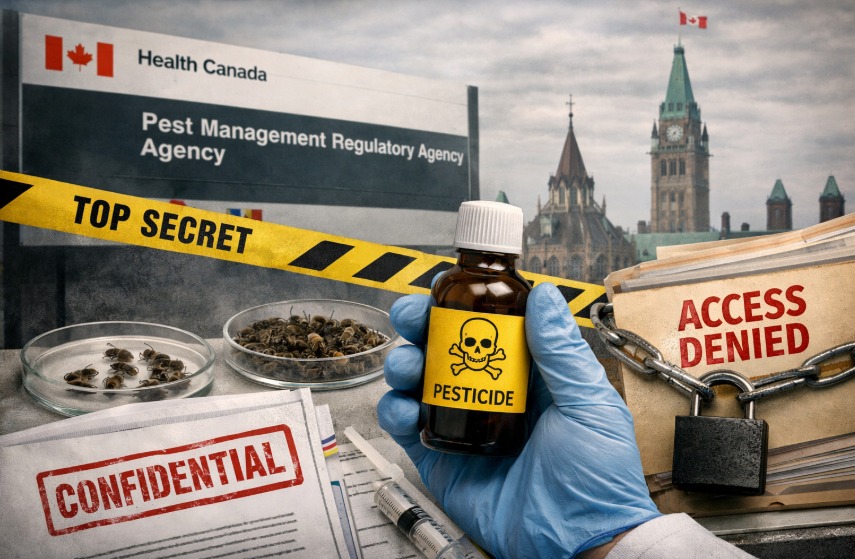
A dispute between an environmental advocacy group and Health Canada’s pesticide regulator over the disclosure of information linked to falsified safety studies has stretched on for more than 18 months, fuelling concerns about transparency, regulatory credibility and public trust in federal science-based decision-making.
The issue centres on the Pest Management Regulatory Agency (PMRA), the branch of Health Canada responsible for determining whether pesticides are safe for use in Canada. According to John Bennett, senior policy advisor with Friends of the Earth Canada, the controversy began with what he describes as an “obscure announcement” quietly posted on the agency’s website in spring 2024.
The notice stated that an international investigation had found that Palamur Bio-sciences Lab, an Indian contract research facility, had falsified scientific studies. As a result, PMRA said it would no longer accept data from the lab and that two pesticide companies that had relied on Palamur studies would be required to replace them.
Palamur later faced further scrutiny. In 2024, Indian authorities determined the lab had falsified 58 studies, and in June 2025 it was charged with animal cruelty.
Despite the seriousness of the findings, Bennett said neither the companies involved nor the pesticides affected were identified publicly. One of the products was already on the Canadian market, while the other was in the approval process.
“There was no media coverage,” Bennett wrote. “Not even Pierre Poilievre, who was attacking everything the federal government did, said or thought, said a word.”
Bennett questioned why products linked to suspect data were allowed to remain on sale and why the regulator would request replacement studies if there was no concern. He also pointed to past regulatory decisions, noting that PMRA waited until bee deaths became a public issue before requiring additional toxicity studies for neonicotinoid pesticides.
After contacting PMRA to ask which companies and products were involved, Bennett said the agency simply repeated its original statement and refused to provide names. He then wrote to Health Minister Mark Holland, citing the regulator’s “public credibility problem” and accusing it of behaving like a “captured regulator.”
The response, Bennett said, came indirectly. A senior PMRA official contacted the chief executive of Friends of the Earth Canada by phone, followed by a letter stating, “The Minister is not required to release the names of the pesticides or the companies.”
Bennett said the letter provided no legal justification for withholding the information. He subsequently filed an access to information request. Health Canada sought a 180-day extension beyond the standard 60-day deadline. More than a year later, the request remains unresolved.
In a later letter from an assistant deputy minister, Bennett said his inquiries were characterized as suggesting the PMRA was “flouting the law.” The letter also stated that the agency was expediting the review of replacement studies submitted by the unnamed companies.
She later confirmed the rationale for secrecy, writing that “…. disclosing names could cause unjustified reputational (sic) harm to these companies, the PMRA is not in a position to disclose the names of the companies (or associated products”.
Bennett argues that position contradicts PMRA’s own public guidance, which states that “the applicant’s or registrant’s name has never been designated as confidential business information (CBI).”
When his access request remained unanswered by June 2025, Bennett filed a complaint with the Information Commissioner. The complaint was rejected on the grounds that it was filed too late, a decision Bennett disputes.
Meanwhile, PMRA quietly updated its website to say that issues with Palamur had been resolved and that studies from the lab were once again being accepted, even as Indian authorities laid animal cruelty charges related to the treatment of hundreds of beagles.
Bennett warned that secrecy by scientific regulators can undermine public confidence, pointing to the U.S. Environmental Protection Agency and the rise of vaccine skepticism during the pandemic. “When governments withhold information, especially scientific information, they create a void for anti-science and government-corporate conspiracy theory rhetoric to fill,” he wrote, citing figures such as Robert Kennedy Jr..
Health Canada has not publicly commented on the specific companies or products involved. Bennett says he is still waiting for answers.
