

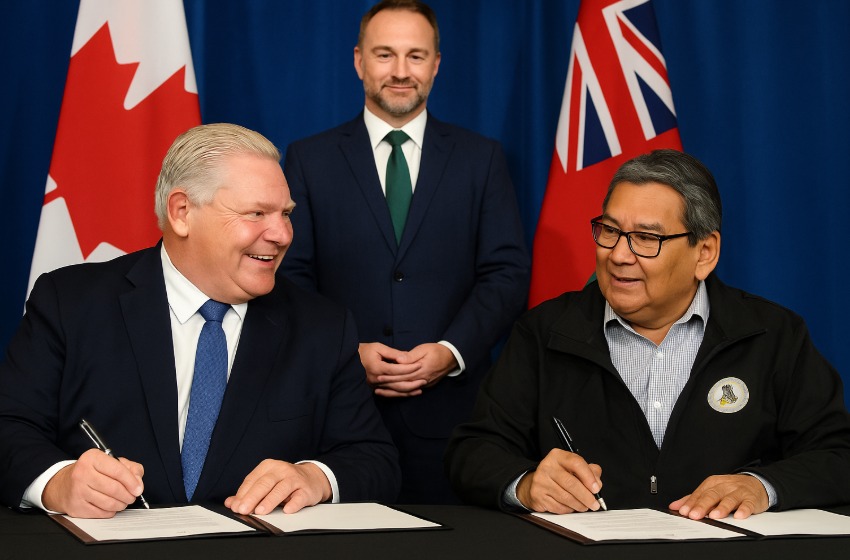
Ontario has signed a major partnership agreement with Marten Falls First Nation aimed at fast-tracking road construction into the Ring of Fire region and advancing the province’s broader critical minerals strategy. The deal, announced Wednesday in Toronto, includes up to $39.5 million for local infrastructure and commits both parties to accelerated work on the Marten Falls Community Access Road (MFCAR), a key link in the future north–south transportation corridor.
Premier Doug Ford, Indigenous Affairs and First Nations Economic Reconciliation Minister Greg Rickford, and Marten Falls Chief Bruce Achneepineskum signed the agreement, which they say marks a significant step toward unlocking economic opportunities in northern Ontario and ensuring First Nations have a central role in development linked to the mineral-rich region.
“This historic agreement is a landmark moment in our plan to unleash the economic benefits of the Ring of Fire, bringing prosperity to Northern Ontario and creating 70,000 jobs across our province,” Ford said. “I want to thank Chief Achneepineskum and Marten Falls First Nation for their vision and partnership, helping our government build a stronger, more competitive economy that can withstand tariffs and any other challenges that come our way.”
The MFCAR would provide the remote Anishinaabe community—located about 400 kilometres northeast of Thunder Bay and currently accessible mainly by air—with a permanent, all-season road connection to Ontario’s highway network. The route is also expected to function as a foundational segment in a planned system of roads linking several First Nations communities with the Ring of Fire, an 8,000-square-kilometre area containing some of the country’s most significant critical mineral deposits.
Under the terms of the agreement, Marten Falls First Nation will submit a final environmental assessment for the MFCAR by February 20, 2026. If approvals proceed on schedule and the federal government ends what Ontario describes as “duplicative impact assessments,” construction could begin as early as August 2026. The province also reaffirmed its joint commitment with Marten Falls to complete planning for the Northern Road Link (NRL), which would connect the community access road to the Webequie Supply Road and the broader transportation network.
Chief Achneepineskum said the agreement represents both economic opportunity and meaningful steps toward reconciliation.
“For years we have worked diligently on the Environmental Assessment processes starting with the Marten Fall Community Access Road and then the Northern Road Link. As the MFCAR EA process comes to an end in 2026, we recognize that we were always working towards reconciliation for our community. Not only economic reconciliation but reconciliation based on fixing a relationship that has historically left us behind,” he said.
“We are very excited for what this agreement represents, because it is not just an agreement that starts to move the Marten Falls Community Access Road towards construction, but it also represents a real and deeper partnership between Marten Falls and Ontario. This includes a commitment to build infrastructure in the community and start community readiness projects to prepare for the work ahead. This means that we build the road as well as our community infrastructure and capacity which was always our vision. This new chapter in our partnership with Ontario is the start of significant progress and prosperity for our First Nation and the region.”
The province said the funding will support urgent community needs this winter, allowing materials to be transported over seasonal roads for infrastructure and economic development projects. Additional funding will be released once the environmental assessment is submitted. The money will also support local employment, equipment procurement and priority community projects tied to the access road.
Rickford said the agreement demonstrates the government’s commitment to collaborative development. “This Community Partnership Agreement is a testament to our strong nation-to-nation partnership with Marten Falls First Nation,” he said. “Together, we are writing the next chapter of First Nations by laying the groundwork for infrastructure and services that will support economic growth and long-term prosperity, advancing our shared commitment to reconciliation and continued partnership.”
The deal forms part of a wider provincial push to build an end-to-end critical minerals supply chain, from extraction to refining and processing, in a bid to support electric vehicle and advanced manufacturing industries. Earlier this year, Ontario signed similar partnership agreements with Aroland First Nation and Webequie First Nation, and in September committed $61.8 million to road infrastructure upgrades in Geraldton, a key southern gateway to the Ring of Fire.
The Ford government has also earmarked nearly $3.1 billion in loans, grants and scholarships to expand Indigenous equity participation and support skills development related to future mining and infrastructure projects.
Marten Falls First Nation and the province said they will continue working with federal officials on environmental review processes and coordinate planning across all proposed road segments. Ontario maintains that new permanent infrastructure in the Far North is essential to unlocking the long-discussed mineral deposits and to ensuring northern and Indigenous communities benefit from long-term economic activity.
