

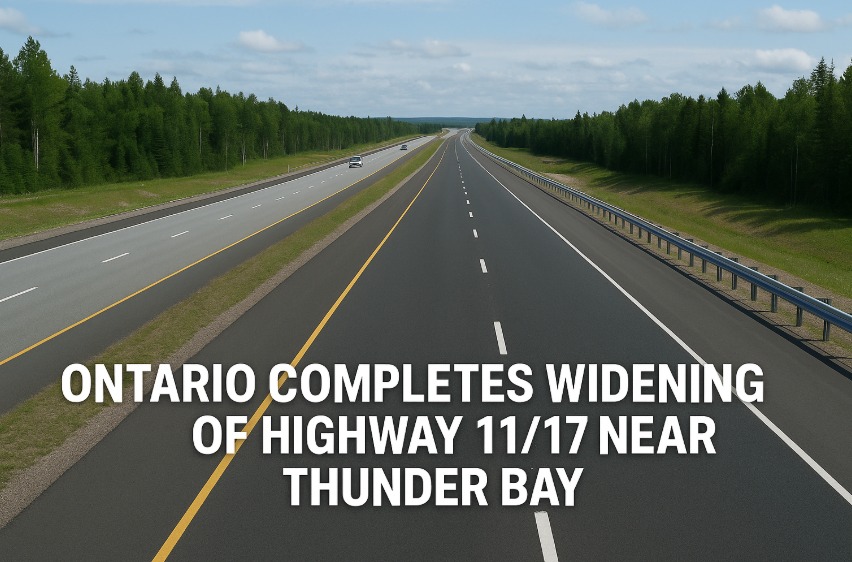
THUNDER BAY, ONTARIO — November 10, 2025. The Ontario government has completed two key sections of the long-term widening of Highway 11/17 between Thunder Bay and Nipigon, marking a significant step in its plan to twin more than 100 kilometres of the Trans-Canada Highway through northwestern Ontario.
The newly opened stretches — from Coughlin Road to Highway 582 and from Highway 587 to Pearl Lake — now feature four lanes separated by a median, doubling capacity along some of the region’s busiest trade and travel routes. The expansion aims to improve safety, reduce congestion, and support the flow of goods and services through northern Ontario’s economic corridor.
“Under the leadership of Premier Ford, our government is investing nearly $6.5 billion to build, repair and expand highways, roads and bridges in northern Ontario,” said Prabmeet Sarkaria, Minister of Transportation. “Expanding the Trans-Canada Highway has never been more important, as we work to protect Ontario by dismantling interprovincial trade barriers to unlock our full economic potential.”
A Critical Trade and Transportation Link
Highway 11/17 forms part of the Trans-Canada Highway — the backbone of the country’s national transportation system and a lifeline for northern communities. It carries more than $45 billion in goods annually, linking Thunder Bay and Nipigon with the rest of Canada.
Because there are no alternate routes for transcontinental and regional traffic, expanding the highway is considered vital for maintaining trade reliability and ensuring access to essential services. The newly completed sections add 20.5 kilometres of divided highway, including two new bridges over the Pearl River.
“The expansion of Highway 11/17 is important for northwestern Ontario,” said Kevin Holland, MPP for Thunder Bay–Atikokan. “By improving safety, increasing capacity and strengthening this vital trade corridor, we’re ensuring that people and goods can move efficiently across our region and the country. This investment supports our northern communities, drives economic growth and builds a stronger, more connected Ontario and Canada.”
Investing in the North
The completion of these sections builds on the province’s broader $30 billion infrastructure investment plan to build, repair and expand highways, roads, and bridges across Ontario. In northern Ontario alone, the Ministry of Transportation has earmarked nearly $6.5 billion for highway expansion and safety projects — including major work on the Trans-Canada corridor.
The province said that while both newly widened sections are now open to traffic, short-term lane closures will take place in spring 2026 to allow for additional finishing work.
Ongoing and future design work will continue eastward:
-
Preliminary design is underway for a 12-kilometre stretch from Highway 582 to Dorion East Loop Road.
-
Detailed design is progressing for a 7.6-kilometre section from Pearl Lake to west of the CP Overhead at Ouimet.
These next phases will complete remaining gaps in the four-lane corridor, a project the province has described as one of the most significant transportation investments in northern Ontario’s history.
Strengthening Economic Resilience
Officials say that expanding Highway 11/17 will have lasting benefits for both regional economies and national supply chains. The corridor supports key industries including forestry, mining, manufacturing, and logistics — all heavily dependent on reliable transport links.
By adding lanes and improving traffic flow, the expansion is expected to enhance road safety and reduce travel times for both commuters and commercial traffic. The project also supports ongoing efforts to modernize critical infrastructure in remote and rural parts of the province, helping northern businesses compete in a fast-changing global economy.
In addition to boosting trade and connectivity, the project has provided steady employment for construction and engineering workers throughout the north. The province has highlighted this as part of its broader economic recovery strategy focused on creating jobs and strengthening local supply chains.
A Safer, More Connected Future
The newly opened sections between Coughlin Road and Pearl Lake bring Ontario closer to its goal of completing a fully twinned, four-lane highway between Thunder Bay and Nipigon. Once finished, the expanded Highway 11/17 is expected to dramatically improve travel reliability, particularly during winter months when weather conditions can create hazards for single-lane traffic.
With construction continuing in the coming years, the Ford government’s highway strategy remains a central pillar of its infrastructure agenda — one that aims to support growth, connect northern communities, and ensure Ontario’s place as a key link in Canada’s national transportation network.
