

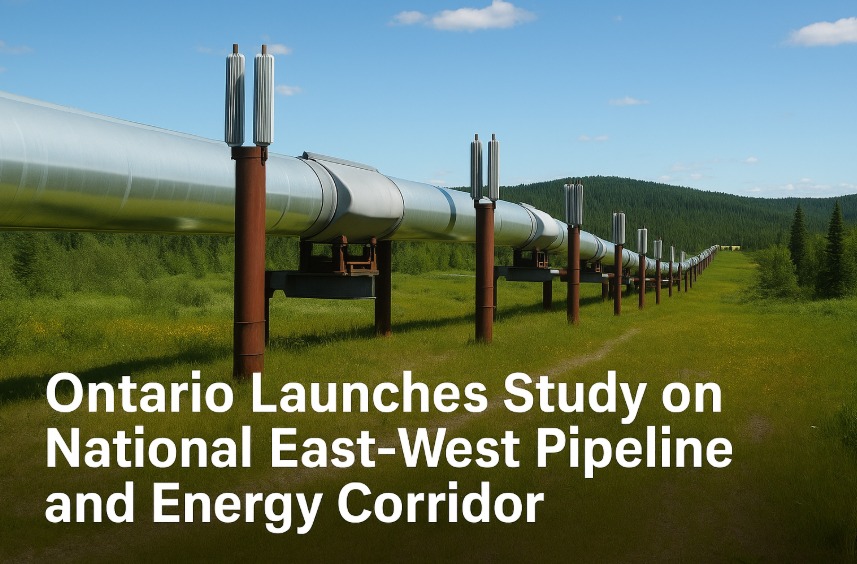
Toronto, The Ontario government has announced a new feasibility study to explore the creation of a national East-West energy corridor and pipeline network, a project it says would strengthen Canadian energy independence, create jobs, and expand domestic and international market access for Western Canadian oil and gas.
The proposed initiative, backed by Ontario, Alberta, and Saskatchewan, aims to transport oil and gas from Alberta and Saskatchewan to refineries in southern Ontario and to new port developments on James Bay, Hudson Bay, and the Great Lakes. The pipelines would be built entirely within Canada, using Canadian steel, and are intended to support local manufacturing and supply chain industries.
A “Nation-Building” Project
Premier Doug Ford described the project as a “nation-building pipeline and energy corridor” that would create new jobs and boost economic self-reliance.
“We’re delivering on our plan to build a more competitive, resilient and self-reliant economy for Ontario and Canada and creating jobs for workers in the face of tariffs from the United States,” said Premier Doug Ford. “This nation-building pipeline and energy corridor will unite our country and help unlock new markets for Canada’s energy resources that will reduce our dependence on the United States, all while creating new jobs and opportunities for Canadian workers from coast to coast to coast.”
The Ontario government said the project aligns with its broader goal of building infrastructure that enhances the province’s competitiveness and supports long-term national growth.
A new East-West corridor, the government said, would also improve energy security for Canadian homes and businesses by ensuring a consistent domestic supply of oil and gas.
Provinces Unite on Energy Vision
The initiative has drawn strong backing from Alberta and Saskatchewan, both major oil-producing provinces. Alberta Premier Danielle Smith framed the project as an example of provincial leadership driving responsible economic growth.
“We’re taking bold action to grow our economy, build real infrastructure and get major projects moving again,” said Alberta Premier Danielle Smith. “Alberta, Ontario and Saskatchewan are proving what’s possible when provinces lead and stand together to advance a shared vision of responsible development, economic freedom and common sense. That means standing up for our energy sector and ensuring our world-class resources reach the markets that need them, so Canadians can prosper from the opportunities we create here at home.”
The feasibility study, expected to conclude next year, will assess potential corridor routes, project costs, and complementary development opportunities such as mineral exports, all-season roads in Ontario’s Ring of Fire region, grid upgrades, and the creation of a strategic petroleum reserve.
Saskatchewan Backs Expansion
Saskatchewan Premier Scott Moe said the project represents a major opportunity for his province’s export-oriented economy.
“Access to domestic and international markets is critical for Saskatchewan’s export-oriented economy. An East-West energy corridor is important for our province and for all Canadians, driving economic growth and delivering responsibly produced Canadian energy products to new markets,” said Saskatchewan Premier Scott Moe. “Saskatchewan is proud of our oil and gas sector and plans to aggressively grow production. New pipeline infrastructure will strengthen Canada’s energy security and help us become a global energy superpower.”
Indigenous Consultation and Participation
As planning progresses, Ontario said it will honour its duty to consult with Indigenous communities and advance economic reconciliation through opportunities for Indigenous equity participation.
“We are seizing a generational opportunity to bring nation-building infrastructure projects, like the East-West energy corridor, to the forefront of our plan to build Ontario,” said Todd McCarthy, Acting Minister of Infrastructure. “This transformative project would connect provinces, unlock new export markets and ensure Ontario’s homes and businesses are powered by secure, Canadian-made energy, strengthening our economy for generations to come.”
Project Partnerships and Advisory Team
The feasibility study will be undertaken by a consortium that includes GHD Limited, Ernst & Young LLP (EY Canada), Mokwateh, AtkinsRéalis Group Inc., Wood PLC, and Turner & Townsend Limited. Infrastructure Ontario will serve as the commercial advisor.
Ontario officials said the study will also evaluate potential synergies with critical minerals development and northern infrastructure expansion.
Federal Collaboration and Strategic Vision
Ontario, Alberta, and Saskatchewan have signed a Memorandum of Understanding (MOU) committing them to ongoing collaboration on energy, infrastructure, and resource development. The agreement includes provisions for advancing nuclear energy initiatives and protecting Canadian workers from global market volatility.
Stephen Lecce, Minister of Energy and Mines, underscored the strategic importance of the corridor.
“We know that with new energy infrastructure, we can truly unlock our potential as an energy superpower. This corridor will strengthen Canadian energy independence, keep costs down for families and ensure Canadian interests always prevail.”
George Pirie, Minister of Northern Economic Development and Growth, added:
“Our government is committed to advancing infrastructure projects that foster economic growth in the North and protect Ontario jobs, businesses and industries. These proposed pipelines and port facilities would serve as a gateway to our northern seas to bring Ontario and Canada’s resources to new markets, reducing our reliance on the United States.”
Greg Rickford, Minister of Indigenous Affairs and First Nations Economic Reconciliation, said the provinces are focused on working collaboratively with Indigenous communities.
“Our government is proud to work with First Nations leadership and communities on projects that support and sustain our shared priorities, both in Ontario, Alberta and Saskatchewan. Central to nation-building projects are First Nations-led economic growth and opportunities, which we will continue to support.”
