

The Ontario government is investing an additional $4 million to help municipalities protect residents and businesses from the risks associated with old and inactive oil and gas wells, expanding efforts to improve emergency preparedness across southwestern Ontario.
Announced December 16 by the Ministry of Natural Resources, the new funding will support nine municipalities as part of Ontario’s $23.6 million Legacy Oil and Gas Wells Action Plan. The initiative is aimed at strengthening local emergency response capacity, enhancing public safety and reducing the risks posed by legacy wells that remain scattered across private lands in the region.
“Today’s announcement is yet another step our government is taking to help municipalities keep their communities safe from the risks of old and inactive oil and gas wells,” said Mike Harris, Minister of Natural Resources. “This investment is helping us protect Ontario’s communities Today, while building a strong, safe and more resilient future.”
Since 2023, Ontario has provided close to $10 million to municipalities to support preparedness for oil and gas–related emergencies. Funding has been used to purchase specialized emergency response equipment, deliver health and safety training for municipal staff, enhance collaboration across municipal boundaries and improve public education and awareness initiatives. The province says these investments are helping municipalities better identify hazards, respond more quickly to incidents and reduce potential impacts on residents and the environment.
The latest funding announcement places a strong emphasis on prevention and readiness, aligning with broader provincial efforts to improve public safety and emergency management. Jill Dunlop, Minister of Emergency Preparedness and Response, said preventing incidents before they occur is a critical element of the province’s approach.
“This important investment reflects Ontario’s commitment to protect families and communities across Ontario,” Dunlop said. “Preventing oil and gas related emergencies is critical to ensuring public safety and is a key component of our government’s plan to enhance Ontario’s ability to be safe, practiced and prepared.”
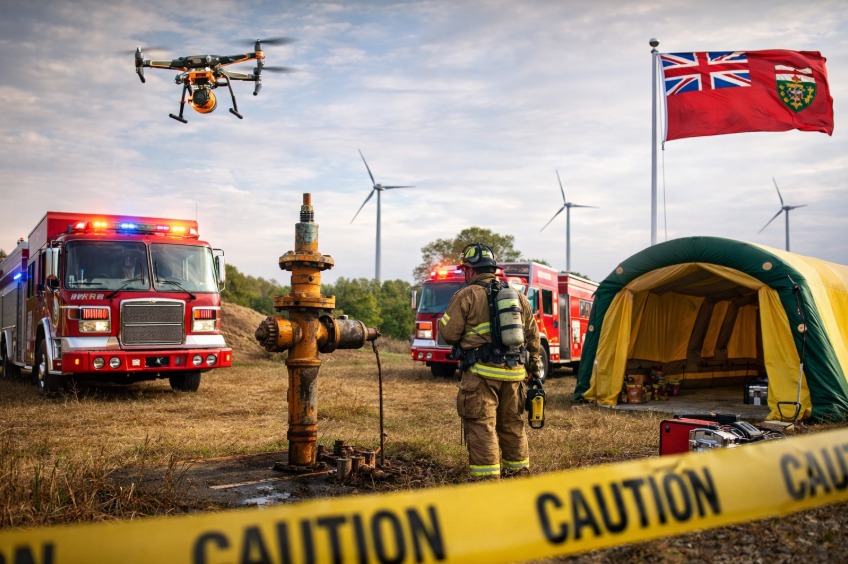
Minister Harris made the announcement in the County of Brant, which will receive up to $185,000 in provincial funding. The County plans to use the funding to acquire new emergency response equipment, including a drone capable of detecting hazardous gases, an inflatable emergency shelter and additional specialized gas detection devices. Local officials say these tools will help first responders better manage incidents involving legacy wells and other hazardous situations.
In addition to the County of Brant, eight other municipalities in southwestern Ontario are receiving funding: the Municipality of Chatham-Kent, Norfolk County, Lambton County, Oxford County, Elgin County, Essex County, Haldimand County and the Regional Municipality of Niagara. Provincial officials say the funding will allow each municipality to address its specific risks while contributing to a more coordinated regional response.
Local representatives welcomed the investment, highlighting its importance for public health and safety. Will Bouma, MPP for Brantford—Brant, said the funding reflects a coordinated approach by the province.
“I am so pleased that Ontario is taking a whole-of-government approach to public safety. This additional funding will help the County of Brant mitigate public health and safety issues that may arise from these old wells.”
County of Brant Mayor David Bailey also expressed appreciation for the provincial support, noting the practical benefits for municipal staff and emergency responders.
“On behalf of the County of Brant, I want to express our appreciation to the Province for this significant funding. We remain committed to emergency planning and preparedness, and this investment provides our staff and first responders with the additional resources they need to keep residents safe and informed.”
Fire Chief Darren Watson described the funding as a continuation of the province’s commitment to addressing legacy well risks.
“We are grateful to be receiving this third-year of funding from the Province, highlighting their commitment to keeping communities safe. Legacy oil and gas wells are present in the County, and by equipping our staff and first responders with specialized tools and training, we are providing essential support to assist in managing emergencies and protecting our community.”
Industry groups also praised the announcement. Jeremy Parkin, Fire Chief and President of the Ontario Association of Fire Chiefs, said the organization supports the ongoing investment.
“The Ontario Association of Fire Chiefs applauds the third-year investment under the Municipal Transfer Payment Program for mitigating risks associated with oil and gas related issues in Ontario. The OAFC continues to work with Minister Mike Harris and the Government of Ontario on this important issue.”
Ontario’s petroleum industry dates back to 1858, when North America’s first commercial oil well was drilled in Oil Springs. Today, the province has records for approximately 27,000 oil and gas wells, most located on private land in southwestern Ontario. Through programs such as the Abandoned Works Program, the province has invested $36.4 million to plug 454 high-risk wells to date.
The government says recent legislative changes, including the Resource Management and Safety Act, 2025, further strengthen its ability to address hazardous wells and protect public safety, particularly in cases of operator non-compliance.
