

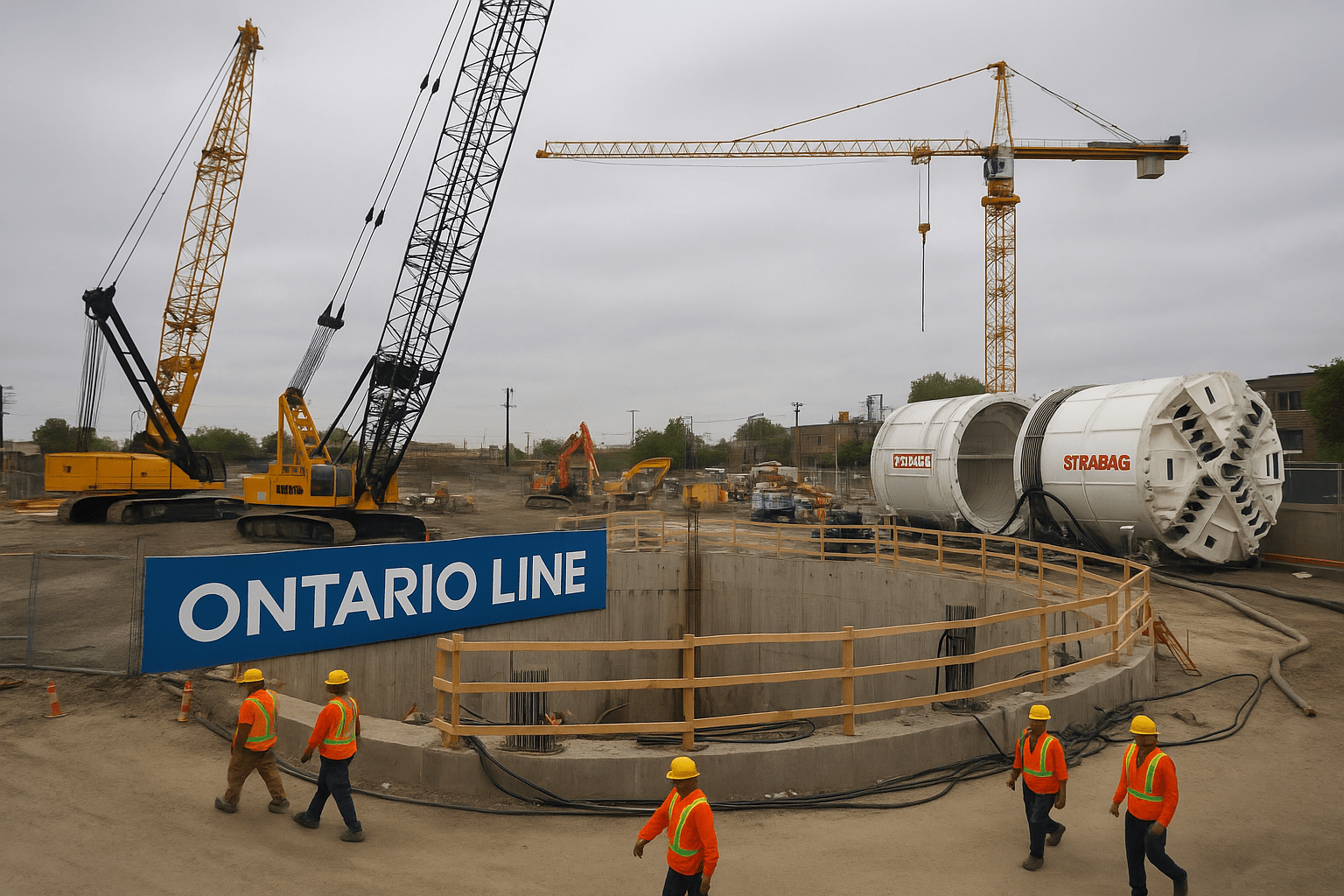
TORONTO — The Ontario government has launched construction on the second tunnel for the Ontario Line, marking what officials call a major step toward delivering faster transit, reducing congestion, and supporting long-term economic growth in the Greater Toronto Area.
The new tunnel launch shaft is being built near the future Gerrard Station in Toronto’s south Riverdale neighbourhood. From this site, tunnel boring machines will dig three kilometres of twin tunnels running north under Pape Avenue to connect with the existing transit network.
Prabmeet Sarkaria, Ontario’s Minister of Transportation, said the project is a cornerstone in the province’s nearly $70-billion transit expansion program. “The Ontario Line will introduce all-new rapid transit to the Gerrard and Carlaw community and surrounding neighbourhoods, part of our nearly $70 billion investment to deliver the largest transit expansion in North America,” Sarkaria said. “In the face of U.S. tariffs and economic uncertainty, we are protecting Ontario’s economy by building the next generation of subway service that will create thousands of good-paying jobs and fuel long-term economic growth.”
Bringing More Riders Within Reach of Transit
The new Gerrard Station, located just south of the launch shaft, will give an estimated 12,000 people direct access to rapid transit. The province projects more than 3,000 passengers will use the station during rush hour daily.
When complete, the Ontario Line will connect Exhibition Place in the west to the Eglinton Crosstown LRT at Don Mills Road in the east, cutting travel time for that cross-city trip to 30 minutes or less from the current 70 minutes. The line is expected to add more than 40 connections to existing TTC subway, bus, and streetcar routes, as well as regional rail services. Officials say this will bring nearly 230,000 more residents within walking distance of public transit.
Michael Lindsay, President and CEO of Metrolinx, said the second tunnel will directly ease pressure on the subway network. “After breaking ground on the Ontario Line’s first tunnel launch shaft at Exhibition Station late last year, we’re here at Gerrard and Carlaw creating another starting point for the project’s second set of tunnels,” Lindsay said. “These tunnels will run underneath Pape Avenue and create a direct connection to the TTC’s Pape Station, which will help reduce crowding on the busiest section of Line 2 by 21 per cent during rush hour. To put it another way, there will be 6,000 fewer people at Bloor-Yonge Station during the busiest travel hour of the day thanks to the Ontario Line.”
Part of a Broader Infrastructure Push
The Ontario Line is the largest single piece of the province’s 15.6-kilometre transit project, which will feature 15 stations stretching from Exhibition Place through downtown to Don Mills Road. The government says the project will reduce crowding on the TTC’s busiest subway segment—between Bloor-Yonge and Wellesley—by up to 15 per cent during peak periods.
Kinga Surma, Ontario’s Minister of Infrastructure, emphasized the development opportunities tied to the new stations. “The Ontario Line will be a game changer for residents of the Riverdale community, reducing gridlock and making it faster and easier for everyone to travel across the GTA,” Surma said. “As part of our capital plan of more than $200 billion to protect and build Ontario, we are seizing a once-in-a-generation opportunity to build two transit-oriented communities at the future Gerrard Station. These will include nearly 2,400 new homes, new retail and office space to support approximately 685 jobs.”
The Ontario government says the line will support about 4,700 jobs annually during construction. It is part of a $70-billion investment in public transit over the next decade, which also includes the Scarborough Subway Extension, the Eglinton Crosstown West Extension, and the Yonge North Subway Extension.
Long-Term Goals
Beyond construction targets, the province is positioning the Ontario Line as a tool for economic resilience. By connecting underserved neighbourhoods and cutting commute times, the government hopes to attract businesses, reduce greenhouse gas emissions, and make transit a more viable alternative to driving.
Officials note that each new connection will improve access to jobs and services across the Greater Toronto Area. With construction now underway at both ends of the line, the province says it is on track to deliver what it calls the largest subway expansion in Canadian history.
The Ontario Line remains one of the central projects in Ontario’s Transportation Plan for the Greater Golden Horseshoe, a long-term blueprint aimed at keeping pace with population growth, addressing road congestion, and bolstering the regional economy.