

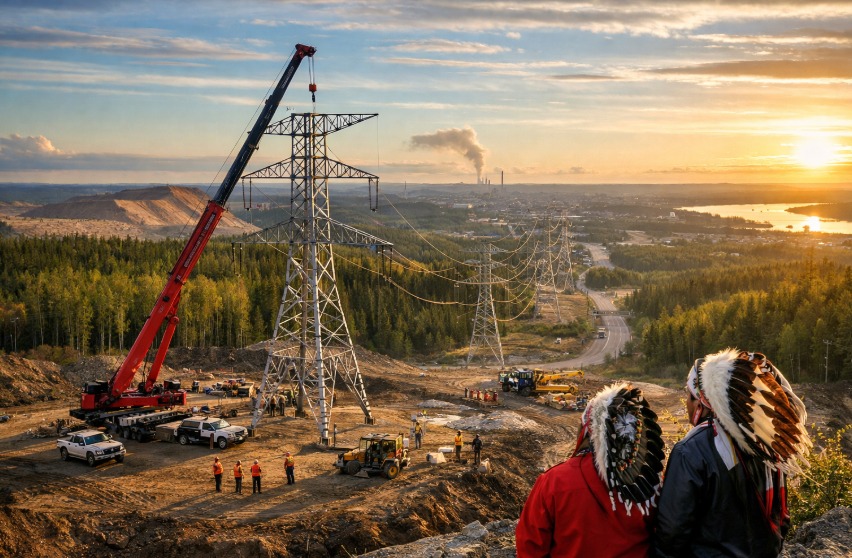
Ontario is moving to accelerate construction of a major electricity transmission project linking Barrie and Sudbury, positioning the line as a cornerstone of its long-term strategy to meet surging power demand in northern Ontario while expanding Indigenous participation in energy infrastructure.
The province has formally designated the Barrie–Sudbury transmission line as a priority project and named Hydro One as developer and constructor. The single-circuit, 500-kilovolt line will span roughly 290 kilometres from the Essa Transformer Station near Barrie to the Hanmer Transformer Station in Sudbury, creating new capacity to move up to 1,500 megawatts northbound and 1,000 megawatts southbound.
The announcement was made in Barrie by Sam Oosterhoff, Ontario’s associate minister of energy-intensive industries, alongside Chiefs from the Energy Corridor First Nations (ECFN) and neighbouring First Nations. The project is expected to generate more than 9,000 jobs and is framed by the province as both an economic development initiative and a step toward Indigenous economic reconciliation.
“Transmission investments are a crucial part of our plan to meet growing electricity demand across Ontario,” said Sam Oosterhoff, Associate Minister of Energy-Intensive Industries. “These new transmission lines will deliver the power needed to support our people and our industries, and they will drive economic growth across northern Ontario for decades to come. We’re especially pleased to be moving ahead on this project in partnership with the ECFN, whose leadership will be critical to its success and will leave a lasting impact on Ontario’s energy grid.”
Northern Ontario’s electricity system was originally designed for smaller, dispersed communities and resource operations. That legacy design is increasingly strained by mining expansion, electrification and new industrial projects. Energy demand in the north is projected to rise 81 per cent by 2050, while industry forecasts point to as many as 41 new mines potentially opening by 2033.
Those pressures were highlighted in the Independent Electricity System Operator’s Northern Ontario Bulk Study, which identified a major transmission bottleneck between the north and south. The IESO recommended a two-phase solution: the Barrie–Sudbury line, targeted to be in service by 2032, followed by early development of a second parallel 500-kilovolt line to be ready as demand grows.
“With up to 40 new mines expected to start by 2033 alone, Ontario is building for the future by accelerating a critical transmission line that will energize the north and boost the economy,” said Stephen Lecce, Minister of Energy and Mines. “Built in true partnership with First Nations, this new line will significantly increase power flow from the south to the north to improve quality of life and unlock responsible resource development across the north. As we navigate global uncertainty, Ontario’s plan is driving Canadian self reliance as we build using over 90 per cent made-in-Canada materials. Ontario’s Integrated Energy Plan expands the grid to boost reliability, add more capacity, and attract job creating investment to Ontario.”
A central feature of the project is Indigenous participation. First Nations along the corridor will have access to Hydro One’s First Nations Equity Partnership Model, which includes First Nation leadership in governance and up to 50 per cent ownership of the line. The province signed a memorandum of understanding with the ECFN in December 2025 to establish shared principles and a framework for joint engagement, with the consortium expected to grow as additional First Nations join.
“The 11-member Energy Corridor First Nations recognize that the Sudbury-to-Barrie transmission corridor must be reinforced to meet future energy needs and support a strong, thriving Ontario,” said Adam Pawis, Chief of the Shawanaga First Nation on behalf of the Energy Corridor First Nations. “In anticipation of today’s announcement, we approached the Minister of Energy and proposed a new strategy for ensuring that the new Sudbury-to-Barrie transmission lines will be completed expeditiously and in a manner that is consistent with our inherent rights, our deep responsibility to the land, and our rightful role in shaping the economic future of our territories.”
Industry groups and regional leaders also welcomed the decision, citing its implications for mining, manufacturing and community growth. Hydro One President and CEO David Lebeter said the line would strengthen the backbone of Ontario’s grid, while IESO CEO Lesley Gallinger described new transmission as essential to supporting growth and enabling new generation projects in the north.
The province has issued an order-in-council and minister’s directive to amend Hydro One’s transmission licence, formally designating it as the transmitter, and a separate order has granted priority status to the first line to reduce the risk of delays.
Ontario says the Barrie–Sudbury project aligns with its integrated energy plan, Energy For Generations, which emphasizes grid expansion, domestic supply chains and Indigenous leadership as demand for electricity accelerates across the province.
