

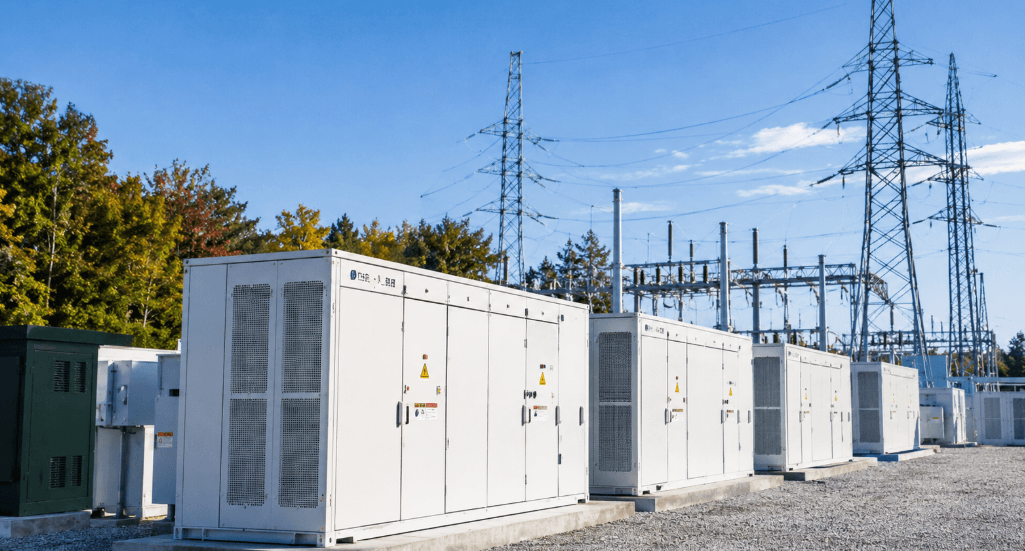
VAUGHAN, Ontario — The Ontario government has announced the completion of three battery energy storage projects in Vaughan and Guelph, adding 80 megawatts (MW) of electricity capacity to the provincial grid. Delivered on time and within budget, the facilities are expected to support approximately 80,000 homes during periods of peak electricity demand.
Announced on November 6, 2026, the projects represent another step in Ontario’s efforts to strengthen electricity reliability, accommodate population growth and expand energy infrastructure to support economic development.
Three New Battery Storage Facilities Begin Operations
The projects were developed by Ontario-based Alectra Energy Solutions, a subsidiary of Alectra Inc., through the Independent Electricity System Operator’s (IESO) Expedited Long-Term 1 (E-LT1) competitive procurement programme.
The three operational facilities include:
- Vaughan 3 Energy Storage 1 LP: 40 MW capacity and 160 megawatt-hours (MWh) of storage.
- Vaughan 1E Energy Storage 1 LP: 20 MW capacity and 80 MWh of storage.
- Arlen Energy Storage 1 LP: 20 MW capacity and 80 MWh of storage in Guelph.
Together, the lithium-ion battery facilities provide 80 MW of power capacity and 320 MWh of energy storage.
The systems store electricity during periods of lower demand and release it when consumption increases, helping balance supply and demand while supporting grid reliability.
Supporting Population Growth and Business Investment
Vaughan and Guelph are experiencing substantial population and economic expansion, creating additional pressure on electricity infrastructure.
Vaughan projects its population will approach 576,000 residents by 2051, alongside more than 354,000 jobs. Guelph anticipates population growth of approximately 40 per cent over the next three decades.
Ontario Energy and Mines Minister Stephen Lecce said the investments are essential to supporting development in both municipalities.
“Vaughan and Guelph are home to some of our country’s most rapidly expanding communities, and ensuring these municipalities have access to the reliable electricity they need is essential to supporting new homes, businesses and jobs,” said Stephen Lecce, Minister of Energy and Mines. “Our government is building Ontario’s energy grid with a focus on affordability. This winter, the cost per kilowatt-hour is decreasing, and we’re expanding the energy savings programs that will lower bills. This builds on a series of large-scale nuclear, battery storage and transmission projects delivered on time and on budget.”
Ontario Expands Battery Storage Capacity Amid Rising Electricity Demand
Ontario’s electricity requirements are projected to increase significantly as manufacturing investment, electrification and population growth accelerate.
According to the IESO, provincial electricity demand could rise by as much as 90 per cent by 2050.
Three years ago, Ontario had approximately 228 MW of energy storage capacity, primarily concentrated in one pumped-storage facility. Through recent competitive procurements, the province has now secured nearly 3,000 MW of battery storage capacity.
The E-LT1 procurement alone contracted approximately 880 MW of electricity storage resources.
Industry Leaders Highlight Grid Reliability
Alectra Inc. President and CEO Brian Bentz described the completion as an important achievement for Ontario’s electricity sector.
“Bringing these three battery storage facilities into operation is an important milestone for Alectra Energy Solutions and Ontario’s electricity system. These projects will strengthen reliability and support our communities’ growing energy needs for years to come.”
IESO President and CEO Jason Fitzsimmons also emphasized the growing importance of storage infrastructure.
“Battery projects are playing an increasingly critical role in keeping Ontario’s electricity system reliable and affordable, storing power and deploying it to the grid when it’s needed most. These projects are part of the over 9,000 MW of new and re-contracted domestic supply that has been secured over the past five years to power communities and businesses across the province.”
Energy Infrastructure Investment Supports Ontario’s Long-Term Economic Strategy
The completed facilities form part of Ontario’s Energy for Generations strategy, which combines investments in nuclear generation, transmission infrastructure and battery storage.
By using existing municipal electricity infrastructure, the projects are intended to improve system flexibility while limiting the need for additional infrastructure development.
The government says its broader energy investments will help strengthen electricity security, support industrial expansion and provide businesses with greater confidence in Ontario’s long-term energy supply.
With electricity consumption expected to increase substantially over the coming decades, battery storage is becoming an increasingly important component of the province’s economic and infrastructure planning.
Discover more from Wire Service Canada
Subscribe to get the latest posts sent to your email.