

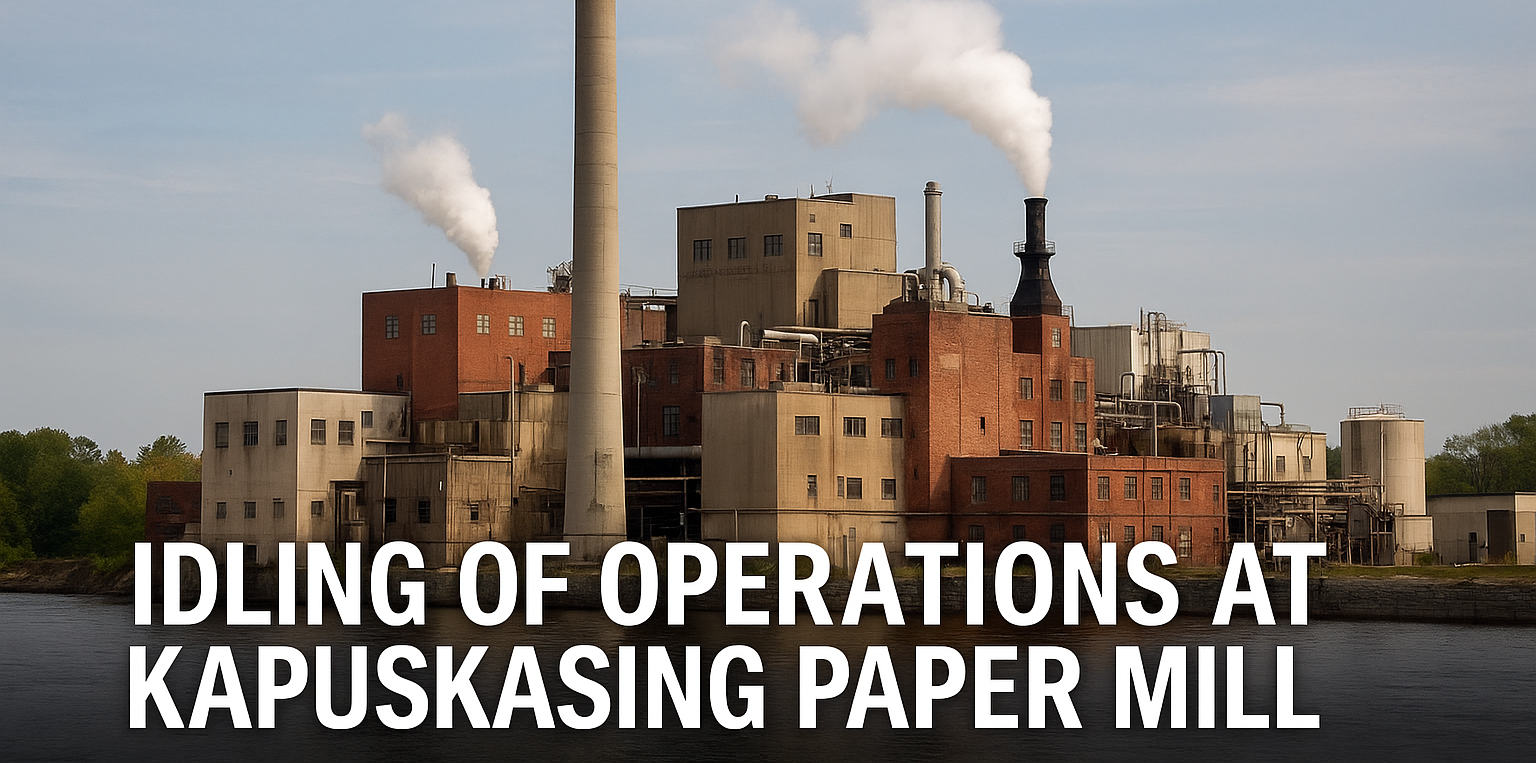
KAPUSKASING, Ont. — The Ontario government is expressing sharp disappointment with Ottawa after Kap Paper announced it would idle operations at the Kapuskasing Paper Mill, citing an unsustainable path to long-term viability without ongoing financial support.
In a joint statement released September 29, Mike Harris, Minister of Natural Resources, and Kevin Holland, Associate Minister of Forestry and Forest Products, said the province had already committed more than $50 million to keep the northern Ontario mill operating. The ministers accused the federal government of failing to match those efforts.
“Our government has worked closely with Kap Paper to help protect jobs at the Kapuskasing Paper Mill, providing more than $50 million to help cover operating expenses and provide business supports to help the company establish a viable, long-term plan,” the statement read.
“We have continuously pushed the federal government to come to the table as an equal partner, standing up for Canadian forestry jobs and treating Ontario forestry workers fairly. We are deeply disappointed that the federal government has failed to join us in providing the immediate support required to keep Kap Paper operating, as Ontario has done repeatedly to date.”
Federal-Provincial Divide
The closure highlights the ongoing tension between provincial and federal governments over support for the forestry sector, particularly in regions affected by U.S. trade disputes and softwood lumber duties. Ontario officials say that while the province has stepped up with repeated investments, Ottawa’s absence has left communities vulnerable.
“Despite Ontario’s extensive support, Kap Paper has concluded there is no sustainable path to long-term viability without continuous significant financial assistance. Our government cannot indefinitely provide this assistance without the active support and engagement of the federal government,” the statement added.
Worker and Community Support
With hundreds of workers and families affected in the Kapuskasing region, Ontario officials pledged to focus on rapid support measures. Programs such as the Rapid Re-employment and Training Service (RRTS) have already been activated, offering laid-off workers access to retraining and employment services.
The province pointed to a suite of programs designed to cushion the blow of major layoffs. These include:
-
Protect Ontario Workers Employment Response (POWER) Centres: an additional $20 million this year for locally organized centres providing job search assistance, counselling, and referrals to training programs.
-
Better Jobs Ontario (BJO): $137 million total funding this year, including a $50 million expansion, to retrain workers for in-demand careers.
-
Skills Development Fund (SDF): a $2.5 billion commitment, with over $1.3 billion invested since 2021, including $131 million for Northern Ontario projects in skilled trades, manufacturing, and forestry.
-
Employment Standards and Income Supports: guidance on severance pay, Employment Insurance, and access to Ontario Works for financial hardship.
-
Employment Ontario services: locally delivered by Collège Boréal, to provide job search and training opportunities.
The province is also offering community-level support through its $40 million Trade Impacted Communities Program, aimed at municipalities facing economic disruptions tied to trade disputes.
Broader Forestry Sector Investments
Ontario has framed the Kapuskasing announcement within its broader efforts to sustain and diversify the province’s forestry industry. Recent investments include:
-
$10 million to help sawmills adapt to changing global markets.
-
$72 million through the Forest Sector Investment and Innovation Program to boost productivity and expand markets.
-
Nearly $50 million in the Forest Biomass Program to develop new uses and markets for wood.
-
$20 million for the Provincial Forest Access Roads Program, bringing total funding to $79 million in 2025.
-
$3 million for wood construction education and training, with support for institutions such as George Brown College and the University of Toronto.
-
$750,000 for FPInnovations’ research on wood-based construction materials.
-
$300,000 for the University of Toronto’s Mass Timber Institute to explore modular housing and underused wood products.
-
Almost $35 million in electricity rate relief for forestry businesses in 2024-25 through the Northern Energy Advantage Program.
Looking Ahead
Ontario officials maintain they cannot indefinitely bear the cost of keeping mills operational without federal participation. The ministers reiterated their call for Ottawa to provide direct and immediate support to forestry sector workers and companies.
“Our government is focused on supporting impacted workers and their families, and will continue to work closely with Kap Paper, local unions and local governments to do so,” the ministers said. “Ontario continues to step up with significant provincial support but cannot do so alone. We have repeatedly called on the federal government to take immediate action to support workers and businesses in this vital sector, and we will continue to do so.”
The idling of the Kapuskasing Paper Mill is the latest in a series of challenges for Ontario’s northern communities, where forestry has long been a cornerstone of local economies. Without a renewed commitment from Ottawa, industry stakeholders warn that further closures could follow, deepening economic strain across the region.
